The Politics of Public Space and the Hostile Architecture of Fear
For many years, public spaces were viewed as the bedrock of democracy, providing opportunities for social encounters, political expressions & common experiences. Contemporary urban space designs now favour control mechanisms, exclusionary practices & surveillance systems over their original function of preserving public access to them.
One obvious example of this change can be seen in the development of designs specifically to deter specific users from using public spaces, such as anti-homeless spikes, divided benches, and/or sloped seating that were implemented as a means of preventing users from resting and/or sleeping. Such interventions are often legitimized based on the notions of “safety,” “order,” or maintenance; however, they create several key issues in relation to who holds the power or has access to public spaces, as well as for whom public spaces were really created.
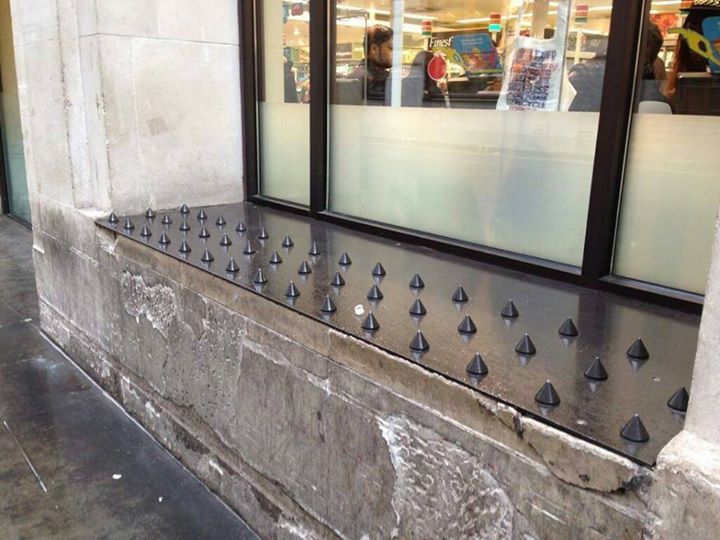
Figure 1: Hostile architecture (anti-homeless spikes) used to restrict use of public space. (Designing Buildings, 2022)
According to Lefebvre (1991), public space is not only a collection of physical spaces but is a product of social processes that reflect the interests of those who have power over those spaces. In neoliberal urban contexts, public spaces are being created primarily for economic purposes and to provide commercial value. Individuals or activities, such as being homeless, that do not have a relationship to consumption, will be classified as undesirable to those who create those spaces. These undesirables will be managed through both direct and indirect exclusion (Mitchell, 2003).
As a form of spatial control through hostile architecture, there are no usual enforcement mechanisms for how people interact in public spaces. Petty (2016) argues that hostile architecture is part of a larger effort to “design out” visible poverty from the public sphere and, in the process, maintain a positive economic image for the city itself. However, the designs of hostile architecture have an impact on already marginalised populations, further marginalising them through the introduction of visual and/or physical barriers to accessing public spaces.
In addition to physical design, the presence of surveillance technology (such as CCTV) contributes to the enforcement of behavioural control. Together, these components create what Low and Smith (2006) refer to as “aesthetics of fear”, where design, designed for safety, changes the behaviour of users of public space. In Foucault’s (1977) terms, this represents a process of the internalisation of external controls into individual behaviour.
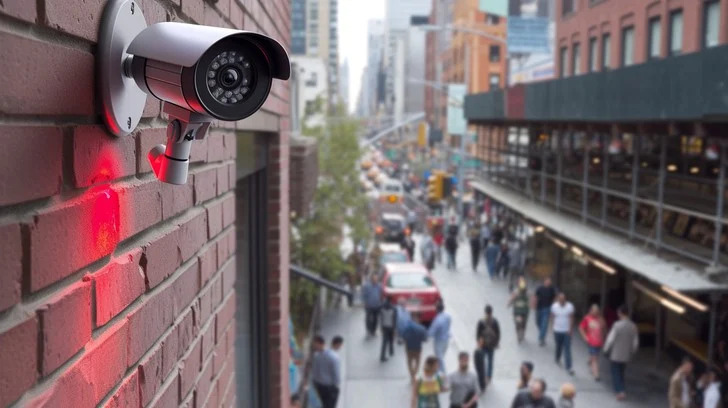
Figure 2—Urban surveillance camera illustrating monitoring and control in public space. (Stockcake, no date)
Hostile architectural design and surveillance work together to create environments where regulating behaviour is more important than including all people, thus negating the idea that everyone has a “right to the city” and should have access to public spaces regardless of their socioeconomic status (Mitchell, 2003).
Designers of urban spaces have to determine whether they will design their spaces to manage/guide people’s behaviour or include the people that reside within the area’s ecology. Designers are continuing to design public spaces around excluding people with a variety of methods; therefore, designers need to take into consideration and implement ethical and inclusive design principles in order to foster social equity amongst and provide the opportunity to participate in a democracy with the people who reside in and around the urban areas.
References:
Foucault, M. (1977). Discipline and Punish: The Birth of the Prison. London: Penguin.
Lefebvre, H. (1991). The Production of Space. Oxford: Blackwell.
Low, S. and Smith, N. (2006). The Politics of Public Space. New York: Routledge.
Mitchell, D. (2003). The Right to the City: Social Justice and the Fight for Public Space. New York: Guilford Press.
Petty, J. (2016). The London spikes controversy: Homelessness, urban securitisation and the question of ‘hostile architecture’. International Journal for Crime, Justice and Social Democracy, 5(1), pp.67–81. doi:https://doi.org/10.5204/ijcjsd.v5i1.286.
Designing Buildings (2022). Hostile architecture. [online] Available at: https://www.designingbuildings.co.uk/Hostile_architecture (Accessed: 17/04/26).
Stockcake (no date). Urban surveillance camera. [online] Available at: https://stockcake.com/i/urban-surveillance-camera_305763_453879 (Accessed: 17/04/26).
List of Figures:
Figure 1 – Hostile architecture (anti-homeless spikes) used to restrict use of public space. (Designing Buildings, 2022)
Figure 2 – Urban surveillance camera illustrating monitoring and control in public space. (Stockcake, no date)



This is a very insightful reflection on the growth of control in public spaces, and how it is used to push some of the most vulnerable users of our streets out of cities. Exclusion in public places is a serious problem facing cities and raises the reality that public spaces are inherently political. You talk about how this spatial control is used as a façade to hide wider inequalities, forcing homeless people out of sight. This method of ‘dealing’ with homelessness takes away the visibility of homeless people and penalises the person rather than the system (McCreath, 2025). As future urban designers I think it is important for us to unpack this issue. This post has inspired me to do some further research on the inequalities of public spaces and how planning and design has previously been used to accelerate these issues.
I would recommend Setha Low’s book ‘Why Public Space Matters’ (2022) as an option for further reading. It could provide an interesting addition to this topic as it touches on not only the role that public spaces play in the functionality of society but also how people have been designed out of public spaces, and the importance of a more socially just public realm.
Overall, your post is a well written piece and I enjoyed reading it.
References:
Low, S. (2022) Why public space matters. Oxford University Press.
McCreath, B. (2025) ‘Hostility in the city: the implications of hostile architecture on the health of the homeless’, Cities and Health, 9(3), pp. 495-508. Available at: https://doi.org/10.1080/23748834.2025.2479206
Whilst I agree it is imperative that, in future, designers prioritise more inclusive design which does not promote inequality within our society, I would argue that rather than choosing between guiding peoples behaviours and including people residing in the area, that creative design can do both. I would also argue that public space which uses hostile architecture is hardly public at all. Would this not instead be considered semiprivate as it is only accessible for those deemed worthy by the state? There is clear precedent to show that aid orientated architecture can benefit those suffering from homelessness whilst also improving the urban landscape of an area. There are solutions that combine both the concept of ‘street’ and ‘home’ together, allowing them to exist in unison with one another (Bridgman, 1998).
Framlabs hexagonal pods, designed as a parasitic form of architecture, provide safe and comfortable sleeping and bathing spaces for the homeless (Gibson, 2017). This leans into the ideas you present by Petty (2016) that visible poverty can be ‘designed out’ but through instead prioritising the needs of the homeless and utilising otherwise empty space.
Another example is the tiny home village by Lehrer Architects in LA which again utilised empty space to provide shelter for the homeless. A number of these ‘villages’ have been implemented around the state of California (Hope the mission, 2026). The implementation of these designs shows that when the homeless are thoughtfully considered rather than pushed aside and discriminated against, that creative solutions can be found which benefit both the urban landscape, and the individuals living within in.
References:
Bridgman, R. (1998) ‘The Architecture of Homelessness and Utopian Pragmatics’, Utopian Studies, 9(1), pp. 50-67. Available at: https://www.jstor.org/stable/20719742?if_data=e30%3D&seq=13 (Accessed: 16/05/2025).
Gibson, E. (2017) ‘Framlab proposes parasitic hexagonal pods to sleep New York’s homeless’, Dezeen, 21 November 2017. Available at: https://www.dezeen.com/2017/11/21/homed-famlab-parasitic-hexagonal-pods-new-york-homeless-shelters/ (Accessed: 16/05/2026).
Hope the mission (2026) Tiny Homes Villages. Available at: https://hopethemission.org/our-programs/tiny-homes-villages/ (Accessed: 16/05/2026).
Lehrer Architects (2021) Alexandria Tiny Home Village. Available at: https://www.lehrerarchitects.com/project/alexandria-tiny-homes (Accessed: 16/05/2026).
This was a really thought-provoking and engaging Dalya! It raises the question of how accessible a space truly is if certain groups are designed out of it. A successful public space is often measured by the diversity of users, activities and accessibility. However hostile architecture contradicts this through embedding exclusion into design. Which reminded me of Lefebvre’s (1991) argument that space is socially produced and shaped by power. This blog also made me think about how some behaviours are accepted when associated with spending, such as bankers drinking outside bars in Soho, while teenagers gathering near transport hubs or fast-food spaces are often labelled antisocial because they lack the same economic value. Mitchell’s (2003) idea of the “right to the city” is important here when looking at who we design for, treating homeless people as design constraints is extremely problematic. And I hope we progress in the built environment to design for the inclusion of everyone, not just those who can afford it!
References
Lefebvre, H. (1991) The Production of Space. Oxford: Blackwell.
Mitchell, D. (2003) The Right to the City: Social Justice and the Fight for Public Space. New York: Guilford Press.