

15 minutes life circle
The research and planning of the living circle can be traced back to Japan, and then spread to South Korea and other countries and regions.
Life circle refers to the space-time range formed by residents when they travel (including shopping, commuting and leisure) to meet their production and living needs. The concept of “living circle” originated from the concept of “wide-area living circle” proposed by Japan’s comprehensive development plan, and then this concept spread in Asia, South Korea, Taiwan and other countries and regions. In 1969, Japan launched the “Municipality Circle” plan, and the Ministry of Construction and the Ministry of Land and Resources proposed the concepts of “local life circle” and “fixed residence circle” respectively. In 1975, in order to coordinate the relationship between people and the environment in the third national comprehensive development plan, Japan controlled the population and industries to be further concentrated in the city, and established a new living circle, which was divided into residential areas (basic living units) and fixed residential areas. (composed of several residential areas) and settlement circle (composed of several fixed settlements, equivalent to the city) 3 circles.

Figure 1:15 minutes life cycle
The construction path of the “15-minute living circle” under the Hangzhou Future Community Pilot Project is as follows:
- Take the standard circle as the construction system
- Based on the living grid
- Take the block pattern as the basic pattern
- Connection based on slow system
- Taking health education and physical training as the function orientation
- Take the neighborhood center as the core node
Building a neighborhood center based on 12 essential functions (catering, supermarket, express delivery, laundry, beauty salon, pharmacy, stationery store, maintenance point, community center, vegetable garden, health institution, nursery and early childhood education) , the radiation diameter is 0.5 ~ 1.5 kilometers, the area is 1000 ~ 1500 square meters / thousand people configuration, forming the core node of the community “15-minute living circle”, providing “one-stop” service.
- Take digital empowerment as the main support
- Co-construction and co-governance as the main mechanism
- Take integrated supply as the main means
However, ignoring the actual pace of the elderly, it is obviously beyond the acceptable range of the service group to set the nursing home for the elderly in the “15-minute life circle center” of ordinary adults. In addition, the spatial organization method of single walking can no longer carry all or even most of the daily life of residents. The travel mode of public bicycles and public electric vehicles should be considered, and the travel wishes and habits of residents should be respected. Therefore, it is necessary to get to the bottom and reflect on the essential connotation of the life circle from the perspective of “people-oriented”. The essence of the problem of the actual contradiction between the supply of facilities in the living circle and the needs of residents lies in the emphasis on “people-oriented” on the one hand, and the lack of attention to “individuals” on the other hand. In the configuration of public service facilities, complex, changeable, The specific demand matching problem is “resolved” into a homogeneous and abstract facility supply problem, which leads to the overhead of the diverse needs of different types of people, and the temporal and spatial characteristics of facility use and the needs of the corresponding population. Requirements for the supply of public service facilities in the life circle with people as the center and “equalization”.
It is recommended to reserve 15%-25% of employment land in the community life circle through the mixed layout of functions and the composite utilization of land, mainly including non-residential land types such as commercial, business office, public service facilities, etc., to create an inclusive and dynamic community. employment environment.
Taking Japan as an example, as the spatial unit of urban planning and city, town and village planning, the fixed area is the basic unit for population dynamic monitoring, land scale calculation, transportation network design and public facilities configuration.
Reflections on the planning of life circle in my country:
- The method of delineating the community life circle is still unclear
- The compilation requirements of the living circle have not been fully integrated with the planning management system
- Administrative subjects such as streets are absent in the implementation of the plan
After fully benchmarking against other global cities such as New York, London and Tokyo, Shanghai believes that the most outstanding shortcoming of urban construction quality is the community-level public service facilities, small public spaces and slow traffic networks. The focus is on the 15-minute community life circle. Shanghai focuses on the basic behavioral characteristics of different age groups, the characteristics of public service facilities and public space use, and the characteristics and needs of walking behaviors. Planning ideas and countermeasures for building a “15-minute community life circle”. The Chuangzhi Farm in Shanghai activates the idle land in the development of the plot, and provides public green space for community residents to participate in, share and jointly build. Shanghai 15-minute life circle, through organic urban renewal, small-scale, low-impact, progressive, adaptive, to create a beautiful community.
The survey found that residents in the old city and the core area of the main city have a strong demand for upgraded facilities (culture, sports, leisure, etc.) Facilities (education, healthcare, etc.) are still in high demand.
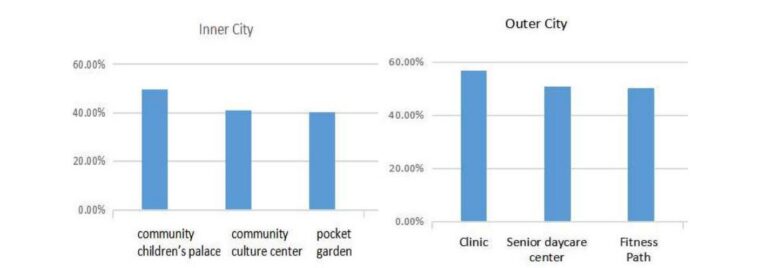
Figure 2:Comparison of demand in public facilities between inner city and outer city
It can be seen that the needs can be classified, green space, outdoor sports facilities, culture, leisure places, education, medical care, elderly care, and others should be configured by the market. Among them, special consideration can be given to some facilities that must be dominated by the government or given certain hardware or policy support, such as markets.
The per capita area of public green space is 2.7 m2/person, compared to about 6-7m2/person in other global cities; there are still walkable blind spots in public green space, and the coverage rate of the service area within a 5-minute walk is 86.1%; a relatively systematic and coherent system has not yet been established. A network of walking trails.
Community planning and design should involve public participation, human scale, small-scale, and progressive.
Community service facilities are divided into basic service facilities, municipal facilities, and living service facilities.
Community should be self-sufficient, shared and localized
Reference
Shanghai Planning and Land Resources Administration (2016) Shanghai Planning Guidance of 15-Minute Community-Life Circle.
http://ghzyj.sh.gov.cn/zcfg/ghss/201609/t20160902_693401.html
Xiao, Z.P., Chai, Y.W. and Zhang, Y. (2014) Overseas Life Circle Planning and Practice. Planners, 10, 93-94.
Wu, Q.Q. (2015) The Exploration on the Dynamic Programming of Community in Megacities from the Living Circle Perspective. Shanghai Urban Planning Review, 4, 13-19.
