

COVID-19: An Unlikely Catalyst to High Street Regeneration
The High Street is Dead, Long Live the High Street.
Lockdown – March 2020. This mandate single-handedly halved footfall across UK High Streets (Enoch et al, 2021). However, the decline of our High Streets was a reality that predated the pandemic. The ‘death of the high street’ is a notion being used by many experts – and for good reason (Hubbard, 2017; Parker, 2017). With convenience being the buzzword of the 21st century, an influx of out-of-town shopping centres is punctuating the UK landscape. Clearly, the archetype of proximity and shelter caters to our insatiable desire for convenience. Throughout the same period, our hypnotic obsession with technology exacerbated the issue. By 2017, 90% of the UK households had access to the internet (Office for National Statistics, 2017). As e-commerce revolutionised the world, people realised that anything they wanted was accessible from the comfort of their own sofa. Now that’s convenience. Following this, COVID-19 truly killed off what was left of our UK High Streets.
The Nail in the Coffin
This is where I return to the harsh reality of Lockdown – March 2020. The population was compelled to lead a sedentary and solitary existence. We were imprisoned. But what does this actually mean? It means that it was this decision that broke what was left of our UK High Streets (Carmona, 2022). It was the nail in the coffin. The UK had entered a period of economic and social demise. People’s livelihoods were lost, mental health was at an all-time low, and our society was suffering. We had hit rock bottom.
However, as JK Rowling once said, “Rock bottom became the solid foundation on which I rebuilt my life”. It is in the same vein that we must proceed. Efforts to regenerate our high streets need to be efficient and effective. For this, we must identify and address the fundamental issues. Following the trend of retail relocation across the UK, the purpose of our High Streets is changing (Local Government Association, 2022). Now, society sees the High Street as a place of predominantly sociability and experience (see figure 1).

Figure 1 – Changing Role of High Streets
Reborn or Resurrected? The Future of UK High Streets
In the pursuit of clarity, I draw on the religious concepts of rebirth and resurrection as a means of approaching High Street regeneration. To be reborn is to experience a complete change. Here, the character and identity of our High Streets would ‘completely’ change. Moreover, to resurrect is to bring back to life, the High Street would remain the same. So, why are these distinctions important?
Inevitably, a reborn High Street would lack the richness and character derived from heritage and culture. This would result in poor place making. Further, to resurrect a High Street would mean retaining what collapsed in the first place. This would be wasteful of both time and resources. Instead, we need to re-consider the balance of offerings on our High Streets with sociability at the forefront. In doing so, heritage and history would coincide with tech and innovation to create a higher quality urban realm (see figure 2). It is a sort of mergence between rebirth and resurrection – between old and new – that will realise a prosperous future for our High Streets.
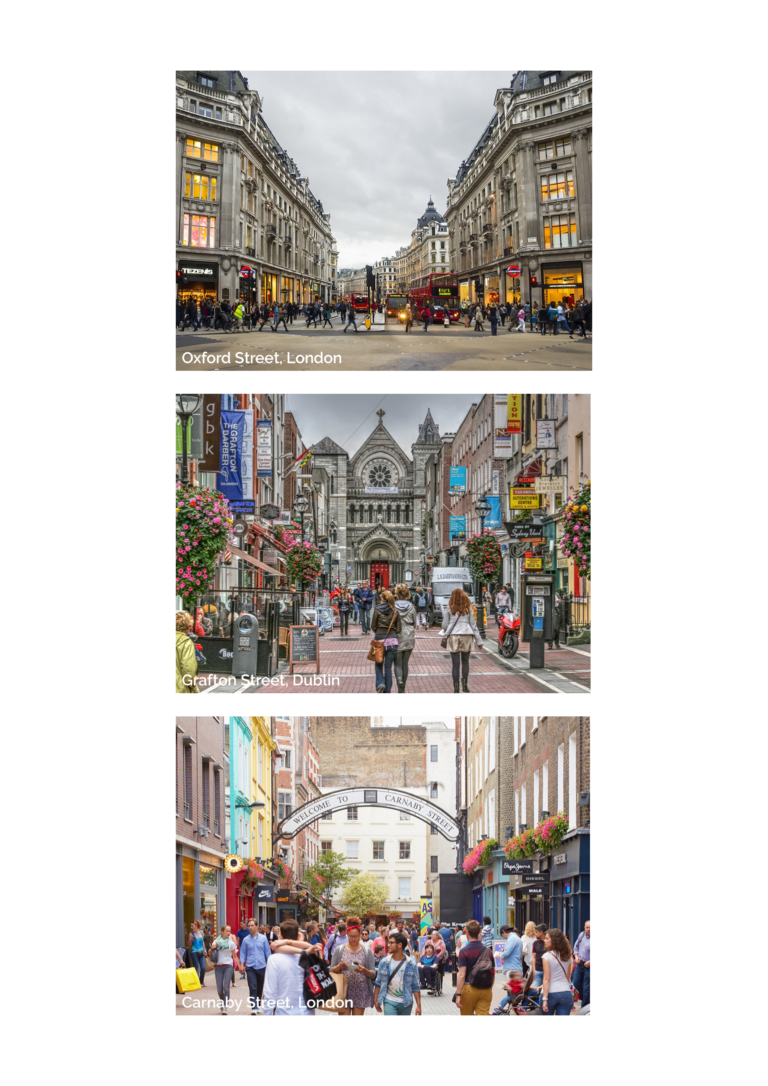
Figure 2 – Exemplar High Streets
List of Figures
Figure 1 – The Changing Role of High Streets. From Local Government Association (2022).
Figure 2 – Exemplar High Streets.
References
Carmona, M. (2022) The existential crisis of traditional shopping streets: the sun model and the place attraction paradigm, Journal of Urban Design, 27:1, 1-35, DOI: 10.1080/13574809.2021.1951605
Enoch, M. et al. (2022) ‘When COVID-19 came to town: Measuring the impact of the coronavirus pandemic on footfall on six high streets in England’, Environment and Planning B: Urban Analytics and City Science, 49(3), pp. 1091–1111. doi: 10.1177/23998083211048497.
Hubbard, P. (2017) The Battle for the High Street. 1st edn. Palgrave Macmillan London.
Local Government Association (2022) Creating resilient and revitalised high streets in the ‘new normal’. Available at: https://www.local.gov.uk/publications/creatingresilient-and-revitalised-high-streets-new-normal (Accessed: 7 February 2022).
Office for National Statistics (2017) Internet access – households and individuals, Great Britain: 2017. Available at: https://www.ons.gov.uk/peoplepopulationandcommunity/householdcharacteristics/homeinternetandsocialmediausage/bulletins/internetaccesshouseholdsandindividuals/2017 (Accessed: 6th March 2022)
Parker, C. et al (2017) Improving the vitality and viability of the UK High Street by 2020: Identifying priorities and a framework for action. Journal of Place Management and Development. DOI:10.1108/JPMD-03-2017-0032
