Can Vauban Teach Us How to Design Truly Resilient and Inclusive Communities?
As an urban design student with a vision for designing sustainable and democratic cities, I have always been fascinated by real-world examples where these principles are being implemented. Germany’s suburb Vauban just outside the city of Freiburg is one location that continues to fascinate me. It’s an active, living example of how cities can be constructed with the planet and people in mind, rather than being a case study.

Figure 1 : Residences in the Sun Ship (Green City Times)
Vauban was built on a former military camp in the late 1990s, but what is amazing is how the residents themselves planned the district. They did have direct participation in decision-making through participatory approaches, therefore it wasn’t planners and developers only. That is why Vauban has cooperative and mixed-tenure homes, providing affordability and social mix for various kinds of people. (Scheurer & Newman, 2009).
Vauban’s environmental and social cohesion strategy are both factors that render it resilient. To minimize energy consumption drastically, the district adheres to Passive House principles. Permeable streets, green roofs, and treed streets are some of the green infrastructure that filters rainwater and reduces urban heat, while clean energy is provided by renewable energy like solar panels and district heating (Register, 2006; Newman & Kenworthy, 2015). Because of these characteristics, the neighborhood has a strong ability to respond to climate issues.
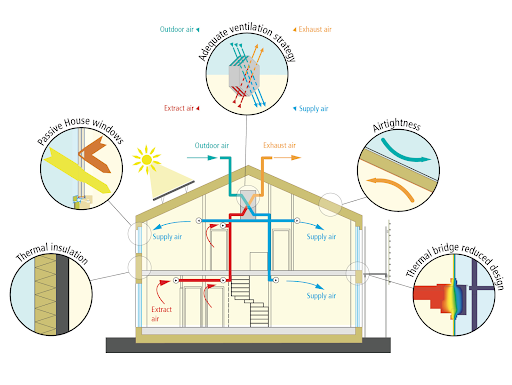
Figure 2: Five Principles of Passive House Design and Construction (Passive House Institute)
The other thing about Vauban that particularly impresses me is its mobility. Car-free living is the foundation of the district’s design. The neighborhood is more secure, clean, and accessible, particularly for those who live without cars, since walking, cycling, and public transport are promoted (Beatley, 2012).
Vauban promotes circular economy projects that make resources from waste, small businesses, and cooperatives (Girardet, 2004). Such activities increase long-term resilience in communities by enhancing local self-reliance and decreasing dependence on external systems.
Conclusion
For me, Vauban is a strong example of how to create resilient and inclusive communities.Its economic resilience, ecological sustainability, and social equality show that cities can be built to endure but also to flourish in the face of future adversity. Putting similar concepts into practice will be essential to the creation of ecologically aware and human-centered communities as the world’s urban population grows.
But the question remains — is it possible to create something like Vauban here in the UK?
References :
Beatley, T. (2012) Green cities of Europe: Global lessons on green urbanism. Washington, DC: Island Press.
Girardet, H. (2004) Cities, people, planet: Urban development and climate change. Chichester: Wiley-Academy.
Newman, P. and Kenworthy, J. (2015) The end of automobile dependence: How cities are moving beyond car-based planning. Washington, DC: Island Press.
Register, R. (2006) Ecocities: Rebuilding cities in balance with nature. Gabriola Island: New Society Publishers.
Scheurer, J. and Newman, P. (2009) ‘Vauban: A European model bridging the green and brown agendas’, Australian Planner, 46(2), pp. 25–33.
Figure 1: Green City Times. “Europe’s Greenest City District | Vauban, Germany.” Www.greencitytimes.com, 31 Mar. 2014, www.greencitytimes.com/europe-s-most-sustainable-city/.
Figure 2: Passive House Institute. “Passive House Requirements.” Passiv.de, 2019, passiv.de/en/02_informations/02_passive-house-requirements/02_passive-house-requirements.html