Designing Cities That Let People Belong
Hello everyone, My name is Fatemeh Fahimi and I am originally from Qom, Iran.
I studied Architecture for my undergraduate degree and am currently a student in a master’s program in Urban Design.
Why Urban Design ?
I chose to study Urban Design because I have always been curious about the way urban environments affect people’s lives and emotions.
I am the type of person who enjoys spending time outdoors, interacting with other people and visiting public spaces. However, most of the cities where I have lived, there have very few proper outdoor spaces.
I often felt it was necessary to have a purpose for leaving home, as there were few opportunities to simply enjoy being in the city.
This got me thinking about the potential of Urban Design for getting people to engage, connect, or even just enjoy being around.
Spatial Inequality in Qom
Thinking about my hometown Qom there is a clear spatial injustice issue around green spaces. There are very limited parks, and hardly any good spaces for relaxation, exercise or meeting social groups architecture in Qom. As a result, most people spend free time in Cafés and restaurants, or walking on sidewalks without shade or amenable seating.
For many people, especially women, children, and older adults, there are virtually no pleasant or safe outdoor places to visit. Lack of access to areas with green space goes beyond limited leisure-time activities: it limits everyday life opportunities, health and well-being, contributing to a social life. To me this is a type of spatial inequality where the built environment does not provide basic opportunity for well-being and social connectedness.
Fig 1:
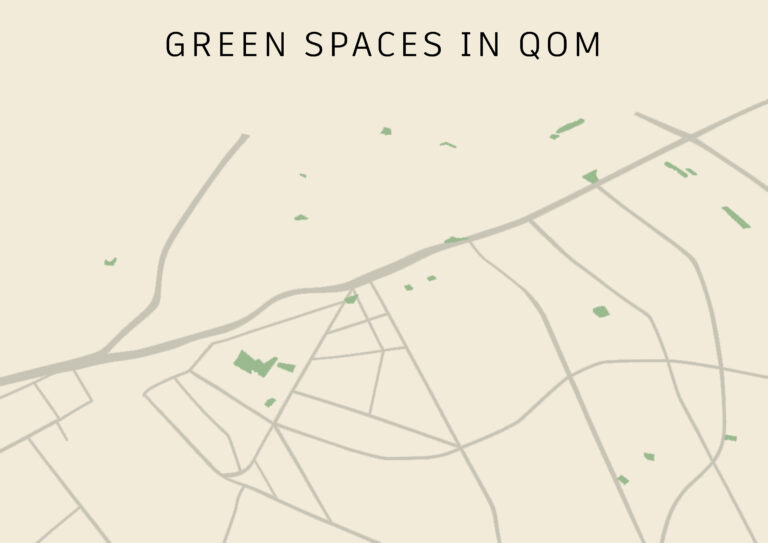
Qom: Area: 123 km² | Population (2025): ~1.39 million
A Vision for a Better Qom
If I had the opportunity to redesign Qom, I would start with green space that is designed well in every neighborhood. A park in every neighborhood would provide safe paths for walking and cycling, a children’s play area, and a quiet area for older adults to gather, talk, or play a game of chess. In addition to improving the environmental quality in the neighborhood, parks could also serve as places of gathering.
I believe that
even small interventions at the local level can potentially shifts larger feelings about a city and residents’ feelings towards each other.
Conclusion
Parks would provide an new space for Qom to move from an entity of which residents stay inside into a part of the city where inhabitants can have a community outside.
I hope that the Urban Design program will teach me how to apply these ideas to real design strategies to create cities that have space for every constituent, irrespective of their age or social background, to engage socially, participate in physical activities, and experience natural phenomena. I feel strongly about using quality urban design to change aspects of people’s daily interactions with their environments, and I’m looking for a way to get involved!
If you’d like to discuss urban projects in Qom or share ideas about public spaces, feel free to reach out to me !!
http://linkedin.com/in/fatemeh-fahimi-550a352ba
Resource
Fig 1: Fahimi, F. (2025) Map visualization of Qom City based on aerial data.
Featured image: OpenAI (2025) AI-generated image created using ChatGPT for featured image:
“An illustration of people walking in a green urban park at sunset, with tall trees, benches, warm light, a peaceful city atmosphere in the background, modern flat illustration style, soft gradients and warm colors.”



Hi Fatemeh,
I appreciate your ideas and overview for Qom. I especially appreciated your reference, which specifically used lived experience in relation to some urban design issue and pointed out spatial injustices relevant to green space, which made your argument about public space and social health and social inclusion really resonate.
I also found your idea of wanting to create a park for every neighborhood was very motivating. It is a very real and, at the same time, comprehensive response to environmental quality, social engagement, and accessibility. You make a great point that local small interventions can lead to larger change or changes that neighbors and residents can feel, once again reiterating that, through urbanism, everyday life can be designed to be improved upon systematically and by intention.
This work provides ample examples of an urban design project that connects architecture, equity, and the human experience.