How spatial injustice affects urban planning.
The term ‘spatial injustice’ first came to prominence during the 1970’s when writers such as David Harvey and Henri Lefebvre began to explore the possibility that the way space itself was organized within a city was politically motivated and detrimental to marginalized communities (Harvey 1973), although Edward Soja suggested that their work was focused on social justice through the lens of critical theory and did not come to the forefront until decades later, with the first instance of the term ‘spatial justice’ coming from a short article written in 1983 by G.H Pirie ‘On spatial justice’ (Soja 2009). Since the early 20th century modernist thinking has prioritized efficiency and economic growth as the main drivers for urban planning, however according to Soja, space is not a neutral backdrop and there is sometimes a deliberate effort to ensure an unequal distribution of space and socially valued resources which could be due to ‘local discrimination’, ‘political organization of space’ or ‘geographically uneven development and underdevelopment’ (Soja 2009).
One of the most well-known historic examples of spatial injustice is the practice of red-lining in Los Angeles during the 1930’s, the city has always been the primary centre for the theorization of spatial justice and unjust geographies in the practices of geography, architecture and urban and regional planning (Soja 2010). During this time, spatial thinking and urban planning was subject to historic racial biases, where entire neighborhoods of ethnic minority communities were graded and colored red on maps to denote them as “hazardous” for mortgages, leading to these areas becoming essentially segregated, receiving less public funding, having less green spaces and created a racial wealth gap.
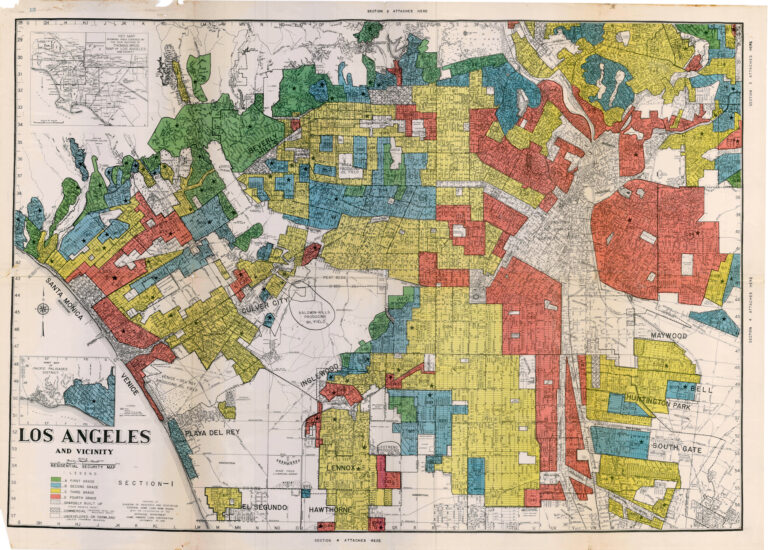
(The 1939 Homeowners’ Loan Corporation ‘redlining’ map of central LA. Via Architectural Review)
A similar example can be found in the field of architecture, where during the 17th and 18th centuries during the time of colonization, servants or slaves were made to occupy small, often overlooked spaces within a house or estate, despite being crucial to the infrastructure of the empire (Chattopadhyay 2022). However, spatial injustice is not a historic issue it persists even today, some examples are obvious and well known, such as atrocities happening in Gaza, or favelas near refineries in Rio de Janeiro. Soja cites the 1996 court case of Labor/ Community Strategy Centre et al v. Los Angeles County Metropolitan Transit Authority, (also known as the Bus Riders Union decision), this was a grassroots organization acting on behalf of people who cannot afford a car and depend on public transport. The outcome of the trial was that for the next 10 years at least, the MTA would give their highest budget priority to improving their services and guaranteeing equitable access to all public transport, this was done in order to remedy decades of discrimination against the transit-dependent poor, who had fewer options and longer commute times (Soja 2010).
In order to combat spatial injustice we must first be aware that it is taking place, as geographers and urban planners are typically more focused on classic location theory, and driving economic growth (Harvey 1973). We should instead strive for a ‘just distribution’ of space and the availability of resources to marginalized communities. Lefebvre takes this a step further in ‘the right to a city’, where he argues that a city’s population should be able to actively shape and control urban spaces, he emphasizes that cities are living, social constructs that should not be dictated simply by capitalist forces outside of inhabitants control (Lefebvre 1996). In the UK, we have a limited say in what is built into the urban fabric via objections on the planning portal, but the planning authority will ultimately still have the final say. In Barcelona there is the ‘Decidim’, a digital platform for citizen participation in urban projects, helping the city’s inhabitants, organizations, and public institutions self-organize democratically, and Porto Alegre was the first city in the world to implement participatory budgeting in 1989, which has allowed low-income neighborhoods to influence spending priorities and the infrastructure available to them (Fainstein 2010).
More than half of the world’s population live in cities, and a large proportion of these people live in austerity, struggling to live below the poverty line, while others enjoy extreme wealth; this juxtaposition is actually common in almost every city, London, LA, New York, Dubai etc, (Fainstein 2010). This is a problem that no single person, entity or even country can solve, marginalized communities and people struggling economically will continue to be disenfranchised, after all we live in a world where private property rights and profit rates trump all other human rights (Harvey 1973). Until there is a drastic shift in public attitude towards space and spatial injustice, the capitalist system we are living in will continue to express inequalities and injustices through spatial forms and practices (Lefebvre 1991).
References:
Harvey D (1973) Social Justice and the City. University of Georgia Press.
Soja E (2009) The city and spatial justice. [«La ville et la justice spatiale», traduction: Sophie Didier, Frédéric Dufaux], justice spatiale |spatial justice | n° 01 septembre | september 2009 (http://www.jssj.org).
Soja E (2010) Seeking Spatial Justice. Minneapolis. University of Minnesota Press.
Chattopadhyay, S (2023). Small Spaces. Bloomsbury Publishing.
Gibbons A (2019) Seeing red: racial segregation in LA’s suburbs. The Architectural Review. Available at: https://www.architectural-review.com/essays/seeing-red-racial-segregation-in-las-suburbs
Henri Lefebvre (1996) The Right to the City, In Writings on Cities (pp. 147-159). Oxford: Blackwell.
Fainstein, S.S. (2010) The just city. Ithaca: Cornell University Press.
Lefebvre, H. (1991). The Production of Space. Oxford: Blackwell.



I really enjoyed reading this blog. It was clear, easy to follow, and made the complex ideas about spatial injustice understandable through real-life examples. The part about redlining in Los Angeles really felt familiar to me. It reminded me of a city where I once lived, where similar patterns of inequality could be seen. This connection helped me understand that spatial injustice is not just a problem in one place or time, but happens in many cities around the world (Soja, 2010; Harvey, 1973).
I also liked that the blog didn’t just explain the problem, but suggested ways to address it. The examples of citizen participation through the planning system and the Barcelona Decidim platform were very interesting. They show that people can have a real say in how their city is planned. Research shows that participatory budgeting and digital platforms can help make cities more equal and support communities, especially in areas with fewer resources (Fainstein, 2010; Sintomer et al., 2016). This matches Lefebvre’s (1996) idea that citizens should have a “right to the city” and be able to shape their urban spaces.
One point to consider is the challenges of these approaches. For example, digital platforms may exclude people who have less access to technology or lower digital skills (Graham & Marvin, 2001). Also, formal objection procedures in planning systems can be confusing or hard for low-income communities, making participation difficult. Thinking about these challenges would make the discussion stronger and more complete.
Overall, this blog helped me think more deeply about the connection between space, power, and planning. It encouraged me to consider both history and current strategies to reduce spatial injustice. I will use these ideas in my future projects and essays.