Blue-Green Infrastructure and Urban Resilience
Introduction
Barriers and buffers provided by natural areas can provide flood protection, climate regulation, carbon storage, air purification, and several other different ecosystem services.
Heavy rain, rising sea levels, and overflowing rivers make flooding a major and real threat. Extreme heat and drought also put cities and large areas in danger, since when rain falls on dry soil that can’t hold water, it quickly becomes flash floods.
The growth of cities and the rise in urban population are one of the most important challenges that we have in our current life. These issues negatively affect the environment, society, and economy. Blue-green infrastructure means a network of natural and semi-natural areas that manage water while providing many environmental, social, and economic benefits. Developing blue-green infrastructure in cities is seen as one of the effective ways to deal with this important challenge.
These infrastructures offer several ecological benefits in cities, including controlling runoff, regulating temperature, and storing carbon, all of which help make cities more resilient to climate change.
Key Questions
In this blog, I will explore several questions regarding:
- What does blue-green infrastructure include?
- What are the benefits of blue-green infrastructure for nature and people?
- Do the Benefits of BGI Outweigh the Costs?
Components of Blue-Green Infrastructure
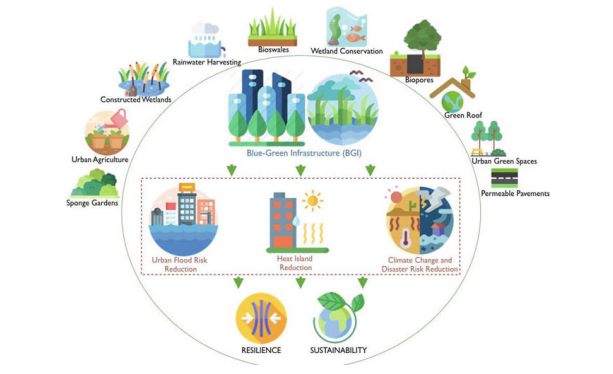
The green component includes a variety of green features, such as
- street trees
- natural and semi-natural vegetation
- green roofs and walls
- woodlands, grasslands, and parks
The blue component includes
- rivers, canals, ponds
- rain gardens, swamps, filtered strips
- urban ecological infrastructure like open spaces, parks, water bodies, and urban wetlands
Together known as ‘Blue-Green Infrastructure’ (BGI), these elements are the first to be affected by urban expansion, yet they often do not receive enough attention.
Benefits of Blue-Green Infrastructure
Effective BGI provides many benefits to road users, local residents, visitors, vendors, and local authorities. These benefits can be grouped into four main areas:
Environmental
- Improve climate resilience against drought and flooding
- Cool streets
- Capture and store carbon
- Support wildlife and nature recovery
- Create new areas for biodiversity
Economic
- Raise property values
- Increase foot traffic to shopping streets
Social
- Provide attractive places for people to meet and socialize
- Create a sense of place and community
- Increase local engagement in planning and conservation
Health
- Reduce air pollution
- Lower noise pollution
- Increase exercise and active travel
- Positively affect mental health
Fig 1:
Case study
The City of Cardiff Council needed to reduce the amount of rainwater entering Cardiff’s sewer system to prevent flooding and protect the long-term resilience of the sewers.
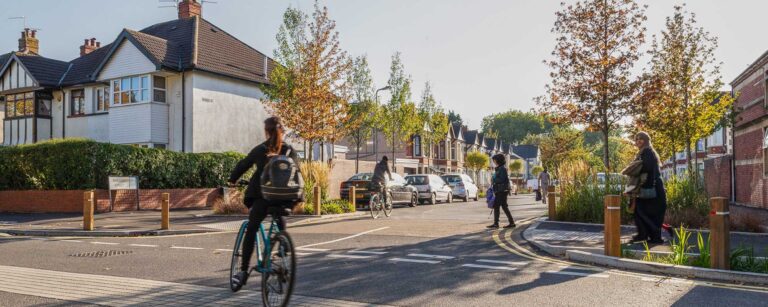
The addition of rain gardens and trees has enhanced the area’s beauty and removed 40,000 m³ of surface water from the sewer system each year. Redesigning the streets in Greener Grangetown to include rain gardens also freed up road space, creating Wales’ first-ever bicycle street along Taff Embankment. The new street design gives cyclists greater visibility and priority on the road.
Fig 2:
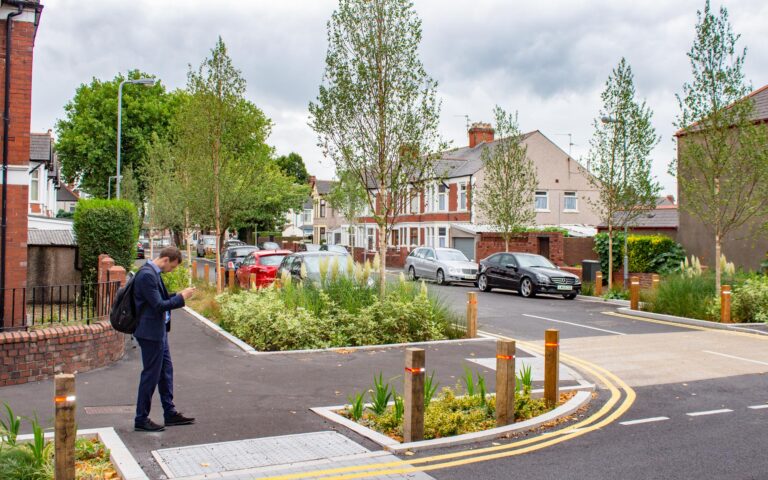
Fig 3:
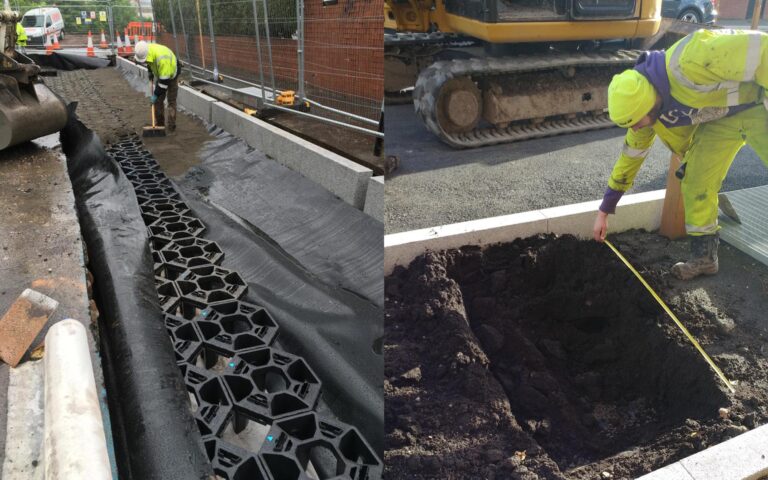
Fig 4:
Do the Benefits of BGI Outweigh the Costs?
Innovative and well-designed Blue-Green Infrastructure (BGI) provides a practical solution. Blue areas, such as water bodies, and green areas, like parks, plazas, and natural spaces, are designed to capture and manage water.
Building and maintaining this kind of infrastructure often costs less than repairing the damage caused by natural and weather-related disasters. In other words, the benefits of BGI generally exceed the costs.
Fig 5:
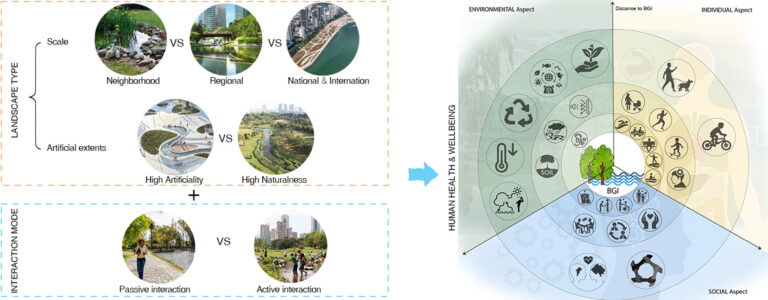
Conclusion
Blue-Green Infrastructure (BGI) is an effective and sustainable way to help cities face the challenges of climate change and urban growth. By using natural and green systems together, BGI helps
- manage water, reduce flooding and heat
- improve air quality
- support biodiversity
- creates healthier and more pleasant places for people to live in
For BGI to work well, cities need good planning, cooperation between different sectors, and community involvement. Although building BGI may require investment, its long-term environmental, social, and economic benefits are much greater than the costs.
In the future, cities that include BGI in their development plans will be better prepared for climate risks, more environmentally friendly, and more enjoyable places for everyone.
Passionate about sustainable cities or Blue-Green Infrastructure? Let’s share insights and build greener futures together.
http://linkedin.com/in/fatemeh-fahimi-550a352ba
Recourses
Dolman, N. and Dr. Emily O’Donnell (2021). 5 lessons learned from blue-green infrastructure delivery. [online] Institution of Civil Engineers (ICE). Available at: https://www.ice.org.uk/news-views-insights/inside-infrastructure/5-lessons-learned-from-blue-green-infrastructure-delivery [Accessed 7 Nov. 2025].
Stormwater2030 (2024). The Role of Blue-Green Infrastructure in Stormwater Management – Stormwater 2030. [online] Stormwater 2030 – Transform stormwater management in New South Wales. Available at: https://stormwater2030.org/the-role-of-blue-green-infrastructure-in-stormwater-management/ [Accessed 7 Nov. 2025].
c.ramboll.com. (n.d.). Climate Adaptation and Resilience: How Blue-Green Infrastructure Enables Livable Places. [online] Available at: https://c.ramboll.com/climate-adaptation-and-resilience-with-blue-green-infrastructure.
A transport sector perspective. (n.d.). Available at: https://www.ciht.org.uk/media/17093/green-and-blue-infra_single-page-version.pdf [Accessed 7 Nov. 2025].
Dhyani, S., Basu, M., Santhanam, H. and Dasgupta, R. eds., (2022). Blue-Green Infrastructure Across Asian Countries. Singapore: Springer Singapore. doi:https://doi.org/10.1007/978-981-16-7128-9.
Kumar, S. and Wilson, I. (2023). A transport sector perspective. [online] Available at: https://www.ciht.org.uk/media/17093/green-and-blue-infra_single-page-version.pdf [Accessed 7 Nov. 2025].
Components of Blue-Green Infrastructure. img. Fig 1. (n.d.). Blue-Green Infrastructure Across Asian Countries Book .
Greener-Grangetown img. Fig 2-3 (n.d.). https://greenblue.com/.
Greener-Grangetown img. Fig 4 (n.d.). https://www.arup.com/.
Benefits of BGI Outweigh the Costs. img. Fig 5. (n.d.). Science of The Total Environment Book .
ChatGPT (2025) Blue-Green Infrastructure Blog Cover Image, generated using the prompt: “Flat vector illustration of an urban park with a small river flowing through green grass and trees, a wooden bench beside the river, modern city buildings in the background, blue sky with clouds, eco-friendly sustainable city concept, soft colors, clean minimal style”, OpenAI, viewed 12 November 2025.



Blue Green Infrastructure is a great way to help combat the challenges of climate change whilst also providing social and economic benefits too. The challenge arises though, particularly for local authorities, with finding the funds to implement these systems. Whilst in the long run they are cost effective solutions and the benefits far outweigh the costs, the upfront cost still presents a challenge. In negotiations with developers and mass house builders, aspects such as greenery, trees, ponds and rain gardens can often end up on the chopping block in exchange for more units, infrastructure delivery and more profitable enterprises. As blue green infrastructure is a relatively new concept, there is limited data establishing the costs against the benefits and so implementing innovative solutions is seen as a bigger risk (Chau et al. 2025). Limited space and the increasing number of requirements for developers mean that due to the lack of policy requirement and political will to implement blue green infrastructure, it is often neglected on new developments, and the bare minimum is incorporated. Infrastructure that is required immediately that provides instant benefits rather than benefits over time are prioritised and the planning system is doing little to change this (Green Blue Urban, 2025). However, as you’ve shown, when implemented correctly by a local authority Green Blue Infrastructure can be very effective and provide numerous benefits for the local community. Locally we can see more examples of this being implemented, for example Newcastle City Council have recently completed the integration of rain gardens on Greys Street. These have been designed effectively and include artwork that reflects the history of the street and also incorporate seating for the street (Blue Green Newcastle, 2025). The implementation of these gardens shows that when blue green infrastructure is prioritised it can be implemented effectively and work to make a more attractive city and also a healthier one.
References:
Chau, H. et al. (2025) ‘Key Barriers and Challenges to Green Infrastructure Implementation: Policy Insights from the Melbourne Case’, Land, 14(5), pp. 961. Available at: https://doi.org/10.3390/land14050961
Blue Green urban (2025) Greening the Gap: The challenges of Implementing Green Infrastructure for local Authorities. Available at: https://greenblue.com/gb/greening-the-gap-the-challenges-of-implementing-green-infrastructure-for-local-authorities/ (Accessed: 18/12/2025).
Blue Green Newcastle (2025) New Raingardens on Grey Street. Available at: https://bluegreennewcastle.co.uk/blue-green-newcastle-news/new-raingardens-grey-street (Accessed: 18/12/2025).
I always enjoy reading about Blue–Green Infrastructure because it sits at the intersection of climate action, everyday urban life, and questions of fairness. While BGI is often framed as a practical and sustainable response to flooding, heat, and biodiversity loss through rain gardens, bioswales, and SuDS- its everyday performance shows that resilience is neither automatic nor inherently just.
What stands out most to me is maintenance. These systems are frequently treated as one-off design interventions rather than living infrastructure that requires continuous care. In parts of Newcastle upon Tyne, including Ouseburn and Byker, early SuDS features have gradually lost effectiveness as planted areas become silted or overgrown. This feels less like a design failure and more like a governance gap, where responsibilities between councils, developers, and housing associations remain fragmented and unclear.
This strongly resonates with an experience from my hometown in India, where a restored urban lake was celebrated as a climate-resilient response to flooding and heat. While initially successful, weak maintenance and informal dumping slowly undermined its function. The lake remained visually appealing but became largely symbolic rather than operational.
Social acceptance further complicates implementation. In Newcastle, proposals to expand rain gardens and green streets raised concerns among local businesses about access and deliveries. Similar tensions are visible in Indian cities, where streets support informal economies, making spatial reallocation politically sensitive.
From a spatial justice perspective, BGI investments often concentrate in high-visibility central areas, while peripheral neighbourhoods remain more exposed to flooding and environmental stress. Overall, BGI must be understood as a long-term social commitment, where resilience depends on care, governance, and who is prioritised in the urban landscape.
I always enjoy reading about Blue–Green Infrastructure because it sits at the intersection of climate action, everyday urban life, and questions of fairness. While BGI is often framed as a practical and sustainable response to flooding, heat, and biodiversity loss through rain gardens, bioswales, and SuDS its everyday performance shows that resilience is neither automatic nor inherently just (Agyeman et al., 2016; Meerow et al., 2016).
What stands out most to me is maintenance. These systems are frequently treated as one-off design interventions rather than living infrastructure requiring continuous care. In parts of Newcastle upon Tyne, including Ouseburn and Byker, early SuDS features have gradually lost effectiveness as planted areas become silted or overgrown. This reflects less a failure of design and more a governance gap, where responsibilities between councils, developers, and housing associations remain fragmented and unclear (Houston et al., 2018; Mell, 2019).
This strongly resonates with an experience from my hometown in India, where a restored urban lake was celebrated as a climate-resilient response to flooding and heat. While initially successful, weak maintenance and informal dumping slowly undermined its function. The lake remained visually appealing but became largely symbolic rather than operational, echoing critiques of “aesthetic” green infrastructure divorced from long-term stewardship (Narain and Prakash, 2016).
Social acceptance further complicates implementation. In Newcastle, proposals to expand rain gardens and green streets raised concerns among local businesses about access and deliveries. Similar tensions are visible in Indian cities, where streets support informal economies, making spatial reallocation politically sensitive (Roy, 2009).
From a spatial justice perspective, BGI investments often concentrate in high-visibility central areas, while peripheral neighbourhoods remain more exposed to flooding and environmental stress (Soja, 2010; Schlosberg, 2007). Overall, BGI must be understood as a long-term social commitment, where resilience depends on care, governance, and who is prioritised in the urban landscape.