

Streets as Health Infrastructure: Ideas from Barcelona’s Superblocks
Can streets really make people healthier?
When people think of health, hospitals, doctors, and medicine come first to their minds. However, when I studied urban design, I came to understand that streets also play a major role in our health. Because streets influence how people walk, cycle, chat with others, take a break, and even plenty of fresh air which they get in their daily lives. Therefore, in my view, streets are not just spaces for transport; they can also be part of the health infrastructure in the city.
What happens when cars step back?
Barcelona’s Superblocks give a very clear example of this idea. This project frees up more space for pedestrians by reducing car traffic within several blocks. So the environment becomes quieter, safer, and greener. I think this is important because it shows that changing street design can have a direct influence on daily life and public health. According to Nieuwenhuijsen (2024), the Superblock concept is associated with liveability, sustainability, and health, which suggests that it should not be considered as a traffic project.

Fig. 1. The superblock in Poblenou.
Why does this model matter?
Mueller et al. (2020) also argued that car-based urban planning has brought problems such as pollution, noise, and a lack of active lifestyles. The Superblock model tries to improve this situation by encouraging walking, cycling, public activities, and green space. I think this changes the meaning of the street. Streets should not only serve cars, but also support people’s well-being.
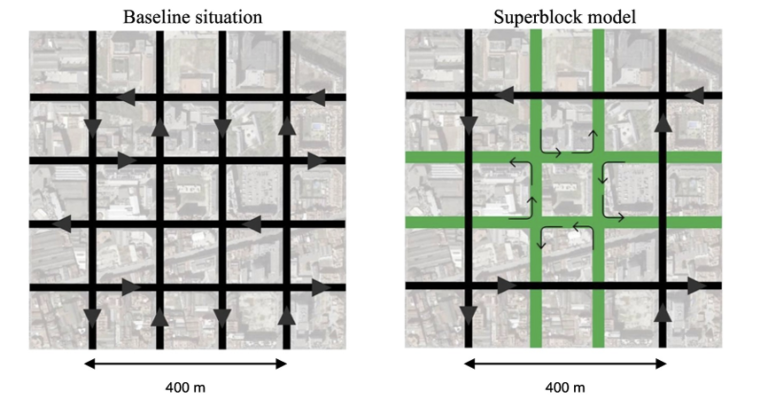
Fig. 2. Road hierarchy and traffic circulation aimed at with the Superblock model.
A positive model, with real challenges
The case of Poblenou Superblock is especially useful because it shows both positive results and difficulties. On the positive side, it created more people-friendly public space and improved the neighbourhood environment. But Zografos et al. (2020) also note that the project caused debate and conflict. This reminds me that healthier urban design is not always easy to achieve, because it is not only about design, but also about politics and different social interests.
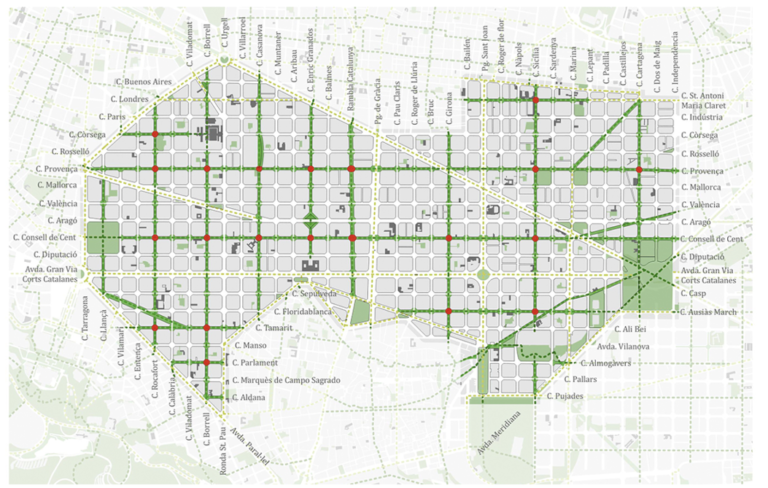
Fig. 3. The proposed Green axis plan in the Eixample district, Barcelona.
What could this mean for Newcastle?
As a student living in Newcastle, this case also makes me think differently about local streets. Some streets here are still too traffic-dominated, with narrow pavements and limited public space. Barcelona’s example makes me think that maybe a healthier city can start from a simple question: can we design streets more for everyday life, and less for cars? I think it will be very helpful for my future research on urban design, because it connects urban design, climate issues, and public health in a practical way.
Reference:
- Mueller, N., Rojas-Rueda, D., Khreis, H., Cirach, M., Andrés, D., Ballester, J., Bartoll, X., Daher, C., Deluca, A., Echave, C., Milà, C., Márquez, S., Palou, J., Pérez, K., Tonne, C., Stevenson, M., Rueda, S. & Nieuwenhuijsen, M. (2020) ‘Changing the urban design of cities for health: The superblock model’, Environment international, 134.
- Nieuwenhuijsen, M., de Nazelle, A., Pradas, M.C., Daher, C., Dzhambov, A.M., Echave, C., Gössling, S., Iungman, T., Khreis, H., Kirby, N., Khomenko, S., Leth, U., Lorenz, F., Matkovic, V., Müller, J., Palència, L., Pereira Barboza, E., Pérez, K., Tatah, L., et al. (2024) ‘The Superblock model: A review of an innovative urban model for sustainability, liveability, health and well-being’, Environmental research, 251(Pt 1), .
3.Zografos, C., Klause, K.A., Connolly, J.J.T. & Anguelovski, I. (2020) ‘The everyday politics of urban transformational adaptation: Struggles for authority and the Barcelona superblock project’, Cities, 99.
List of figures:
- Fig. 1. The superblock in Poblenou.
- Fig. 2. Road hierarchy and traffic circulation aimed at with the Superblock model.
- Fig. 3. The proposed Green axis plan in the Eixample district, Barcelona.
