

Reflective Summary – Semester 2
From Urban Resilience to Urban Well-Being
During Semester 2, my understanding of urban design developed further from the ideas I explored in Semester 1. Previously, I focused mainly on sustainable mobility, climate resilience, and spatial justice through topics such as pedestrianisation on İstiklal Street in Istanbul and Blue–Green Infrastructure as a strategy for urban resilience. These topics helped me understand how mobility systems, ecological infrastructure, and public spaces can improve environmental sustainability and urban quality of life.
This semester, however, my perspective shifted more toward the emotional and psychological relationship between people and urban spaces, especially through researching Blue–Green Infrastructure (BGI) and mental well-being.
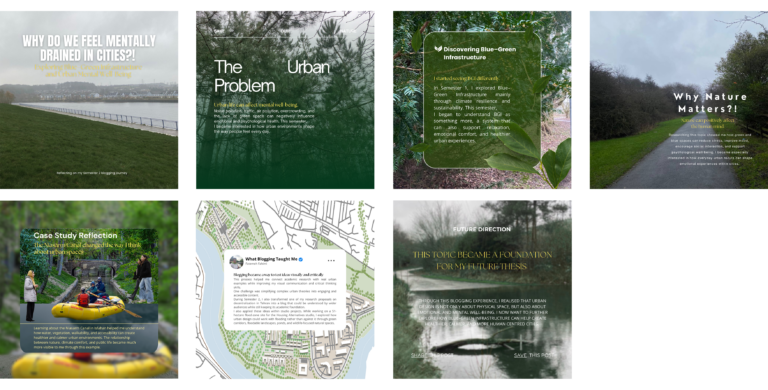
All images used in this Carousel are by Fatemeh Fahimi.
You can view the carousel for this blog on the following Instagram page:
Key takeaways
One of my main takeaways was understanding that urban nature can influence people emotionally as much as physically. Researching green and blue spaces helped me understand how urban environments can reduce stress, encourage relaxation, and support healthier everyday experiences. As Gascon et al. (2015) explain, long-term exposure to green and blue spaces is linked to improved mental health outcomes, while the World Health Organization (2016) highlights the role of urban green spaces in reducing stress and improving well-being.
Another important takeaway came from researching decentralization and urban inequality in Tehran. Writing about the concentration of economic and administrative resources in Tehran helped me better understand how urban policies can influence spatial justice and regional inequality. Transforming this research proposal into a public blog also improved my ability to communicate complex urban issues in a clearer and more accessible way.
These ideas also influenced my studio work. During the Housing Alternatives studio, I worked on a 51-hectare flood-zone site where I explored how urban design could work with flooding rather than against it through green corridors, floodable landscapes, ponds, and wildlife-focused natural spaces.
Through these experiences, I developed a stronger interest in human-centred urban design, urban well-being, and spatial justice, which I hope to continue exploring in my future thesis research.
References
Gascon, M., Triguero-Mas, M., Martínez, D., Dadvand, P., Forns, J., Plasència, A. and Nieuwenhuijsen, M.J. (2015) ‘Mental health benefits of long-term exposure to residential green and blue spaces: A systematic review’, International Journal of Environmental Research and Public Health, 12(4), pp. 4354–4379.
World Health Organization (2016) Urban green spaces and health: A review of evidence. Copenhagen: WHO Regional Office for Europe.
Fatemeh Fahimi (2026) Photographs and visual materials used in the carousel for “Why do we feel mentally drained in cities?”. Personal collection.
