

From Case Studies to Design Decisions: A Semester 2 Reflection
My Personal Experience:
This carousel reflects on my learning process from case studies to design judgment in the second semester. My biggest challenge is moving from describing precedents to really supporting my studio design with precedents. Through blog research, I began to raise broader issues about healthy streets, shared living, communities and daily life. Newburn Riverside’s site research helped me better understand my studio site, especially street relationships, waterfront boundaries and public spaces. The field visit to Leeds LILAC also showed me how co-housing can serve as a real precedent, supporting community life through shared gardens and daily spaces. In the studio, I learned to test the design judgment through scale, house type, street connection and flow relationship. For me, blog has become an important tool for connecting research, field research, visual expression and design narrative.
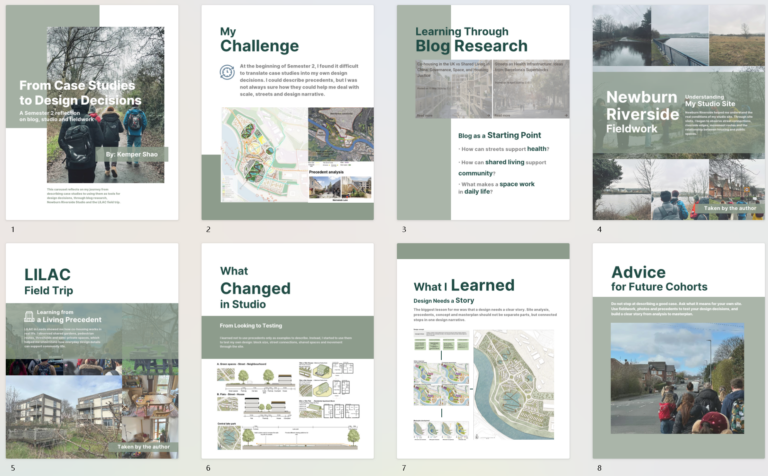
Images: Pictures posted on Instagram (All the diagrams and photos were taken and produced by Kemper Shao)
Additional detailed images are available for viewing on our Instagram page.: @maurbandesign
Key Takeaways:
Connecting Research, Visual Communication and Design Practice
Through blog, Instagram work and studio learning in the second semester, an important gain for me in academic development is that urban design should not be understood only through spatial forms, but also through daily health and social life. In the reflection of the first semester, I mentioned that one of my biggest challenges was from “interior design thinking” to “urban design thinking”. At that time, I often focused on comfort, atmosphere and small-scale spatial experience. This semester, through the study of “Streets as Health Infrastructure”, I began to understand that streets can affect walking, staying, safety, social interaction and well-being. Barton and Grant’s “health map” (2006) helps me understand health is not only determined by individual behavior, but also by wider social, environmental and built conditions.
A second takeaway is that fieldwork and visual communication helped me move beyond learning only from texts. In the first semester, I reflected that as an international student, I had too few field visits to the local community, so some case analyses were more dependent on literature. In the second semester, the field trip of Newburn Riverside Studio and Leeds LILAC helped me connect research with real places. For example, we visited this LILAC in Leeds, I observed how shared gardens, pedestrian routes, front-door spaces and semi-private boundaries support daily encounters. Williams (2005) argues that co-housing is more likely to promote social interaction when community design includes shared facilities and walking spaces. Similarly, Leyden (2003) suggested that walkable communities can support social capital by creating more opportunities for chance encounters and local participation.
I think the task of using Instagram is also very important. In the first semester, I mainly used it as a platform to show the final results, but this semester I began to use it as a reflective visual storytelling tool. Choose my own photos, arrange a clear picture order, and write a short caption to help me express my complex ideas more directly.
In studio, the most difficult part is to understand the scale relationship, street relationship and design narrative. At first, it was difficult for me to judge the size of blocks, streets and shared spaces, and to connect them into a clear urban structure. I also struggled to use precedents actively, rather than only describing them. Through site research, LILAC observation and studio discussion, I gradually learned to use precedents to test design judgment, and connect analysis, concepts and masterplan.
In conclusion, I feel I have further shifted from the perspective of interior design to a broader urban design method. Now I will think more about governance, affordability, daily use, health, community and long-term social values.
Reference:
- Barton, H. & Grant, M. (2006) ‘A health map for the local human habitat’, The journal of the Royal Society for the Promotion of Health, 126(6), pp. 252–253.
- Leyden, K.M. (2003) ‘Social Capital and the Built Environment: The Importance of Walkable Neighborhoods’, American journal of public health (1971), 93(9), pp. 1546–1551.
- Williams, J. (2005) ‘Designing Neighbourhoods for Social Interaction: The Case of Cohousing’, Journal of urban design, 10(2), pp. 195–227.
