The role of benches in restoring the independence of Older Adults
As summer approaches, the days are getting warmer and longer. I’m excited to find a bench in my local park and enjoy the sun and nature. For me, and perhaps most of you, a bench is a place to rest and enjoy the view, or a location for a chat with a friend. However, for some people, including the aging population, the presence of a bench can be a chance for independence. A key piece of street furniture that allows them to get outdoors, run errands, and be self-reliant.
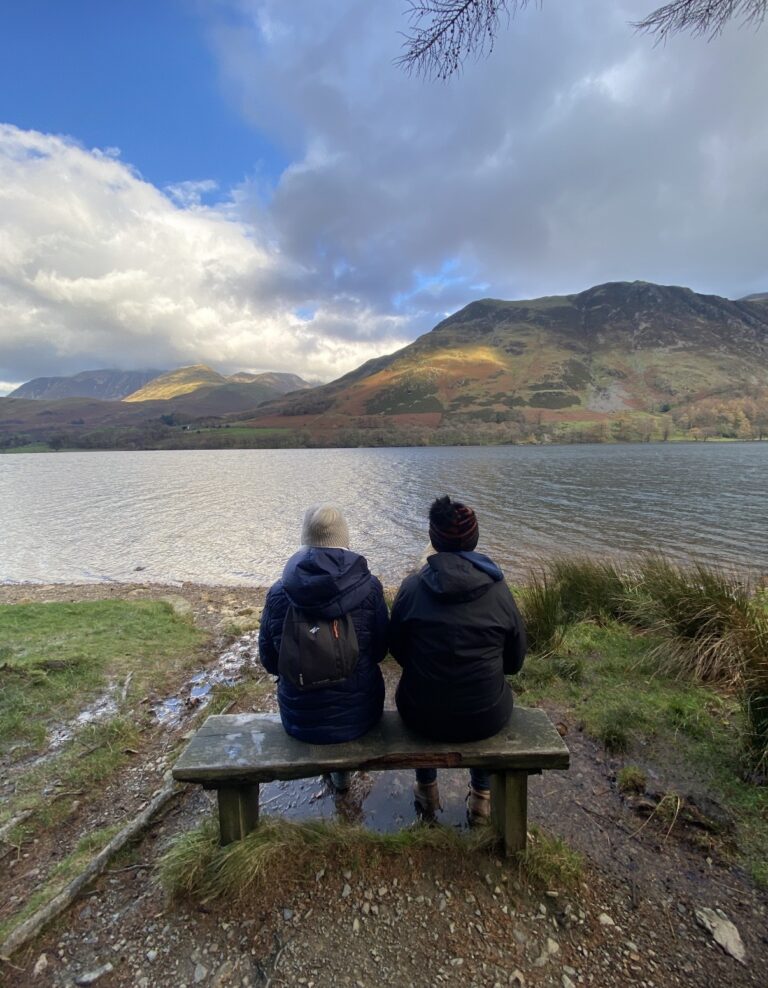
Image: Bench in the Lake District. Authors Own.
The Aging Population
We are an aging population, the World Health Organization has stated that “by 2030, 1 in 6 people will be aged 60 years or older” (2025). With aging comes several health factors that can impact mobility. So, as we get older it can be harder to move as easily and freely.
Walking has beneficial effects in improving physical and mental resilience – especially in older people (Su et al, 2025). But for many, the chance to exercise is taken away by the lack of facilities to accommodate reduced manoeuvrability. One barrier to the outside world is a lack of public seating.
The importance of benches in the public realm
A bench can be the difference between whether or not someone can leave the house (Coman, Caponecchia, and Gopaldasani, 2021), it can determine where they may go, and how long they can stay. The health conditions, reduced mobility, and lower physical resilience associated with aging means that long walking distances can be much more difficult and uncomfortable. Stopping to rest can help to mitigate these issues and provide a space for recovery.
It is uncommon to find benches on residential streets; not enough seating means that the distance people must travel before they can rest is often too far.
In Coman, Caponecchia, and Gopaldasani’s study (2021), roughly 60% of participants reported “difficulty standing from public seating” (pp. 268) often due to seating being too low, causing more physical strain to carry on their journeys. So even when resting places are provided, they can often be just as inconvenient.
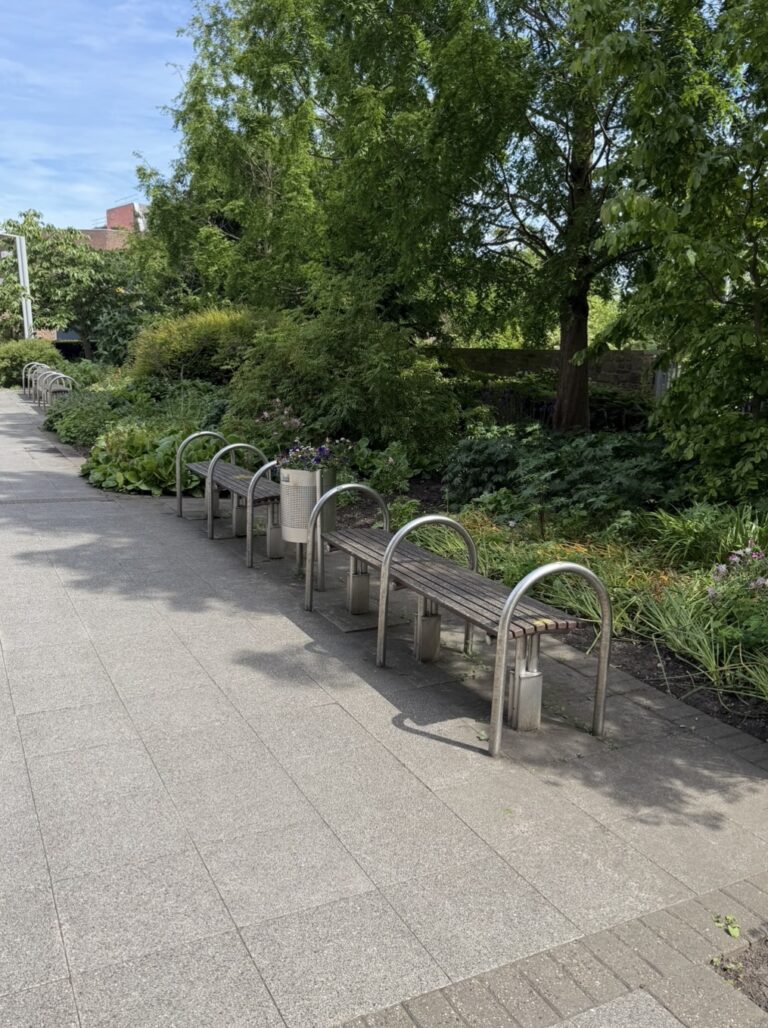
Image: Public benches on Newcastle Campus. Authors Own.
How can public seating be improved?
- Benches are often placed at a destination, rather than on the journey. Increasing the number of benches on streets, especially main routes to town centres and supermarkets, means that more people can walk there.
- Raising the height of benches or providing more height options so that it is easier for people to stand back up (Coman, Caponecchia, and Gopasani, 2021).
- Public seating is designed for functionality, and the materiality often lacks comfort (Huang, Zhang, and Chen, 2025) and so sitting down for longer periods can be difficult. More comfortable seats can be restorative.
- Seating which is designed with aesthetics in mind is more attractive to people and can facilitate more positive interactions with the public realm (Mohamed, 2024).
References
Coman, R.L., Caponecchia, C.D. and Gopaldasani, V. (2021) ‘Impact of Public Seating Design on Mobility and Independence of Older Adults’, Experimental aging research, 47(3), pp. 262-272. Available at: https://doi.org/10.1080/0361073X.2021.1884445
Huang, Q., Zhang, Z. and Chen, Z. (2025) ‘The effects of multi-sensory public seating on emotion regulation in youth communities’, Scientific Reports, 15(1), pp. 1-16. Available at: https://doi.org/10.1038/s41598-025-12473-x
Muhaed, A. (2024) ‘User satisfaction with aesthetics of urban park seating’, architecture Papers of the Faculty of Architecture and Design STU’, 29(4), pp. 47-54. Available at: https://doi.org/10.2478/alfa-2024-0023
Su, T., Barclay. R., Moineddin, R. and Salbach, N.M. (2025) ‘The impact of outdoor walking interventions on frailty among older adults with mobility limitations: Findings from the Getting Older Adults Outdoors’, PLoS One, 20(9), pp. 1-16. Available at: https://doi.org/10.1371/journal.pone.0323923
World Health Organization. (2025) Aging and Health. Available at: https://www.who.int/news-room/fact-sheets/detail/ageing-and-health (Accessed: 17th May 2026)



This was such a lovely read, Jess. It’s really interesting because I love walking, but one of the biggest frustrations I feel in a lot of places is that there’s rarely space to pause, linger, or briefly gather yourself during a journey. Walking often feels like it has to be continuous rather than something that can naturally expand and contract through moments of rest.
I genuinely think I’d go on much longer walks if there were more incremental moments of social infrastructure throughout the journey small benches, edges, places to sit and observe rather than seating only appearing at a final destination.
It really made me think about how benches are often treated as purely functional objects rather than social infrastructure that shapes the rhythm, comfort, and experience of movement through space. Really eye-opening piece, I loved this.