

Gentrification, Commodification and Financialization in Africa’s smallest country – How tourism has impacted urban design in The Gambia
Having volunteered in The Gambia myself on numerous occasions, I have seen firsthand how the larger cities have changed with the rise in tourism. Between 2012 and 2023, The Gambia saw an increase of 49,513 air arrivals per year, with European visitors making up most arrivals (Gambia Tourism Board, 2023). This has resulted in a rise of tourism-driven development, changing the urban form, land use, and social equity, particularly affecting the bigger coastal cities.
Increasingly, land close to the port and coastline have been treated as economic assets which attract foreign investment and drive-up land and property values, attracting the rich and forcibly displacing the poor due to a lack of housing policy (Sambou et al., 2024, p. 145). Whilst these high levels of tourism bring opportunities, it also brings about greater inequality.
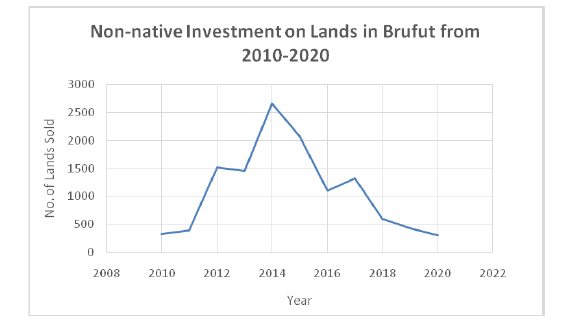
Non-native investment on Lands in Brufut from 2010-2020 (Sambou et al., 2024, p. 146)
A key example of gentrification and commodification within The Gambia would be the introduction of the Tourism Development Area (TDA) protection that was introduced to all coastal communities in Kombo. It required that all land within 800m of the Ocean now fell into the TDA, resulting in land being forcibly seized from local residents to be used for tourism developments such as beachfront hotels and related businesses. Many locals were displaced by this process as they became unwelcome on now privatized land. This process did however attract more tourists, and as such generated income which led to improvements in road infrastructure, water supply, and electricity supply (Sambou et al., 2024, p. 141). The architectural style shifted to appease tourists rather than reflect the culture of the country. Public spaces became heavily targeted towards tourists and much of their previous identity was lost.
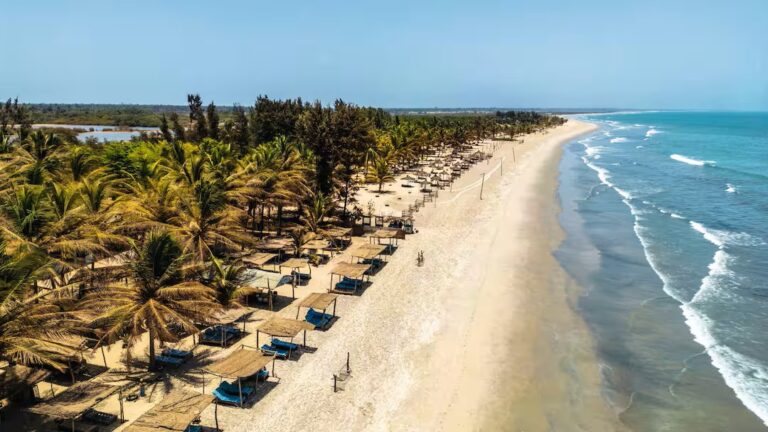
Beachfront Tourist area of The Gambia (Tui, 2026)
Most visitors to the country stay within a small, more developed, radius primarily made up of hotels, bars, restaurants, and nightclubs in lieu of exploring the cultural offerings of the country. Cultural heritage sites have since been reshaped to support heritage tourism, prioritizing visitor economies over local preservation. As such, historic neighbourhoods, like Half Die, have been completely erased in the name of modern development. This has led to great loss of community in the area as many locals have chosen to move away to other parts of the Gambia (Gijanto, 2013).
This unfortunate chapter in Gambia’s history highlights the importance of balancing tourism-led development with culturally sensitive urban design. This is essential for both protecting the local culture and providing long term stability which reduces spatial injustice.
References:
Department of State for Tourism and Culture, Republic of The Gambia (2006) ‘The Gambia Tourism Development Master Plan’. Available at: https://unevoc.unesco.org/e-forum/The%20Gambia%20Summary%20Report%20November%202006.pdf (Accessed: 25/04/2026).
Gambia Travel Board (2023) ‘Arrivals & Statistics’. Available at: https://visitthegambia.com/?page_id=5318 (Accessed: 25/04/2026).
Gijanto, L. (2013) ‘Historic Preservation and Development in Banjul, The Gambia’, Journal of African Diaspora Archaeology and Heritage, Vol 2, pp. 93-114. Available at: https://doi.org/10.1179/2161944113Z.0000000003
Sambou, O. et al. (2024) ‘The Nexus between Touristification and Tentrification: A case in Brufut Heights, the Gambia ‘, International Journal of Economics, Business and Management Research, Vol. 8, No.04., pp. 139-151. Available at: https://doi.org/10.51505/IJEBMR.2024.8410.
Tui (2026) ‘The Gambia Holidays’. Available at: https://www.tui.co.uk/destinations/africa/gambia/holidays-gambia.html (Accessed: 25/04/2026).
United Nations Conference on Trade and Development (UNCTAD) (2019) ‘The Tourism Policy Action Plan Tourism Sector of the Gambia.’ Available at: https://unctad.org/system/files/official-document/unda-project-1819I_The-Gambia_pap_en.pdf (Accessed: 25/04/2026).
