Gentrification, Commodification and Financialization in Africa’s smallest country – How tourism has impacted urban design in The Gambia
Having volunteered in The Gambia myself on numerous occasions, I have seen firsthand how the larger cities have changed with the rise in tourism. Between 2012 and 2023, The Gambia saw an increase of 49,513 air arrivals per year, with European visitors making up most arrivals (Gambia Tourism Board, 2023). This has resulted in a rise of tourism-driven development, changing the urban form, land use, and social equity, particularly affecting the bigger coastal cities.
Increasingly, land close to the port and coastline have been treated as economic assets which attract foreign investment and drive-up land and property values, attracting the rich and forcibly displacing the poor due to a lack of housing policy (Sambou et al., 2024, p. 145). Whilst these high levels of tourism bring opportunities, it also brings about greater inequality.
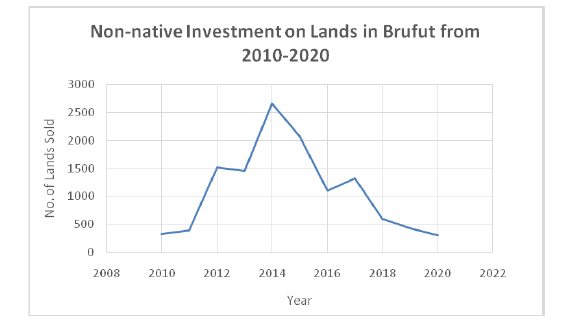
Non-native investment on Lands in Brufut from 2010-2020 (Sambou et al., 2024, p. 146)
A key example of gentrification and commodification within The Gambia would be the introduction of the Tourism Development Area (TDA) protection that was introduced to all coastal communities in Kombo. It required that all land within 800m of the Ocean now fell into the TDA, resulting in land being forcibly seized from local residents to be used for tourism developments such as beachfront hotels and related businesses. Many locals were displaced by this process as they became unwelcome on now privatized land. This process did however attract more tourists, and as such generated income which led to improvements in road infrastructure, water supply, and electricity supply (Sambou et al., 2024, p. 141). The architectural style shifted to appease tourists rather than reflect the culture of the country. Public spaces became heavily targeted towards tourists and much of their previous identity was lost.
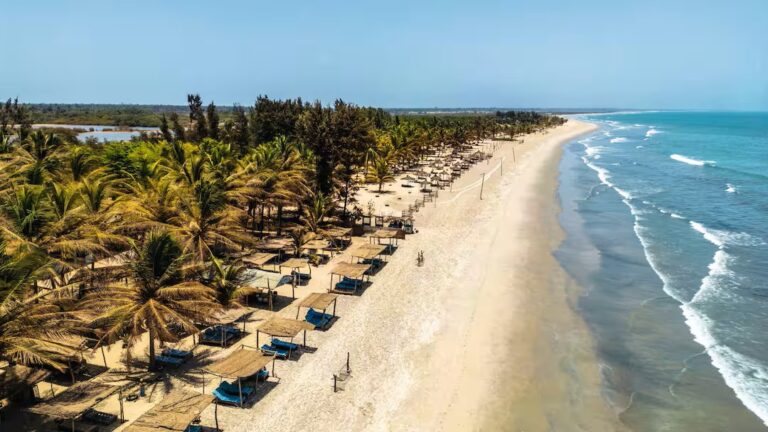
Beachfront Tourist area of The Gambia (Tui, 2026)
Most visitors to the country stay within a small, more developed, radius primarily made up of hotels, bars, restaurants, and nightclubs in lieu of exploring the cultural offerings of the country. Cultural heritage sites have since been reshaped to support heritage tourism, prioritizing visitor economies over local preservation. As such, historic neighbourhoods, like Half Die, have been completely erased in the name of modern development. This has led to great loss of community in the area as many locals have chosen to move away to other parts of the Gambia (Gijanto, 2013).
This unfortunate chapter in Gambia’s history highlights the importance of balancing tourism-led development with culturally sensitive urban design. This is essential for both protecting the local culture and providing long term stability which reduces spatial injustice.
References:
Department of State for Tourism and Culture, Republic of The Gambia (2006) ‘The Gambia Tourism Development Master Plan’. Available at: https://unevoc.unesco.org/e-forum/The%20Gambia%20Summary%20Report%20November%202006.pdf (Accessed: 25/04/2026).
Gambia Travel Board (2023) ‘Arrivals & Statistics’. Available at: https://visitthegambia.com/?page_id=5318 (Accessed: 25/04/2026).
Gijanto, L. (2013) ‘Historic Preservation and Development in Banjul, The Gambia’, Journal of African Diaspora Archaeology and Heritage, Vol 2, pp. 93-114. Available at: https://doi.org/10.1179/2161944113Z.0000000003
Sambou, O. et al. (2024) ‘The Nexus between Touristification and Tentrification: A case in Brufut Heights, the Gambia ‘, International Journal of Economics, Business and Management Research, Vol. 8, No.04., pp. 139-151. Available at: https://doi.org/10.51505/IJEBMR.2024.8410.
Tui (2026) ‘The Gambia Holidays’. Available at: https://www.tui.co.uk/destinations/africa/gambia/holidays-gambia.html (Accessed: 25/04/2026).
United Nations Conference on Trade and Development (UNCTAD) (2019) ‘The Tourism Policy Action Plan Tourism Sector of the Gambia.’ Available at: https://unctad.org/system/files/official-document/unda-project-1819I_The-Gambia_pap_en.pdf (Accessed: 25/04/2026).



I found your blog very insightful because it does not present tourism only as an economic opportunity, but also as a force that can reshape urban identity, social equity, and everyday life. The discussion about the Tourism Development Area (TDA) was especially powerful because it clearly demonstrates how tourism-led urban development can create spatial inequality and displacement when economic interests are prioritised over local communities. Your analysis strongly connects with David Harvey’s argument that urban space is increasingly shaped by capital investment and market-driven development, often at the expense of social justice and local identity. Harvey (1973) explains that processes of urban redevelopment can transform cities into spaces designed more for consumption and profit than for the people who originally inhabited them.
I must agree that your observation regarding the process of cultural heritage being commoditized due to tourism is significant too. The concept you have identified is linked closely to the notion raised by Sharon Zukin of the possibility of loss of cultural authenticity of cities due to their redesigning in favor of tourism and investments rather than the local culture. According to Zukin (2010), “The city, they said, had lost its soul.” The phrase clearly conveys the message of your observations related to how tourism-driven urban design leads to the diminishing of authenticity and sense of community among other issues. Your blog post efficiently points to the necessity of developing balanced approaches to urban design in view of tourism growth.
Resources:
Harvey, D. (2008) The Right to the City. Available at: https://newleftreview.org/issues/ii53/articles/david-harvey-the-right-to-the-city
Zukin, S. (2010) Naked City: The Death and Life of Authentic Urban Places. Available at: https://archive.org/details/nakedcitydeathli0000zuki
It is really eye-opening to read about your time in The Gambia Rhiannon, and I appreciated how you bridged the gap between academic theory and your personal observations from volunteering.
I found myself circling back to your point about the Tourism Development Area (TDA) and the tensions between viewing the coast as a financial asset versus the lived reality of the communities that call it home. I’d recommend an article by Navarrete-Hernandez et al. (2024) to explore this further. They argue for a ‘regulatory equilibrium’, or sweet spot, in planning. Their research suggests that instead of blunt policies tackling sprawling development, we need evidence-based regulations (such as specific height limits or façade guidelines) that protect an area’s unique heritage value without scaring away any future investment.
In this case, it seems the TDA 800m rule might lack this nuance, prioritising tourist comfort over the local community’s right to the coast. It has also prompted me to think about whether tourism-led regeneration can ever remain culturally sensitive once places become economically dependent on visitor economies. It makes me wonder: based on what you saw, do you think a more balanced ‘equilibrium’ approach could have saved Half Die, or is the pressure for investment in The Gambia just too high to make this realistic?
Before reading your post, this was a topic I hadn’t previously researched or considered in depth. Your reflection has left me thinking about whether we can ever truly develop a tourist economy that doesn’t displace a community’s culture in favour of someone else’s holiday. It is a powerful reminder that our design choices have deep, human consequences.
References
Navarrete-Hernandez, P., Urrutia, J. P., and Mellouki, K. (2024). ‘Preserving enough? A randomised controlled trial approach to determine relevant urban planning regulations for small touristic towns’, Habitat International, 146, 103033.