Activating residential back alleys to improve social life of streets
Understanding the Residential back alleys
Alleys are often forgotten spaces in an urban setting that holds a sense of drama with the nature of linearity. This blog discusses about, how transforming the back alleyways of terraced housing in the UK could lead to a creation of community driven, environmentally attractive zone for mental health and well-being. As we all know, currently the back alley ways of Victorian/ Georgian terrace housing serves the purpose of disposing household waste. Alleys accumulated with utility bins, leaves the space isolated from human involvement most of the time. As a result, residential alleys foster many anti-social elements such as fly tipping, unorganized littering and graffiti. The recent surveys indicate that the local environment quality of alleyways fall far behind the average standards of streets/facades. 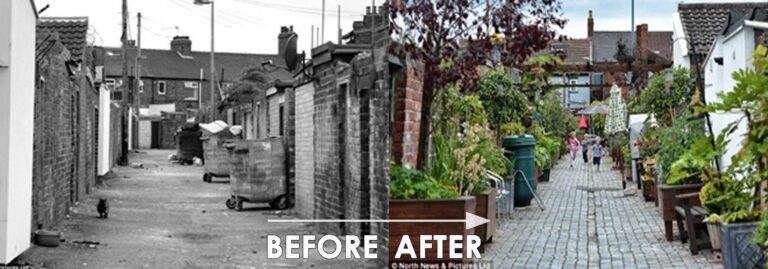
Fig 1: An example of transforming residential back alley into a community driven space for engagement, Middleborough
However, alleys can be an important layer in the modern day residential development with its intimate relation to human scale. Also, possesses a compelling potential to become a part of urban intervention through unique experiences. Using proper revaluation and regeneration techniques, alleys could become an active secondary network for movement and interactions. Besides, an off street space for multiple generations facilitating intimate personal outdoor experiences and cultural activities.(Duell & Harding, 2013)
Potentials of Residential back alleys:
- Alley creates an activity driven network for pedestrian movement.
- Alleys can be welcoming to induce green infrastructure in its streets.
- Intimate and safe personal spaces, keeping in mind the use of services.
- A multi-generational space with age inclusive development.
- Off street podium for festivals and cultural activities.
- Unique spatial features and experiences.(Witte & Meisel, 2011)

Fig 2: Proposed activity chart in a redeveloped alley way, Seattle, USA
An alley could achieve this transformation into an active interactive space by :
- Diluting boundaries of back yard using robust boundaries
- adding colours and mixed pavement materials to differentiate the functions.
- using linearity of space to create sequential activity nodes for children and elderly using furniture and plants.
These community driven efforts to create communicative neighborhoods could contribute to the collective sustainable development and helps in enhancing the overall quality of life of the residents, evidently reflecting its effect on urban intervention. At the same time the purpose of service laid on alleys should not be forgotten to keep the area clean and healthy.
Keys for creating a Successful residential back alley
The goal of revitalizing alleys is to create a closely knit public realm which are safe and healthier with a communicative environment in the urban housing fabric. (Fialko & Hampton, 2010). And, a successful alley requires:
Quality of space
- Users should be able to recognize the importance of the space by reduced speed of movement with intermediate activity nodes throughout the linearity of alleys.
- It should form the part of street identity, rather than a neglected space for services.
- The redevelopment should not hinder the service aspect of alley and alternatives such as community bins should be provided for waste management.
- Using mixed pavement materials to differentiate and distinguish the functions aesthetically and practically.
- The purpose of alley for services should be kept in mind during regeneration.
- Opening/ Diluting the backyard to the alley creates eyes on alley and fosters a secondary movement network.


Fig 3: Dilution of back yard boundaries Fig 4: Transforming back alleys in West Belfast- “Miracle way”
Ecological impact on streets
- Blue- Green Infrastructure
Using permeable materials in alley way would help in collecting surface water and distribute efficiently to the drainage, keeping the area clean and hygiene. Additionally, Permeable paving and bios wales are potential on site water treatment to eradicate waste water from the site. (Fialko & Hampton, 2010)


Fig 6: Old Firehouse Alley Redesign – Fort Collins Fig 5: Detroit’s first alley, Green garage Detroit
2. Flora and Fauna
Adding plants to the street brings attractions to the alley and creates robust boundary between backyard and alley space. Moreover, Plants provide welcoming spirit for people to use the space and improve the atmospherical quality of the alley. Furthermore, Planting trees and small plants foster new habitat generation for the existing ecosystem in the urban fabric. Therefore, “Giving back the taken”. Above all, Alley gardens can also be an area for economic generation and create sustainable and positive interactive spaces. Along with all these benefits, plants play an integral part in the green infrastructure by supporting water filtration and absorbing pollutants.


Fig 8: Green infrastructure in Chicago alley redevelopment Fig 9 Wild alley- Revitalizing neglected alley in Belfast
In conclusion, re vitalizing the back alleys require intense effort from the occupants. Therefore, efforts should be laid by the community itself, as they form the heart of this development. Subsequently, It starts from the communication with neighbors followed by cleaning up the space, identifying potential strengths and threats to invent a proper plan of action to create a community driven intimate personal space. Consequently improving the quality of the neighborhood and the life style of residents in an urban scale.



This is really a very interesting blog. We have to admit that people ignore back alleys. In many cities, back alleys are generally not very conspicuous, and people do not pay much attention to issues such as aesthetics, environmental protection, and safety. This needs to be changed urgently.
There is a scenic spot called Three Lanes and Seven Alleys in Fuzhou City, China. This is a very good example. Three Lanes and Seven Alleys is one of the typical representatives of the lane system in ancient Chinese cities. It is an important carrier and concrete expression of Fuzhou’s urban cultural characteristics. The overall environment and place spirit formed by the many unique Ming and Qing Dynasty buildings it retains reflect the style and characteristics of the Ming and Qing historical periods and have immeasurable historical value. The government not only protects this area, but also develops tourism to realize revenue. It is completely different from other ordinary alleys and gives full play to its characteristics. Therefore, some alleys can try to learn from this case, cater to the needs of today’s society, and improve street community life.
Reference:
Li, W., Hu, L., Cao, X. & SpringerLink (2021) Human-Centered Urban Planning and Design in China: Volume II Urban Design and Mobility. 1st ed. 2021..
Ghosh, M. & SpringerLink (2020) Perception, Design and Ecology of the Built Environment A Focus on the Global South. 1st ed. 2020..
The issue discussed in this blog, how to enhance the social life of the street through the transformation of residential back alleys, is indeed a matter of great interest and has been widely discussed. Alleys are prevalent in all urban forms, yet this important feature of urban space is often ‘neglected’ (Wolch et al., 2010). This neglect reinforces the problems of anti-social behavior, safety and hygiene in alley spaces.
The authors not only point out the current shortcomings of these spaces, such as littering and anti-social behavior, but also suggest specific ways to transform these areas through community engagement and landscaping. Firstly, community engagement, the blog highlights the key role of community engagement in the transformation of back alleys. This is important because it is only through the active participation and engagement of residents that transformation projects can be sustainable and productive. Second is the creativity of multi-functional spaces, the article mentions enhancing the functionality of back alleys by adding activity nodes, green infrastructure and multi-generational shared spaces. This creativity not only increases the frequency of use, but also promotes interaction between neighbors. Then there is the ecological benefit of using permeable materials and vegetation to improve the ecology of back alleys, which not only helps with stormwater management, but also beautifies the environment and enhances the quality of life for residents. Lastly, there is the space for cultural activities. The transformation of back alleys provides new venues for community cultural activities, which can provide residents with more opportunities for socializing and recreation in their daily lives and promote community cohesion. All these approaches are very inspiring.
However, one question that arises is how to ensure that these spaces are maintained and managed in the long term after the community back alley transformation is completed. The article refers to ongoing community engagement and the sustainability of alley gardens. However, Forde, McElduff, and Rafferty’s study of alley greening projects in Belfast (2023) suggests that there is a lack of consensus on the governance aspects of green alley projects, which can undermine community efforts. Are there therefore specific and effective proven mechanisms that can guarantee the sustainability of transformation outcomes?
Overall, this blog presents a back alley renovation concept that is full of innovative and practical implications. By fully considering the above questions and incorporating specific implementation plans, it is believed that such a renovation project can bring about significant positive changes to the community.
References
Forde, D., McElduff, L. and Rafferty, G. (2023) ‘Alley greening: a tool for enhancing community resilience?’, Local Environment, pp. 1–20. doi: 10.1080/13549839.2023.2284944.
Wolch, J. et al. (2010) ‘The forgotten and the future: Reclaiming back alleys for a sustainable city’, Environment and Planning A: Economy and Space, 42(12), pp. 2874–2896. doi: 10.1068/a42259.
Thank you for such an insightful read on the activation of back alleys. Here the author talks about how the neglected back alleys in the Victorian houses do not serve their purpose as they were made for. Their core usage is only waste disposal and they are unattended to or not maintained well.
Additionally, Alley greening, a type of green infrastructure (GI), offers several potential benefits such as improved pedestrian mobility, the formation of social and recreational spaces, and surface water runoff management. [1] To accurately evaluate how green alley projects may affect people-place relationships, it is first important to explore the many forms that these attachments or relationships can take. [1]
One of the key ways to secure alleyways is by alley gating. Alley gates serve as basic security gates created to reduce criminal activity. The size and form of the alley will impact the most suitable design. [2] Some of the key components of the alley gates should be their appearance, material, anti-climb design, and a lock.
Overall improving the back alleys results in a better neighbourhood by promoting safety and ensuring a smooth functioning of the neighbourhood. Creating beautiful spaces by adapting the existing infrastructure to create communal and social spaces.
Although a question arises, why are these spaces are often neglected? A siple way to approach this is by starting to make changes one place at a time, to create more such places until it has a domino effect.
References:
[1] Forde, D., McElduff, L. and Rafferty, G. (2023). Alley greening: a tool for enhancing community resilience? Local Environment, pp.1–20. doi:https://doi.org/10.1080/13549839.2023.2284944.
[2] rbwm.moderngov.co.uk. (2024). Logon. [online] Available at: https://rbwm.moderngov.co.uk/Data/Cabinet/20070322/Agenda/meetings_070322_cab_alleygating_appendixB [Accessed 19 May 2024].
Beautiful transformations. Back alleys are usually wasted space with great potential for reinvigorating a community. There are many of these spaces in the United States I would love to transform just to show the neighborhood what a treasure they have.
thank you for sharing
Oscar