

Beyond Green Solutions: Blue–Green Infrastructure and Urban Resilience
Blue–Green Infrastructure (BGI) is increasingly framed as a practical and sustainable response to urban climate challenges. Interventions such as rain gardens, bioswales, and Sustainable Drainage Systems (SuDS) are intended to manage flooding while enhancing public space and biodiversity. However, their performance in everyday urban life suggests that resilience is not guaranteed—and nor is justice.
Maintenance, Governance, and Everyday Performance
One of the most persistent challenges facing BGI is maintenance. These systems are often treated as one-time installations rather than living infrastructure that requires continuous care. In parts of Newcastle upon Tyne, including Ouseburn and Byker, early SuDS features have shown reduced effectiveness over time, with planted areas becoming silted or overgrown. This reflects less a failure of design and more a failure of governance, where responsibilities between councils, developers, and housing associations remain fragmented and unclear.

Image 1: Rain gardens / SuDS in Newcastle
This challenge resonates with an experience from India. A restored urban lake in my hometown was celebrated as a climate-resilient response to flooding and heat. While initially successful, it gradually deteriorated due to weak maintenance and informal dumping. Although the lake remained visually appealing, it no longer functioned effectively—demonstrating how green infrastructure can become symbolic rather than operational.
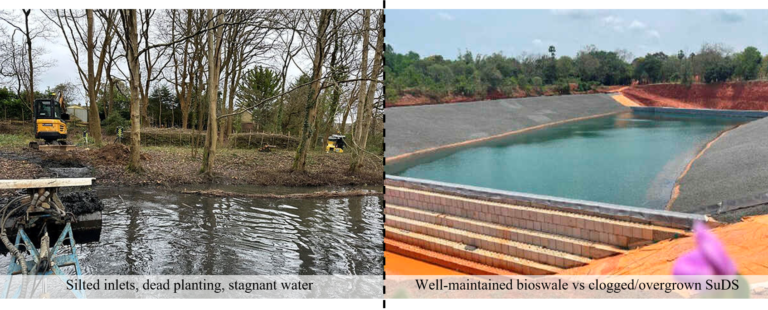
Image 2: Performance Contrast in Sustainable Drainage Systems
Social acceptance further complicates implementation. In Newcastle, proposals to expand rain gardens and green streets linked to Grey Street improvements raised concerns among local businesses about access and deliveries. Similar tensions are evident in Indian cities, where street space often supports informal economies and livelihoods, making spatial reallocation politically sensitive.
Spatial Justice and Uneven Urban Resilience
From a spatial justice perspective, BGI frequently reinforces existing inequalities. Investment tends to concentrate in high-visibility central areas, while peripheral neighbourhoods—both in Newcastle and Indian cities—remain more exposed to flooding and environmental stress.
BGI holds significant potential, but these reflections suggest it must be understood as a long-term social commitment. Urban resilience depends not only on design quality, but on ongoing care, clear governance, and decisions about who is prioritised in the urban landscape.
Resources
CIRIA (n.d.) Blue–Green Infrastructure reports. Available at: https://www.susdrain.org/news/articles/new_blue-green_infrastructure_reports.html (Accessed: 02/01/2025).
Consumer Scotland (2023) Overcoming barriers to the adoption of blue-green infrastructure. Available at: https://consumer.scot/publications/overcoming-barriers-to-the-adoption-of-blue-green-infrastructure-html/ (Accessed: 02/01/2025).
Surrey County Council (n.d.) Green and blue infrastructure: best practice and case studies. Available at: https://www.surreycc.gov.uk/community/climate-change/what-are-we-doing/green-and-blue-infrastructure (Accessed: 02/01/2025).
weADAPT (n.d.) Urban green infrastructure: an introduction. Available at: https://weadapt.org/knowledge-base/cities-and-climate-change/urban-green-infrastructure-an-introduction/ (Accessed: 02/01/2025).
Image References
Image 1: https://www.northumberlandgazette.co.uk/news/politics/council/new-image-reveals-how-newcastles-grey-street-could-be-transformed-3636875 (Accessed: 02/01/2025).
Image 2: https://timesofindia.indiatimes.com/city/coimbatore/opposition-to-fill-coimbatores-chinnavedampatti-lake-with-treated-water-mounts/articleshow/123607769.cms (Accessed: 02/01/2025).
