Blue–Green Infrastructure for Urban Mental Well-Being
Blue–Green Infrastructure: Can Nature Fix Our Urban Minds?
Introduction
Many factors contribute to the occurrence of mental health disorders, including social, psychological, and biological influences, as well as the characteristics of the environment in which we live, particularly urban settings. Living in a city can support people’s well-being by facilitating social networks and providing access to various services, including healthcare; however, certain aspects of urban life, such as air pollution, limited space, and noise, can negatively affect health. Within cities, green and blue spaces have been linked to better mental health outcomes, such as reduced risk of depressive symptoms and psychological distress. (Gascon et al., 2015).
Enter Blue–Green Infrastructure
Blue spaces are defined by the presence of water, such as lakes, rivers, or coastal areas. Green spaces may include water features, but are mainly characterized by vegetation like grass, trees, and other plants. According to Natural Resources Wales (NRW), green spaces and their networks include parks, community gardens, trees, woodlands, hedgerows, informal spaces, allotments, food-growing sites, and bodies of water such as rivers, canals, lakes, ponds, and coastal areas. “Green infrastructure” refers to the interconnected network of all these spaces (Geary et al., 2023).
Urbanization problems
Urbanization-related problems from city structure and human activities include:
- Air pollution
- Noise pollution
- Urban heat island effect
- Flood risk and water management
- Reduction of green space and biodiversity
- Urban inequalities
Why Nature Works on the Brain
Living near water coasts, lakes, or rivers supports better mental health (Pasanen et al., 2019). Green infrastructure fosters social connections in neighborhoods. Greener areas feel friendlier, and parks or open spaces allow planned gatherings and casual encounters, strengthening social cohesion and trust (Townshend et al., 2022).
Spending time in natural environments is linked to:
- improved mood
- lower cortisol levels
- reduced mortality
- enhanced cognitive function
Case Study
The Niasarm Canal, one of Isfahan’s largest canals, starts near Marnan Bridge, passes through the Lanban district, and runs east across the city, almost parallel to the Zayande Rood River. With more water and green space than other canals, it is the city’s most popular blue and green area, surrounded mostly by residential land, while key commercial areas are at Charbagh Street.
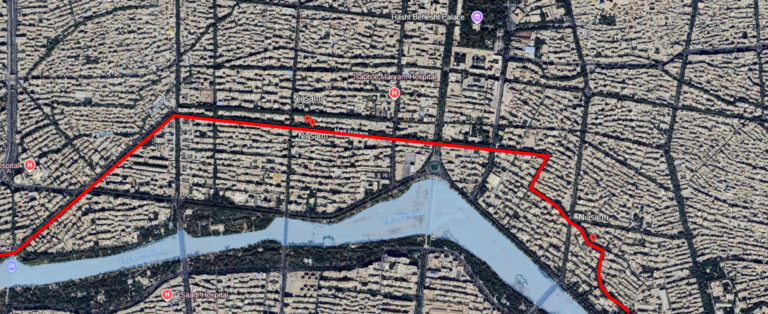
Fig 1: The Niasarm route is positioned horizontally along the Zayandeh Rud River.
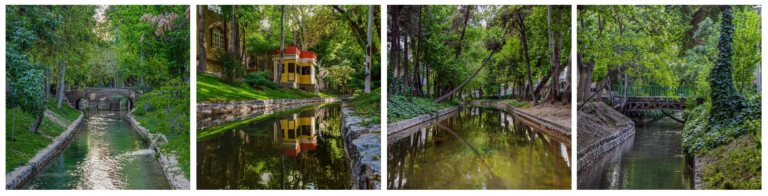
Fig 2
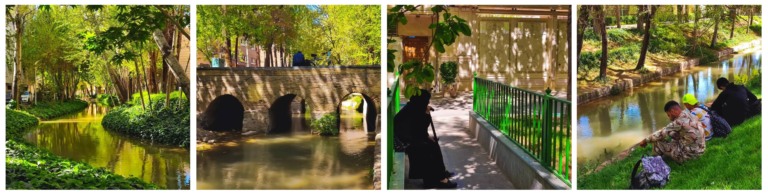
Fig 3
The canal attracts visitors, has a good pedestrian network, and is easily accessible via a nearby underground station. Its plants and flowing water create fresh air and a cool breeze, making the area 2–3°C cooler than the rest of the city in summer (Vaeztavakoli et al., 2018).
To better understand the atmosphere of this area and hear the surrounding sounds, you can access videos of this location through the links below:
https://youtu.be/yb-sg0MAk40?si=Hppp06_m0GNVJ6bU
https://youtu.be/ARP-49QqA9w?si=-atuJPeyIRrZ70rd
Conclusion
Access to urban green and blue spaces is linked to better mental health, including lower risks of depression and psychological distress, supporting overall psychological well-being (Gascon et al., 2015).
Urban green spaces can reduce environmental health risks by improving air and water quality, buffering noise, and mitigating the effects of extreme events. They also promote health and well-being by facilitating stress relief, relaxation, physical activity, social interaction, and community cohesion, leading to enhanced mental health, physical fitness, cognitive and immune function, and lower overall mortality (WHO, 2016).
Reference
Geary, R.S., Thompson, D.A., Garrett, J.K., et al., 2023. Green–blue space exposure changes and impact on individual-level well-being and mental health: a population-wide dynamic longitudinal panel study with linked survey data. Southampton (UK): National Institute for Health and Care Research. Public Health Research, No. 11.10.
Gascon, M., Triguero-Mas, M., Martínez, D., Dadvand, P., Forns, J., Plasència, A. & Nieuwenhuijsen, M.J., 2015. Mental health benefits of long-term exposure to residential green and blue spaces: A systematic review. International Journal of Environmental Research and Public Health, 12(4), pp.4354–4379.
Pasanen, T.P., White, M.P., Wheeler, B.W., Garrett, J.K. & Elliott, L.R., 2019. Neighbourhood blue space, health and wellbeing: The mediating role of different types of physical activity. Environment International, 131, p.105016.
Townshend, T., 2022. Healthy Cities? Design for Well-being. London: Routledge. Chapter 5: Green infrastructure for health and well-being.
Vaeztavakoli, A., Lak, A. & Yigitcanlar, T., 2018. Blue and green spaces as therapeutic landscapes: Health effects of urban water canal areas of Isfahan. Sustainability, 10(11), p.4010.
World Health Organization, 2016. Urban green spaces and health: A review of evidence. Copenhagen: WHO Regional Office for Europe.
Figure 1: Fahimi, F., 2026. Adapted from Google Earth image; edited by the author.
Figure 2: Harirsaz_photography, 2024. Instagram post. Available at: View Instagram post
Figure 3: mehdi.shahdeli, n.d. Instagram profile. Available at: View Instagram post
Cover image source: Harirsaz_photography, 2024. Instagram post. Available at: View Instagram post



I think your blog chosen a very meaningful topic, because mental health is becoming an increasingly important issue in many cities. The structure of your article is very clear, you first explain the urban problems, then introduce the benefits of blue-green infrastructure, and finally use the Niasarm Canal as a case study, so it’s easier to understand. I also really like the pictures you show on your blog, because they give me a more intuitive feel for the atmosphere of the canal space.
I prefer you connects nature with people’s daily feelings in your blog, such as relaxation, breathing fresh air and social interaction. I have a similar feeling myself. When I walk by the water or near the green space, I do feel less stress. This is also the same as Gascon et al. (2015) is related to the view that they believe that long-term exposure to green and blue space can help improve mental health.
However, I also think your blog can be more critical. For example, I’m thinking: can everyone enjoy this kind of space equally? If the canal becomes more attractive, will it mainly serve tourists and middle-class users, or will it also serve local residents? Also, mental well-being is not only about having water and trees. Safety, seating, shade, maintenance and walkability are also important for people’s everyday experience. Kabisch et al. (2017) argued that urban green space should consider social justice, because different groups may not have equal access to high-quality natural space. At the same time, it also reminds me that in my own studio design, I should not only design beautiful open spaces, but also think about who is using it, who will feel welcome, and who may be excluded.
Reference:
1.Gascon, M., Triguero-Mas, M., Martínez, D., Dadvand, P., Forns, J., Plasència, A. & Nieuwenhuijsen, M. (2015) ‘Mental Health Benefits of Long-Term Exposure to Residential Green and Blue Spaces: A Systematic Review’, International journal of environmental research and public health, 12(4), pp. 4354–4379.
2.Kabisch, N., van den Bosch, M. & Lafortezza, R. (2017) ‘The health benefits of nature-based solutions to urbanization challenges for children and the elderly – A systematic review’, Environmental research, 159pp. 362–373.