

Reflecting on the blog’s discussion about the UK’s ambitious housing targets and the challenges of balancing rapid development with sustainability, I recall a lecture at the Farrell Centre in Newcastle. The speaker highlighted the increasing trend of allocating green belt land, which constitutes 13% of England’s total land area (Koster, 2023), for affordable housing projects. This practice has led to the emergence of the term “green-grey belt,” signifying areas of green belt land being repurposed for development. The UK’s National Planning Policy Framework (NPPF) has undergone reforms to address housing shortages. One significant change is the introduction of “golden rules” for green belt development, which stipulate that any housing projects on green belt land must include at least 50% affordable housing (Pinsent Masons, n.d.).
However, this approach has sparked debate. Critics argue that developing green belt land undermines its purpose of preventing urban sprawl and preserving natural landscapes, as well as whether they truly address the housing needs of lower-income populations. (Lange, 2024).
A study by Koster (2023) on the welfare effects of green belt policy in England found that while greenbelts generate positive amenity effects, they also restrict housing supply, driving up property prices. The research shows that greenbelts reduce housing density by more than 50%, ultimately leading to higher property prices, particularly in cities like London, Manchester, and Birmingham. Relaxing these restrictions could significantly decrease housing prices, potentially improving affordability. However, such a move would come at the cost of sacrificing the amenity benefits provided by green space. Interestingly, the study suggests that the amenity effect—stemming from the presence of green areas—slightly outweighs the housing supply effect, which reflects the need to accommodate more people in limited space. This conclusion is somewhat surprising, given the general skepticism among economists toward excessive planning regulations. The findings suggest that prioritizing inner-city development is preferable to sacrificing green spaces.
To address housing affordability while protecting the green belt, alternative strategies such as home-sharing have been proposed. Koster (2024) recommends home-sharing, where multiple individuals or friends jointly purchase a home and share costs, as a practical short-term solution to make better use of the existing housing stock. He advocates for more flexible regulations to support such arrangements, making them more accessible to a broader population.
The concept of home-sharing as an affordable housing strategy is not new but remains underutilized. Harten and Boeing (2024) found that shared rentals can provide a critical pathway into the housing market for low-income individuals, particularly in unaffordable cities. Their study of rental listings in Los Angeles demonstrated that shared rentals were both more widely available and more affordable than entire housing units, offering a vital option for low-income renters.
In conclusion, the balance between housing development and green belt preservation is complex. Introducing home-sharing as an alternative housing strategy, alongside higher-density multi-family housing over single-family homes or townhouses, could help alleviate affordability issues without compromising green spaces.
References
1. Koster H. (2023) The Welfare Effects of Greenbelt Policy: Evidence from England. Available at: https://academic.oup.com/ej/article/134/657/363/7276598?login=false&utm_source=etoc&utm_campaign=ej&utm_medium=email (Accessed 07/01/2025)
2. Koster H. (2024) The housing market is under pressure: what can we do? Available at: https://vu.nl/en/research/the-housing-market-is-under-pressure-what-can-we-do (Accessed 07/01/2025)
3. Harten J. G., Boeing G. (2024) Access to the exclusive city: Home sharing as an affordable housing strategy. Available at: https://journals.sagepub.com/doi/10.1177/00420980241258297 (Accessed 07/01/2025)
4. Pinsent Masons (2024) Rethink ‘golden rules’ for green belt development, UK government urged. Available at: https://www.pinsentmasons.com/out-law/news/housing-delivery-risk-nppf-green-belt (Accessed 07/01/2025)
5. Lange M. (2024) What are the “green belt” and the “grey belt”? Available at: https://www.centreforcities.org/blog/what-are-the-green-belt-and-the-grey-belt/ (Accessed 07/01/2025)
Can sustainable housing meet the UK’s Ambitious Delivery Goals?
With the Labour Party’s rise to power, the UK has been promised the deliverance of 1.5 million new homes over the next parliament while facing unprecedented challenges such as climate crisis and a growing social inequality (The Planner, 2024). Although admirable, can the balance between quantity and quality, speed and sustainability truly be achieved?
We’ll explore the Labour Party’s proposed housing policies and their potential to reshape the UK’s housing design, economically and socially.
WHAT IS SUSTAINABLE HOUSING DESIGN?
Sustainable housing design is design that considers all sorts of environmental, social and even economic impacts and provides solutions to minimise those in hopes of enhancing the quality of life for residents. This involves considerations such as energy-efficient technologies, utilising eco-friendly building materials, and designing for water conservation and biodiversity. For example, features like solar panels, green roofs, and rainwater harvesting systems help reduce resource consumption and carbon emissions. Importantly, sustainable housing also addresses social dimensions by fostering inclusivity, accessibility, and community interaction (Ravetz, 2008).
Labour’s Housing vision
The Labour Party’s housing policies promise:
- Increased delivery of affordable and social housing
- Commitment to building energy- efficient homes aligned with net-zero carbon targets
- A focus on community-based, mixed-use developments to foster inclusivity (Labour Party Manifesto, 2024)
With such an ambitious -but not so new- approach from the Labour Party, such promises have definitely raised some important questions about its implementations.
Sustainability And Delivery Targets
One could argue, labour’s plans provide a blueprint for change, with their success mainly depending on balancing rapid delivery with environmental, economic, and social concerns. Let’s dissect these a little further:
Environmental impact
One could argue, sustainability is but a cornerstone of Labour’s housing strategy. By reinforcing the use of low-carbon construction materials like timber, renewable technologies such as solar panels, and urban greening practices, the policy could thus set a path to new environmental standards to be implemented in the United Kingdom (UK Green Building Council, 2023).
However, the real challenge lies in ensuring that with rapid delivery, the sustainability aspect of development, is not compromised. Large-scale construction projects often face pressure to cut costs, which can lead to the use of less eco-friendly materials for example and this is something that we -built environmental .
The BedZED development in London is a beautiful example that demostrates how sustainability could be successfully integrated into housing, but something we should be aware of is how replicating such models at scale requires significant investment and like we know… political will.
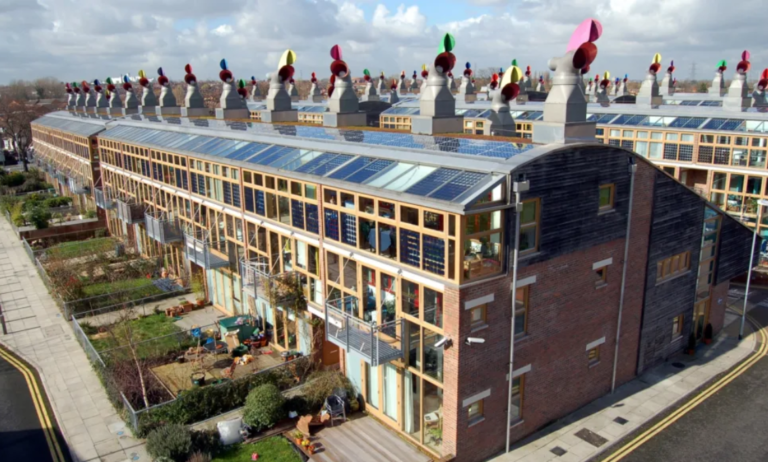
BedZED village, South London. Author: Bioreginal Projects, 2019
Economic Impact
Sustainable housing offers long-term economic benefits through energy savings and reduced healthcare costs linked to better air quality and living conditions. Labour’s focus on affordable housing and green retrofitting could also create jobs in construction, design, and renewable energy sectors.
Yet, the upfront costs of sustainable materials and technologies does remain an argued barrier. Developers often hesitate to adopt these practices without clear incentives or subsidies, which can a divide between affordability and quality.
Social Impact
Housing design profoundly affects how people live, work, and connect. Labour’s proposals for mixed-tenure developments and community-focused designs could strengthen social cohesion and reduce inequality (Town and Country Planning Association, 2023).
Goldsmith Street in Norwich, a council housing project built to Passivhaus standards, is an excellent example of how sustainable design can provide affordable, high-quality homes. The project’s emphasis on shared spaces fosters community interaction while drastically reducing residents’ energy costs (RIBA, 2019).
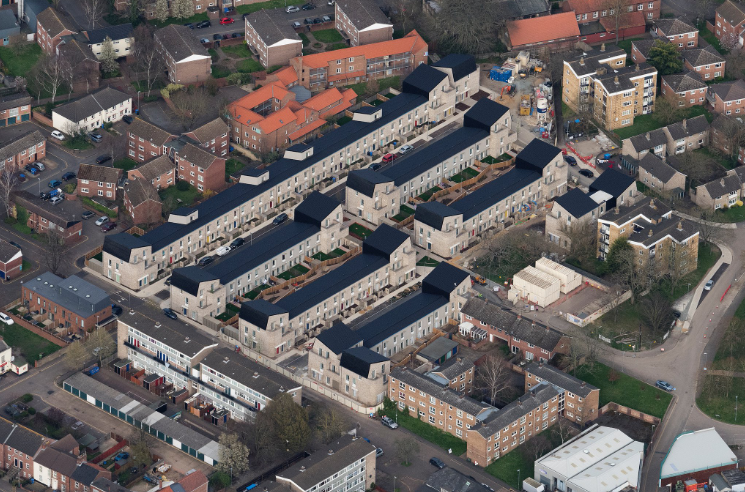
Goldsmith Street, Author: www.rodedwards.com, 2020
The challenge is ensuring that these benefits reach all demographics and that it is of course inclusive for everyone. Without firm oversight, profit-driven developers may prioritize higher-value housing, marginalizing vulnerable groups.
Final thoughts on overcoming these challenges:
In order to achieve its ambitious housing targets while maintaining sustainability as a key factor in housing design in the UK , Labour must address several key challenges, some of these could be by:
- Offering financial incentives such as tax breaks or subsidies can encourage developers to use sustainable materials and technologies. Government funding programs could bridge the gap between affordability and quality with no doubt
- Simplifying planning and building regulations. These could potentially accelerate project timelines while ensuring compliance to sustainability standards. A clear framework would reduce bureaucratic delays without compromising quality of the projects
- Partnerships between local councils, private developers, and non-profit organizations would allow for a great collaboration of resources and expertise. By involving communities in the planning process, developments could also better address local needs and preferences
- And by Investing in training programs for green construction techniques and renewable technologies which coild eventually support the delivery of Labour’s vision.
Looking ahead
Labour’s housing plan is an opportunity to redefine the UK’s approach to housing development. However, success will depend on robust implementation, political will, and active community engagement.
Looking ahead, sustainable housing can definitely become more than a policy goal and it can serve as a model for resilience in the face of climate and social challenges. By prioritising sustainable and inclusive design, and innovation, Labour could lay the foundation for a housing sector that meets the needs of both current and future generations.
Ultimately, the question remains: Can the UK deliver on its ambitious promises? The answer lies in our collective commitment to building not just homes, but thriving, sustainable communities.
References:
Bioregional Projects, n.d. BedZED: An overview of the UK’s first large-scale sustainable housing development. (online) Available at: https://www.bioregional.com/bedzed (Accessed 25 Nov. 2024).
Labour Party Manifesto, 2024. Labour promises to restore mandatory housing targets and build 1.5 million homes. (online) The Planner. Available at: https://www.theplanner.co.uk/2024/06/13/manifesto-labour-promises-restore-mandatory-housing-targets-10-year-infrastructure (Accessed 25 Nov. 2024).
Levitt, D, and MacCafferty, J. 2019, The Housing Design Handbook, Routledge
Ravetz, J., 2008. Environment and Sustainable Development. 2nd ed. London: Routledge.
Royal Institute of British Architects (RIBA), 2019. Goldsmith Street: Winner of the 2019 Stirling Prize. [online] Available at: https://www.architecture.com/awards-and-competitions-landing-page/awards/riba-stirling-prize/goldsmith-street [Accessed 25 Nov. 2024].
Town and Country Planning Association (TCPA), 2023. Community-focused design principles for housing developments.
UK Green Building Council, 2023. Sustainability in Housing: A Blueprint for Net-Zero Construction. [online] Available at: https://www.ukgbc.org/resources/publications/sustainable-housing [Accessed 25 Nov. 2024].

Reflecting on the blog’s discussion about the UK’s ambitious housing targets and the challenges of balancing rapid development with sustainability, I recall a lecture at the Farrell Centre in Newcastle. The speaker highlighted the increasing trend of allocating green belt land, which constitutes 13% of England’s total land area (Koster, 2023), for affordable housing projects. This practice has led to the emergence of the term “green-grey belt,” signifying areas of green belt land being repurposed for development. The UK’s National Planning Policy Framework (NPPF) has undergone reforms to address housing shortages. One significant change is the introduction of “golden rules” for green belt development, which stipulate that any housing projects on green belt land must include at least 50% affordable housing (Pinsent Masons, n.d.).
However, this approach has sparked debate. Critics argue that developing green belt land undermines its purpose of preventing urban sprawl and preserving natural landscapes, as well as whether they truly address the housing needs of lower-income populations. (Lange, 2024).
A study by Koster (2023) on the welfare effects of green belt policy in England found that while greenbelts generate positive amenity effects, they also restrict housing supply, driving up property prices. The research shows that greenbelts reduce housing density by more than 50%, ultimately leading to higher property prices, particularly in cities like London, Manchester, and Birmingham. Relaxing these restrictions could significantly decrease housing prices, potentially improving affordability. However, such a move would come at the cost of sacrificing the amenity benefits provided by green space. Interestingly, the study suggests that the amenity effect—stemming from the presence of green areas—slightly outweighs the housing supply effect, which reflects the need to accommodate more people in limited space. This conclusion is somewhat surprising, given the general skepticism among economists toward excessive planning regulations. The findings suggest that prioritizing inner-city development is preferable to sacrificing green spaces.
To address housing affordability while protecting the green belt, alternative strategies such as home-sharing have been proposed. Koster (2024) recommends home-sharing, where multiple individuals or friends jointly purchase a home and share costs, as a practical short-term solution to make better use of the existing housing stock. He advocates for more flexible regulations to support such arrangements, making them more accessible to a broader population.
The concept of home-sharing as an affordable housing strategy is not new but remains underutilized. Harten and Boeing (2024) found that shared rentals can provide a critical pathway into the housing market for low-income individuals, particularly in unaffordable cities. Their study of rental listings in Los Angeles demonstrated that shared rentals were both more widely available and more affordable than entire housing units, offering a vital option for low-income renters.
In conclusion, the balance between housing development and green belt preservation is complex. Introducing home-sharing as an alternative housing strategy, alongside higher-density multi-family housing over single-family homes or townhouses, could help alleviate affordability issues without compromising green spaces.
References
1. Koster H. (2023) The Welfare Effects of Greenbelt Policy: Evidence from England. Available at: https://academic.oup.com/ej/article/134/657/363/7276598?login=false&utm_source=etoc&utm_campaign=ej&utm_medium=email (Accessed 07/01/2025)
2. Koster H. (2024) The housing market is under pressure: what can we do? Available at: https://vu.nl/en/research/the-housing-market-is-under-pressure-what-can-we-do (Accessed 07/01/2025)
3. Harten J. G., Boeing G. (2024) Access to the exclusive city: Home sharing as an affordable housing strategy. Available at: https://journals.sagepub.com/doi/10.1177/00420980241258297 (Accessed 07/01/2025)
4. Pinsent Masons (2024) Rethink ‘golden rules’ for green belt development, UK government urged. Available at: https://www.pinsentmasons.com/out-law/news/housing-delivery-risk-nppf-green-belt (Accessed 07/01/2025)
5. Lange M. (2024) What are the “green belt” and the “grey belt”? Available at: https://www.centreforcities.org/blog/what-are-the-green-belt-and-the-grey-belt/ (Accessed 07/01/2025)