Engaged or just consulted? The struggle of finding meaningful engagement in UK Placemaking Plans
Across the UK, most placemaking plans now come with a promise: this is your chance to shape the future of your area. Through exhibitions, surveys and workshops, participation is presented as central to planning and urban design. Yet a pattern often emerges. The opportunity to contribute is there, but the ability to exert real influence feels far less certain.
In theory, placemaking means designing places not just for people, but with people. It should reflect local identity, everyday life and community needs (Project for Public Spaces, 2007). UK planning policy has embedded engagement within plan-making and development processes. However, as Baker (2007) notes, once participation becomes formalised, it can quite often function less like an open conversation and more like a procedural requirement.
Consultation or Conversation?
This box-ticking risk is clear in how consultations are structured. Public exhibitions often present proposals that feel largely decided, supported by polished visuals and carefully framed arguments. Feedback is invited, but within limits. Surveys guide people towards set responses, while workshops tend to refine rather than question core concepts. Similar concerns emerged around Newcastle Quayside’s “Plot 12”, where residents criticised limited engagement opportunities, poor visibility of events, and difficulties submitting objections through the council’s online portal (Northern Insight, 2020).
 Figure 1: A polished render from Newcastle’s Plot 12 development, highlighting how engagement can occur once proposals already appear visually resolved. (Source: BBC News (2023), Available at: https://www.bbc.co.uk/news/uk-england-tyne-65167479)
In this sense, participation can operate as risk management for developers and councils, as communities are consulted, but the project direction remains largely unchanged. As Innes and Booher (2004) suggest, tightly controlled participation can struggle to produce meaningful change and instead reinforce existing decision-making structures.
Arnstein’s “ladder of participation” (1969) is useful here. Much of what is presented as engagement actually amounts to consultation, where people are heard but not given genuine influence. Within many placemaking plans, participation becomes visible and measurable, but not necessarily meaningful.
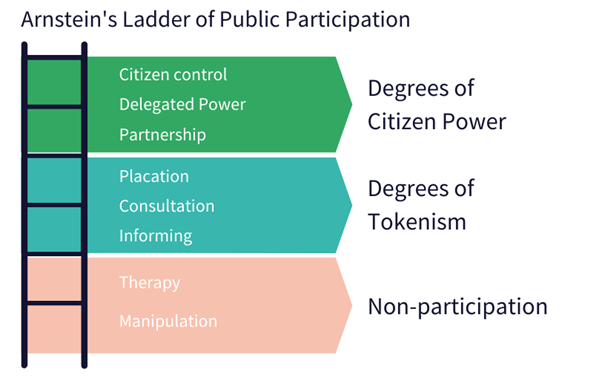 Figure 2: Arnstein’s (1969) “Ladder of Participation”, illustrating the difference between consultation and genuine citizen power. (Source: Commonplace (2023), Available at: https://www.commonplace.is/blog/arnsteins-ladder-of-citizens-participation-explained)
From my placement experience, this creates a noticeable disconnect. Planning documents often present engagement as a strength, yet it can be difficult to see how public input has materially changed the final outcome. Participation can begin to feel more like building support for proposals rather than shaping them from the outset.
Learning from Newport
However, this is not always the case. A strong example I encountered was the Stride Treglown Newport Placemaking Plan. The project embedded engagement early on, involving over 1,700 residents, businesses and community groups through surveys, workshops and face-to-face discussions. This feedback directly informed the Plan’s “60 Big Ideas for Newport”, including walking routes, public spaces and community initiatives (Stride Treglown, 2025). What made Newport convincing was not simply the scale of engagement, but the visibility of its impact within the final proposals. Rather than participation sitting alongside the design process, it became part of how the vision itself was shaped.
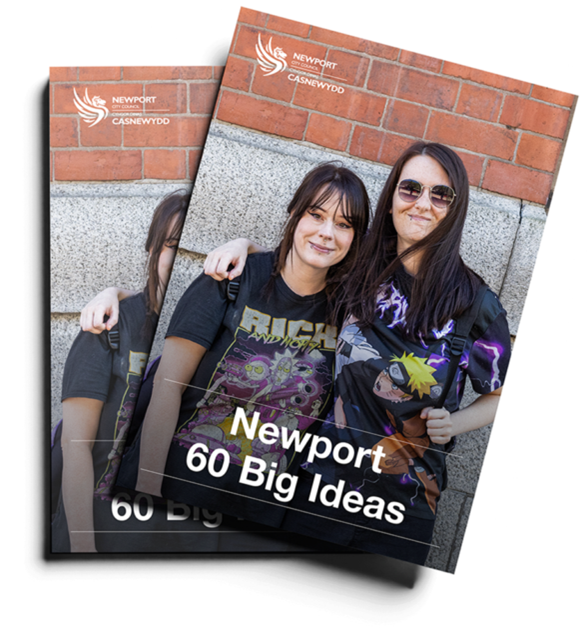 Figure 3: ’60 Big Ideas for Newport’, where residents and community groups shared their “hopes, frustrations and ideas for the city’s future”. (Source: Stride Treglown (2026), Available at: https://stridetreglown.com/projects/newport-placemaking-plan/)
That said, examples like Newport remain difficult to achieve consistently. Placemaking plans operate within tight timelines, funding pressures and policy constraints, limiting flexibility. Participation is also shaped by who can engage. Those with time, confidence or planning knowledge are often overrepresented, while others remain excluded (Cooke and Kothari, 2001).
The issue, then, is not whether participation exists, but whether it moves beyond consultation into genuine engagement. While meaningful engagement is possible, too many placemaking plans experience the same gap of relying on consultation processes that ask communities to respond to decisions rather than help dictate them. Bridging that gap means involving communities in shaping proposals from the beginning, rather than inviting feedback once key decisions have already been made.
References
Arnstein, S.R. (1969) ‘A Ladder of Citizen Participation’, Journal of the American Institute of Planners, 35(4), pp. 216–224.
Baker, M. (2007) ‘Planning, policy and participation: The UK experience’, Planning Theory & Practice, 8(1), pp. 31–50.
Cooke, B. and Kothari, U. (2001) Participation: The New Tyranny? London: Zed Books.
Innes, J.E. and Booher, D.E. (2004) ‘Reframing public participation: Strategies for the 21st century’, Planning Theory & Practice, 5(4), pp. 419–436.
Northern Insight (2020) Newcastle City Council and developers come under attack for lack of full consultation. Available at: https://northern-insight.co.uk/media/newcastle-city-council-and-developers-come-under-attack-for-lack-of-full-consultation/ (Accessed: 2 May 2026).
Project for Public Spaces (2007) What is Placemaking? Available at: https://www.pps.org/article/what-is-placemaking (Accessed: 29 April 2026).
Stride Treglown (2026) Newport Placemaking Plan. Available at: https://media.stridetreglown.com/wp-content/uploads/2025/07/11085240/250619_Newport-Placemaking-Plan_Stage-3_FINAL_1_resize-for-web.pdf (Accessed: 1 May 2026).



I found this to be a thought-provoking exploration on the almost tokenistic nature of the public engagement system in the UK planning system.
I particularly resonated with the focus on ‘engaged vs consulted’ using Arnstein’s ladder for participation to highlight how the formality of consultation can be misused as a tool for risk management rather than genuine resident led design principles. (Arnstein, S.R, 1969) Reading your perspective of this from experience in the private sector was interesting as both the private and public sector seem to face similar issues. During my placement at Wirral Council, I witnessed the same tensions play out during the consultation process of the Local Plan; despite extensive public feedback, the real opportunity for community led decisions felt severely restricted until the plan was already heavily formalised and ready to be published. This reinforces the significance of critical analysis for us as future urban designers and has inspired me to apply this lens to how we approach community-led design.
For further reading, I recommend looking into the work around ‘co-production’ coined by Mitlin (2008). She argues that moving beyond Arnstein’s top-down ladder requires a collaborative framework where residents and professionals co-manage the design process ‘which enables marginalised communities to strengthen their organisational capacity and exert influence on the state to achieve pro-poor political change.’ The example of Newport gave me hope for this being achieved in the future.
Overall, your post left me dwelling on another question: if the planning system operates within strict institutional timelines and market-driven funding pressures (Cooke and Kothari, 2001), can urban designers truly achieve the level of engagement seen in Newport without a fundamental legislative shift in how developments are financed and approved?
References
Arnstein, S.R. (1969) ‘A Ladder of Citizen Participation’, Journal of the American Institute of Planners, 35(4), pp. 216–224.
Cooke, B. and Kothari, U. (2001) Participation: The New Tyranny? London: Zed Books.
Mitlin, D. (2008) ‘With and beyond the state—co-production as a route to political influence, power and transformation for grassroots organizations’, Environment and Urbanization, 20(2), pp. 339–360.
Stride Treglown (2026) Newport Placemaking Plan. Available at: https://media.stridetreglown.com/wp-content/uploads/2025/07/11085240/250619_Newport-Placemaking-Plan_Stage-3_FINAL_1_resize-for-web.pdf (Accessed: 16 May 2026).
I really enjoyed how clearly you contrasted the “box-ticking” often seen in UK planning like the Newcastle Plot 12 example with the genuinely collaborative approach taken in Newport.
What I found most interesting was your observation about polished visual renders. You perfectly highlight how presenting highly resolved graphics at public exhibitions can inadvertently weaponise design professionalism. It subtly signals to the community that the project is a “done deal,” actively shutting down the co-design process and keeping citizens firmly stuck on the lower “consultation” rungs of Arnstein’s ladder.
Going forward, something for you to think about is the medium of this engagement. You pointed out that traditional workshops overrepresent those with the spare time and confidence to attend. To bridge this gap, how might digital placemaking tools disrupt the “usual suspects” paradigm? Research suggests that blending physical workshops with digital civic technologies can help democratise participation and reach historically excluded groups (Fredericks et al., 2016). Furthermore, as Legacy (2017) argues, simply tweaking consultation methods might not be enough; we may need to rethink statutory planning frameworks entirely to move from developer risk-management to genuine power-sharing. Achieving truly equitable urban spaces requires systemic shifts in how local, lived knowledge is valued alongside technical expertise (Fainstein, 2010).
References:
Fainstein, S. S. (2010). The Just City. Cornell University Press.
Fredericks, J., Hespanhol, L., & Tomitsch, M. (2016). ‘Not just another app: amplifying community voices through digital participation’. Proceedings of the 28th Australian Conference on Computer-Human Interaction.
Legacy, C. (2017). ‘Is there a crisis of participatory planning?’. Planning Theory, 16(4), 425-442.
Speaking from personal experience, I can confirm that often consultation can lean towards a tick box exercise, particularly at the later stages of plan making. Consultations are required at many stages of plan preparation, and the further through the process, the less likely any actual change will occur. Political pressure, budget constraints and timescales all limit the amount of change that can be implemented at these stages.
Often only those with background planning knowledge, or ample time to put into research, can effectively respond to these consultations with questions which are set through regulations rather than determined by the local authority. This can often skew the data collected through a consultation and make it appear that some issues are bigger than they are, as they are a concern for those able to respond but not necessarily the rest of the population (Culver and Howe, 2004). There is also the issue concerning the fact that often the only people who respond to a consultation are those who have concerns or issues. It’s rare that someone will respond if they are happy with what is being presented. This can also present a more negative picture than is in fact the case (Norton and Hughes, 2017).
The newly introduced 30-month plan making process will no doubt exacerbate this issue too, not allowing local authorities sufficient time to seek good quality engagement from residents as it requires at least 4 consultations within that time frame (Gov.uk, 2026).
References:
Culver, K. and Howe, P. (2004), Calling all citizens: The challenges of public consultation. Canadian Public Administration, 47: 52-75. https://doi.org/10.1111/j.1754-7121.2004.tb01970.x
Gov.uk (2026) Engaging the public when preparing a local plan. Available at: https://www.gov.uk/guidance/engaging-the-public-when-preparing-a-local-plan (Accessed: 18/05/2026).
Norton, P. and Hughes, M. (2017), Public consultation and community involvement in planning: A twenty-first century guide. Routledge.