What is Environmental Justice
Environmental justice means that every person has the right to a healthy environment, regardless of race, income or background. In practice, EJ aims to ensure that everyone has equal access to environmental benefits like clean air, parks and clean water. Communities should also share environmental burdens, such as pollution and waste facilities in a fair way. Furthermore, communities must have a real voice in environmental decision-making. Historically, the modern EJ movement began in the US when marginalized communities protested toxic dumping in the 1980s. Since then EJ has grown into a broad principle of distributive justice, procedural justice and recognition justice.
Unfairness in the city
In many cities, the burdens and benefits are terribly unbalanced. Low-income or minority neighborhoods tend to have far fewer parks and trees than wealthy districts. Indeed, Sustainability Directory researchers (2025) found that busy roads and factories are unreasonably built near disadvantaged communities, exposing them to poor air quality. This imbalance has real health consequences: higher pollution and fewer facilities lead to more asthma, stress, and other illnesses in marginalized areas. Yale researchers (2020) pointed out that low-income communities usually lack trees, parks and other open green spaces. So that, residents in these communities cannot enjoy the various benefits brought by nature. In short, environmental inequality contributes to worse health and shorter lives for the poor.
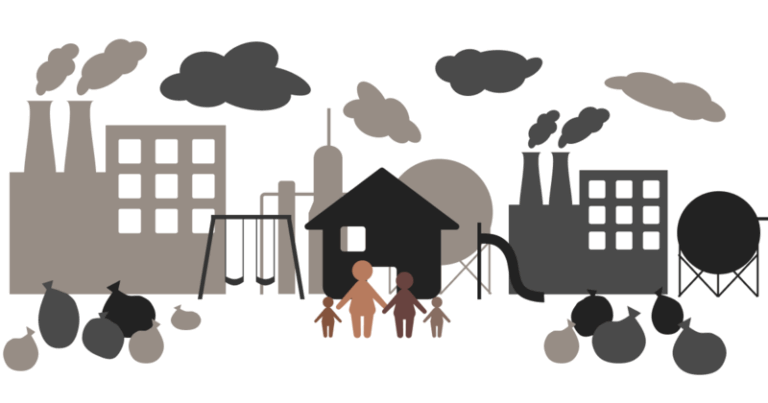
The surrounding environment of some communities
Shanghai’s Green Space Justice: A Resident’s Observation
I have lived in Shanghai for twenty years and I have seen how green spaces are not shared equally. In the suburbs there are many large parks with big trees, but in the busy downtown we have only small gardens or open plazas. Feng et al. (2025) found that parks in the city center are smaller and more crowded, while larger parks lie in the outskirts. This matches what I have seen: in the center we often have only pocket gardens or playgrounds rather than full-size parks.
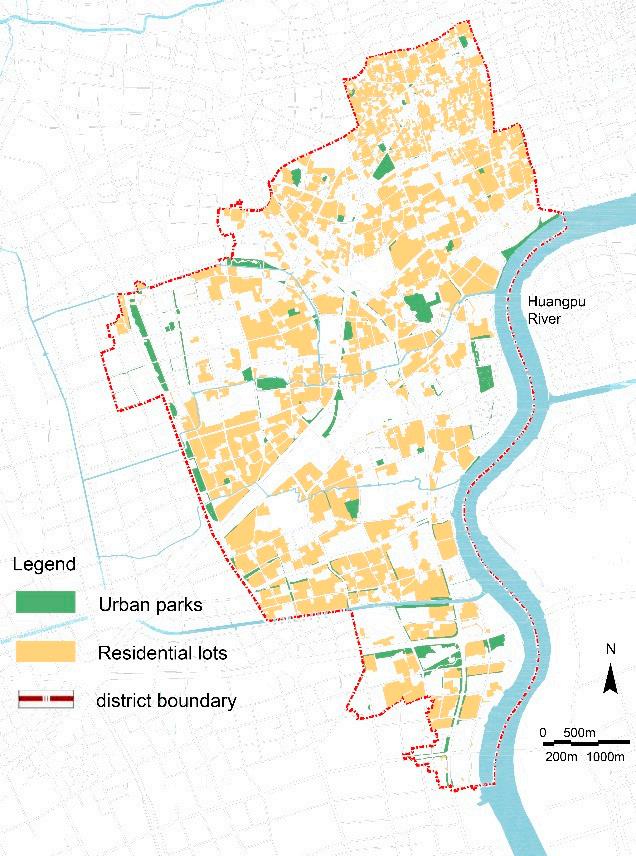
The distribution of residential areas and urban parks in the center of Shanghai
When I walk around the old city center, I see few green areas. I remember finding only a tiny playground or a row of street trees. If I want a big park, I must go far outside the center. Wang et al. (2025) report that the central city “suffer from a shortage of accessible green spaces,” while most of the large parks are in outer districts. Shanghai journalist Zhou (2022) even calls downtown a “sore spot” where small and medium parks are very scarce, leading to an uneven distribution of green space.
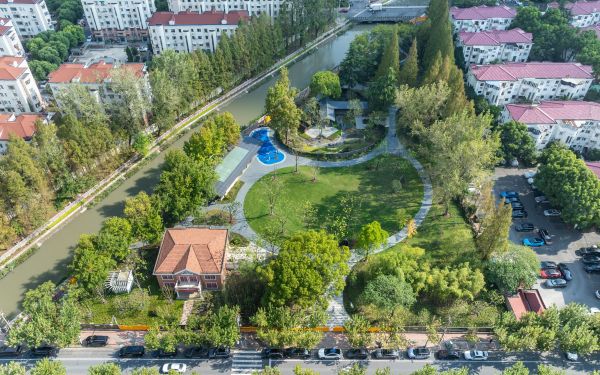
The common pocket parks in the center of Shanghai
Recently Shanghai has tried to add small parks in crowded areas. Shanghai plans to create around 300 pocket parks by 2025. I have seen some of these in my neighborhood: a small green corner with benches or a renovated lane garden. These pocket parks are good and bring more plants and seats, but they are still very small and far from making green space equal for everyone.
Despite the new pocket parks, big parks remain far from downtown homes. Even after living here two decades, I feel the city centre still needs more green areas. People in older parts of the city still walk a long way to find a park. I hope the city keeps building small parks and planting street trees so that all residents can enjoy green space, not just people near the big new parks.
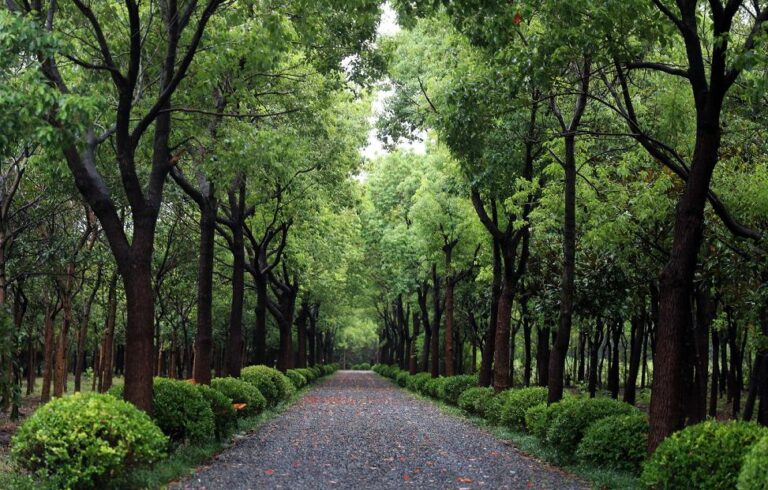
The green park in the suburbs of Shanghai
Understanding and Reflection
From the studies and case examples, I have realized that urban designers can improve environmental equity through planning and design. They can build more parks and open spaces in communities short on green space because research shows that public green spaces help reduce stress and improve health. This is particularly important for low-income groups. Designers and planners should also listen to community residents and involve them in the processes of urban projects. This approach can make resource allocation fairer and ensure that everyone’s needs are considered. By doing this, future cities can provide clean environments and healthy living conditions more equitably for everyone.
Reference list
Feng, Y., Huang, S., Chen, S., Guan, C., Li, Y., Tan, Q., Jin, Y., Yang, X. and Xu, Y. (2025). Dataset for visitations of public green spaces in Shanghai, China. Scientific Data, [online] 12(1). doi:https://doi.org/10.1038/s41597-025-05581-w.
Sustainability Directory (2025). What Is Environmental Justice in Urban Planning? → Question. [online] Pollution → Sustainability Directory. Available at: https://pollution.sustainability-directory.com/question/what-is-environmental-justice-in-urban-planning/.
Taylor, D. and Torres, G. (2020). Yale Experts Explain Environmental Justice. [online] sustainability.yale.edu. Available at: https://sustainability.yale.edu/explainers/yale-experts-explain-environmental-justice.
Tone, S. (2022). How Many Parks Make a City? [online] #SixthTone. Available at: https://www.sixthtone.com/news/1011450.
Wang, J., Jiang, H., Wang, M., Xiong, Y., Zhu, A. and Wang, F. (2025). Assessment of Spatial Equality and Social Justice of Urban Park Distribution from Park Category Perspective: Evidence from Shanghai, China. Sustainability, [online] 17(12), p.5474. doi:https://doi.org/10.3390/su17125474.
Images:
https://sustainability.yale.edu/explainers/yale-experts-explain-environmental-justice
https://www.mdpi.com/2071-1050/17/12/5474
https://www.shanghai.gov.cn/nw31406/20241225/3cb91ff270ea473291ddd1c70827abea.html
https://www.thepaper.cn/newsDetail_forward_14772646



Whilst there are clear patterns that show poorer areas have an unfair proportion of factories and busy roads, is it that they are put there because the area is poor or that the area becomes poorer because it sits so close to these undesirable forms of infrastructure? Do house prices decrease because a new factory has been built close by, thus causing those better off to leave the area and those with less means to move into the area. I would also be curious to see how the design quality of these developments impacts the area. Are there areas that are considered well off which do still have factories and busy roads but because they have been designed and integrated better it has less of a detrimental impact on the area and health outcomes? For example, the Fendi factory which sits in Tuscany has used green roofs to blend into the landscape (Archdaily, 2024). I would also consider that the implementation of new employment areas would have some positive effects on nearby communities as they provide better opportunities for work that is accessible to those living close by. This is a trade-off that lower income areas may be willing to make, a boost in the economy that unfortunately comes with higher pollution levels (Hanna, 2007). I enjoyed reading about your experience of green spaces within Shanghai and do agree that to achieve greater environmental justice more green spaces should be implemented. However, as the city is such a densely built up area I can appreciate the difficulties in implementing this. A large footprint of green space may not always have the greatest benefits if not managed correctly. The real green space inequality will be overestimated if only the quantity of green space is evaluated (Wu et al. 2022). Also, if the increase in green space would result in fewer dwellings or essential services then is it still worth implementing and would the harm caused through this loss be mitigated by the new green space?
References:
Hanna, B.G. (2007) ‘House values, incomes, and industrial pollution’, Journal of Environmental Economics and Management, 54(1), pp. 100-112. Available at: https://doi.org/10.1016/j.jeem.2006.11.003
Wu, J. et al. (2022) ‘Is the green inequality overestimated? Quality reevaluation of green space accessibility’, Cities, 130. Available at: https://doi.org/10.1016/j.cities.2022.103871
Archdaily (2024) Fendi Factory / Piuarch. Available at: https://www.archdaily.com/994593/fendi-factory-piuarch (Accessed: 15/12/2025).
I think your blog makes research topic of environmental equity quite clear, linking those “big ideas” with daily life in Shanghai, I really like it when you use real examples. I would like to add that it is actually quite difficult to build a huge new park in many old urban areas, key issue is not just “how many parks” or “how big they are”, but whether people can really get there and whether they are really useful in daily life. From a fair perspective, focus should be on parks that are easy to enter, comfortable to live in, and safe for users. Wolch, Byrne, and Newell (2014) proposed that cities can become greener by improving stability and using research methods that do not increase inequality. For Shanghai, this means that there is a need for more miniature parks that appear frequently, have good shade, and comfortable pedestrian connections, rather than relying solely on large parks that residents rarely visit.
In contrast, I believe it is necessary to propose a relative perspective: greenization of middle class. New green planning projects make an area look better and feel more stable, but they increase rent and drive out those who would otherwise benefit. High Line Park in New York is a good example which can improve public space, but at same time, rapid rise in nearby real estate prices is associated. Gould and Lewis (2017) uses examples to demonstrate that if cities do not protect affordable housing and safeguard interests of local residents, environmental “benefits” will still lead to exclusion. Instead of just saying ‘building more small parks’, you can set a more rational goal to make sure that most residents can reach a tree lined public green space with seating and play areas within a 10 to 15 minute walking distance, This makes your summary more practical and measurable.
References:
1.Gould, K.A. and Lewis, T.L. (2017) Green Gentrification: Urban Sustainability and the Struggle for Environmental Justice. London: Routledge.
2.Wolch, J.R., Byrne, J. and Newell, J.P. (2014) ‘Urban green space, public health, and environmental justice: The challenge of making cities “just green enough”’, Landscape and Urban Planning, 125, pp. 234–244.