Environmental Justice as Lived Theory
Environmental Justice often feels like a distant concept in textbooks or policy reports. But in reality, it is something we live before we ever name it. It is felt in the heat of streets, the freshness of the air we breathe, the comfort of our homes, and the simple ease—or struggle—of moving around our cities. Long before policies or debates, Environmental Justice manifests in everyday life, shaping who thrives and who adapts. Understanding it as a lived theory shifts the focus from abstract ideals to how urban spaces actively produce care—or risk—for those who inhabit them (Agyeman et al., 2016).
Everyday Spaces: Exposure, Comfort, and Opportunity
In Indian cities, small but intentional urban interventions are already making a difference. Tree-lined streets, shaded walkways, and community-managed micro-parks in Pune and Bengaluru reduce heat, improve air quality, and encourage movement and play. Residents benefit not only from cooler, cleaner streets but also from stronger social connections, as public spaces become sites of interaction. These improvements show that Environmental Justice is achievable when design and planning respond to lived needs (Bullard, 1990).
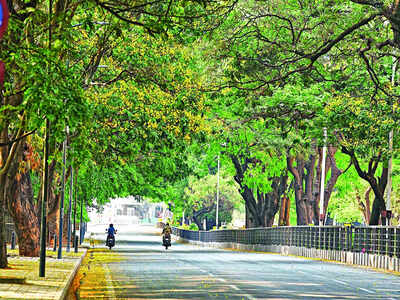
Image 1: Tree-lined streets and shaded walkways in Pune, India.
Yet, the reality is nuanced. Streets without shade or homes with poor ventilation still exist, reminding us that urban equity is rarely automatic. Interventions like passive cooling in housing, flood-resilient pathways, or participatory micro-parks are proof that design can redistribute environmental benefits, allowing residents to live healthier and more comfortable lives (Schlosberg, 2007).
Housing, Daily Life, and Structural Patterns
Housing conditions offer a clear window into lived Environmental Justice. In India, initiatives that incorporate passive cooling, ventilated layouts, and communal spaces demonstrate that affordability need not come at the cost of comfort or resilience. Residents experience less heat stress, better airflow, and improved everyday well-being (Soja, 2010).
Even small design decisions—orienting buildings for airflow, including shaded courtyards, or ensuring safe walkways—shape daily comfort and long-term opportunity. Housing is where inequity and care are most tangible: it reveals who is protected, who adapts, and how planning choices either exacerbate or alleviate everyday stress (Harvey, 2008).
Learning from Lived Experience
Observing cities closely makes Environmental Justice legible. Micro-parks, tree-lined streets, pedestrian pathways, and flood-adapted public spaces are not merely aesthetic improvements—they redistribute environmental benefits and reduce daily exposure to risk (Agyeman et al., 2016). Participatory design amplifies this effect, as residents contribute their knowledge of local conditions, cultural priorities, and daily rhythms.

Image 2: Micro-parks or community-managed green spaces in Bengaluru, India.
Ordinary moments—waiting at a bus stop, walking along a shaded street, choosing a nearby park—accumulate to shape wellbeing. For architects and urban designers, these are not trivial details. They are opportunities to embed care into the built environment and ensure that equity is not an afterthought, but a guiding principle.
Optimism Through Design
-
Environmental Justice is not only about highlighting deficits; it also focuses on proactive, positive interventions.
-
In India, initiatives like community-managed green corridors, passive-cooled housing, and participatory public spaces demonstrate how cities can actively redistribute environmental care.
-
These examples show that equity is not merely aspirational; it can be intentionally designed into streets, homes, and parks.
-
Observing such transformations illustrates that thoughtful, context-sensitive urban design can turn everyday city life into a space of justice, well-being, and opportunity (Schlosberg, 2007; Soja, 2010).
Reflections from Newcastle
Living in Newcastle as an international student offers a complementary perspective. Here, streets are generally shaded, parks are accessible, and housing infrastructure provides thermal comfort. While subtle inequalities exist—older or rental housing may lack full insulation—the city demonstrates how care can be embedded into infrastructure. Seeing this reinforces a critical point: Environmental Justice does not occur automatically. It requires observation, intention, and design that respond to human experience (Harvey, 2008).

Image 3: Accessible parks, pedestrian streets, and cycle corridors in Newcastle.
Conclusion
Environmental Justice is felt long before it is debated. It is present in the streets we walk, the homes we inhabit, and the public spaces we share. In India, small urban interventions show how design can redistribute comfort, safety, and opportunity. Newcastle provides a reminder of how systemic care can subtly shape equity. Observing these patterns transforms Environmental Justice from an abstract principle into a practical, lived guide for architects and urban designers. By embedding care into everyday spaces, cities can support health, dignity, and wellbeing—not for a privileged few, but for everyone.
References
Agyeman, J., Schlosberg, D., Craven, L. and Matthews, C. (2016) ‘Trends and directions in environmental justice: from inequity to everyday life’, Annual Review of Environment and Resources, 41, pp. 321–340.
Bullard, R.D. (1990). Dumping in Dixie: Race, Class, and Environmental Quality. Boulder, CO: Westview Press.
Soja, E.W. (2010). Seeking Spatial Justice. Minneapolis: University of Minnesota Press.
Schlosberg, D. (2007). Defining Environmental Justice: Theories, Movements, and Nature. Oxford: Oxford University Press.
Harvey, D. (2008) ‘The right to the city’, New Left Review, 53, pp. 23–40.
Images
Image 1: https://www.thenatureofcities.com/TNOC/2018/07/01/secular-sacred-domestic-living-street-trees-bangalore/ (Accessed: 20/11/2025).
Image 2: https://una.city/nbs/amsterdam/ribbon-pocket-parks-indian-neighbourhood (Accessed: 20/11/2025).
Image 3: https://new.newcastle.gov.uk/news/2025/shaping-future-transport-newcastle (Accessed: 20/11/2025).



I always enjoy reading about environmental justice and spatial justice, so I was very excited to read this blog. You explain clearly how environmental problems are not the same for everyone. Some neighborhoods have clean air, parks, and shade, while others face pollution, heat, and floods. I liked your examples because they show how everyday life is affected by unfair planning.
I want to add that history matters too. Many neighborhoods that have problems today were denied investment in the past. This means environmental injustice is not just about now, but also about decisions made long ago (Anguelovski & Connolly, 2021). Harvey (1973) also says cities are not neutral they show social inequalities in their streets, parks, and buildings. Thinking about history can help planners avoid repeating mistakes.
A relevant case study in Iran is Tehran’s low-income neighborhoods like Khak Sefid or southern districts. These areas often face severe air pollution, higher temperatures due to lack of green spaces, and poor infrastructure, while northern Tehran benefits from parks, tree-lined streets, and cleaner air. Historical patterns of investment and planning have concentrated resources in wealthier districts, leaving southern neighborhoods more at risk to environmental hazards (Azizi et al., 2020; Mahdavi & Moridpour, 2018). This example shows clearly how environmental and spatial justice are linked to social inequality in an Iranian context.
I agree with you that including community voices is very important. People living in these areas know their problems better than outsiders. But we should make sure all voices are heard, not just the strongest ones (Holifield, Porter & Walker, 2010). Tools like community mapping or talking directly with residents can help planners understand real needs.
In short, your blog shows that environmental justice is about space and fairness. By thinking about history, including the community, and learning from real-life cases like Tehran, we can make cities healthier and fairer for everyone. I really enjoyed reading your blog and learning from your examples.