

Not just getting around: How design guidance shapes approaches to street design in Germany and the UK
On a recent trip to Germany, I noticed a subtle, yet impactful difference in the design of the residential and urban streets. Whilst still forming the core movement network of cities, for cars and pedestrians alike, the spaces felt notably more relaxing to walk through, with pedestrians appearing to lead the negotiation of user priority. This felt like a stark contrast to the UK, where pedestrians are often pushed to the sides of the street, serving almost entirely as movement corridors for the convenience of car users from the front door.
Whilst it would be easy to attribute this to cultural norms, the reality is that the design priorities which shape streets between the two counties promote an entirely different experience of negotiating residential streets, supported by two very different sets of street design guidance.
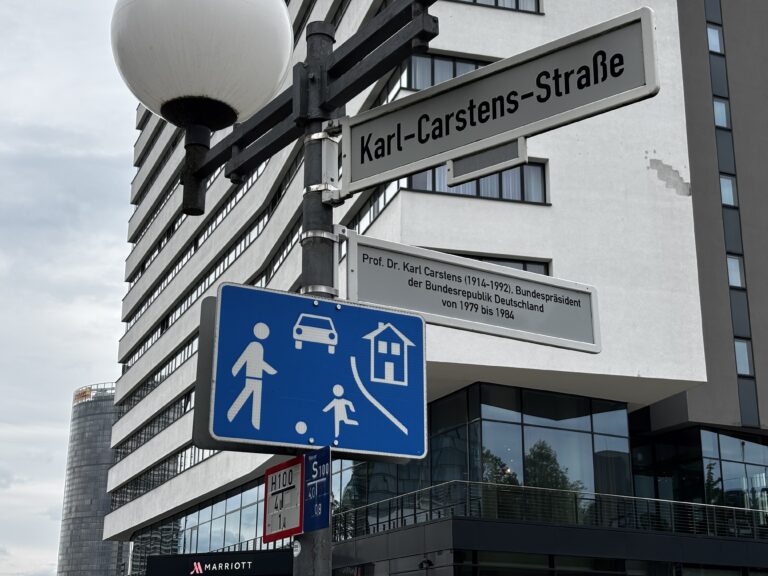
Image: Author’s Own, (2026) ‘Verkehrsberuhigter Bereich’ sign on Karl-Carstens-Strasse, Bonn, Germany
In German cities, whether at the core or fringes, a common sight in is the ‘Verkehrsberuhigter Bereich’ (lit. ‘traffic-calmed area’) sign (pictured above). This denotes a street in which pedestrians are permitted use of the full width of the street, and where cars must travel at walking speed, as set out by the German Road Traffic Regulations (StVO, 2013). Translating this legal requirement into design guidance, the Guidelines for the Design of Urban Streets (RASt 06) requires that designers consider the streets through a balance of functions: between movement, access and the unique “stay function”, which explicitly recognises the social function of streets (FGSV, 2006). In practice, this means that streets often have narrower carriageways, tighter corners, and less explicit boundaries between functions. Rather than separating the public realm into specific uses and between modes, this supports the need for cars to negotiate co-existence with pedestrians, in turn giving pedestrians the confidence to use the carriageway to walk, play and relax safely.
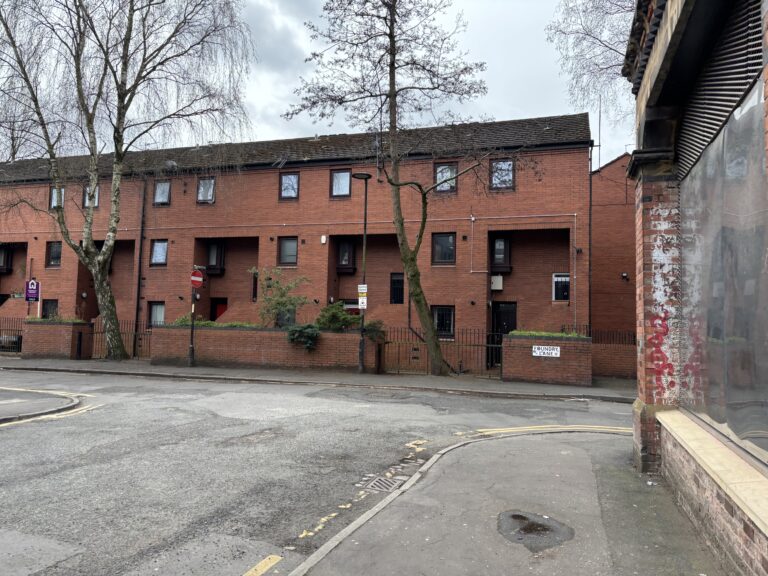
Image: Author’s Own, (2025) An urban residential street frontage on Foundry Lane, Manchester, UK
In contrast to this, street design in the UK promotes the safe and efficient movement of cars, leading a default approach to highway design which prioritises vehicles. England’s Design Manual for Roads and Bridges sets out specific geometric safety standards, including carriageway widths, junction layouts and visibility splays, which centre around the safe movement of cars (Highways England, 2020). Whilst the Streets for Healthy Life guidance adopts a degree of advice toward shared spaces in residential-dominated streets, it continues to enforce generally rigid street layouts, with legible separations between different modes and functions (Homes England, 2022). This notably differs from advice in Germany, with the RASt 06, despite also providing technical standards, recognising the role of streets beyond being movement corridors.
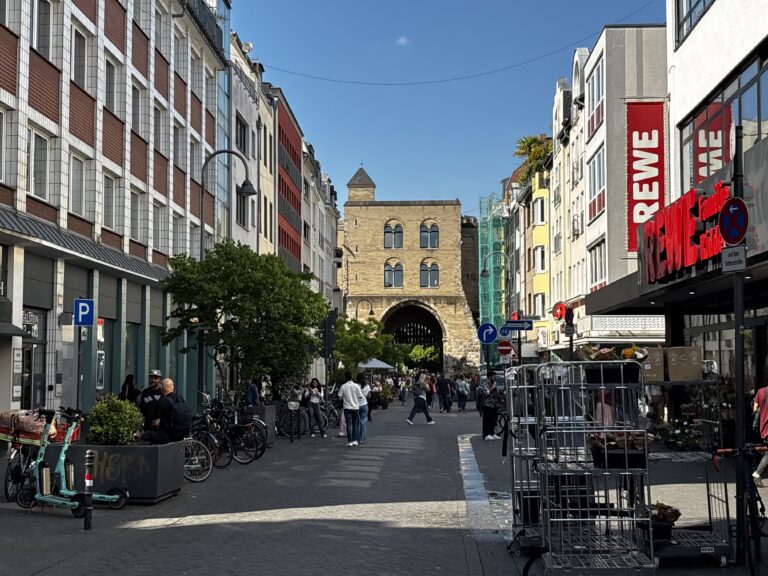
Image: Author’s Own, (2026) View onto Eigelstein, Cologne, Germany
What becomes clear between the two approaches to street design is that enabling the negotiation of space, rather than its strict segregation, allows the street to function as both valuable social infrastructure and as a movement corridor. By embedding coexistence into its design, a street can be actively used as part of everyday life, empowering people to inhabit and shape public space beyond simply moving through it.
References
FGSV (2006) Guidelines for the Design of Urban Streets (RASt 06) – English Translation. Cologne: FGSV Verlag. Available at: https://www.fgsv-verlag.de/pub/media/pdf/200_E_PDF.i.pdf (Accessed 16/05/2026)
Highways England (2020) Design Manual for Roads and Bridges (DMRB). London: Highways England. Available at: https://www.standardsforhighways.co.uk/dmrb (Accessed 16/05/2026)
Homes England (2022) Streets for a Healthy Life: Design and Planning Guidance. London: Homes England. Available at: https://www.gov.uk/government/publications/streets-for-a-healthy-life (Accessed 16/05/2026)
Road Traffic Regulations (StVO) (2013) German Road Traffic Regulations (Straßenverkehrs-Ordnung), English Translation. Federal Ministry of Justice and Consumer Protection, Germany. Available at: https://www.gesetze-im-internet.de/stvo_2013/ (Accessed 16/05/2026)
