

This article gives a clear, engaging description of Segal’s housing methodology. The article shows how Segal’s design process can be adjusted for individual needs, the cost to build using Segal’s technique, and Segal’s social impact. The article also emphasizes the significance of user participation, which promotes the idea of empowerment when it comes to housing (Grahame and Wilkhu, 2017). However, a more thorough elaboration of the housing system and the Segal Method would give further depth in supporting the Segal Method. Henri Lefebvre (1991) states that housing is not simply functional but is produced socially by political and economic forces. The article describes self-build as an alternate model of housing; however, it does not address all limitations regarding scaling self-build as a model through the current housing markets (Broome, 1986). Although the article discusses affordability, it does not provide a sufficient discussion of the structural barriers that create long-term barriers to accessing land for self-building. This is especially important in relation to the post-Right-to-Buy situations (MHCLG, 2026). Overall, this article presents a tremendous opportunity for an even stronger critical examination.
Radical DIY Housing: The Segal Method and its Legacy
In 1978, nearing the end of Social Housing’s dominance in the UK (MHCLG, 2026), Lewisham Council took a chance on the experimental idea of architect Walter Segal: equipped with an awkwardly sloped council-allocated site and 14 families waiting for new housing, Segal set out to use a newly engineered, low-skilled timber construction method to help the families build new homes for themselves (Grahame, 2017).
Nearly 50 years later, the completed Segal Close, and nearby successive 13-home Walter’s Way, now form some of the ‘200 or so’ homes around the UK built with the method (Grahame, 2017), becoming a renowned example of self-help housing. Whilst not a common housing model, the method and its communities highlight an alternative approach to housing which tackles a range of ever-relevant issues, spanning beyond just its technical principles.
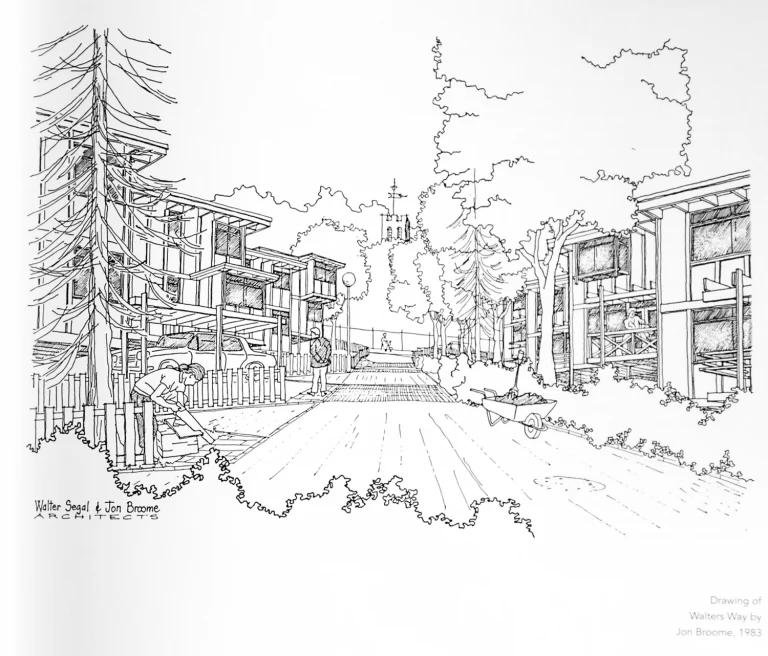
Image: Sketch of Walter’s Way from Grahame, A. & Wilkhu, T. (2017) Walters Way & Segal Close. Zürich: Park Books.
Adaptability
Being designed for simple construction, the Segal Method works primarily within readily available standard timber sizes designed on a tartan grid (The Architects’ Journal, 1986). At the initial design stage, this modular grid allows for self-builders with a limited understanding of spatial scales to design bespoke layouts which works for their individual needs, with any number of bedrooms at different sizes (Grahame & Wilkhu, 2017). As families in the original schemes grew, the residents, already trained to build with the method, were able to extend their homes with additional bedrooms, as one expecting family did for a new child (The Architects’ Journal, 1986), adapting to their needs rather than selling up and moving to a more appropriately sized home.
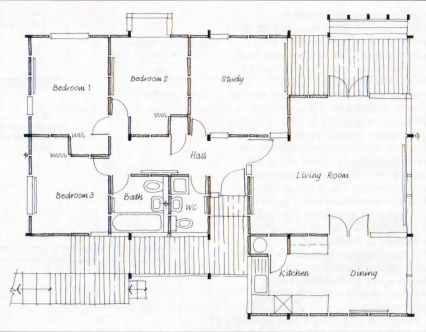
Image: Plan of a Segal Method House from Broome, J. (1986) ‘Special Issue: The Segal Method’, The Architects’ Journal. The Architects’ Journal, 184(45), 5 November, pp. 31-68. Available at: https://jonbroome.co.uk/wp-content/uploads/2021/02/AJ-Segal-Special-Issue-The-Segal-Method-05-Nov-1986-reduced.pdf (Accessed 10/04/2026)
Longevity
This structural adaptability also provides the benefit of simple and cheap maintenance: much of the materials panels can be bought in standard sizes, readily available at any DIY or trade shop, with self-builders already trained from their construction. Whilst the frame accommodates for the same general wall thickness, retrofitting and panel replacements can also make use of newer insulation and climate control systems, adapting to newer technologies and changes in the climate into the future.
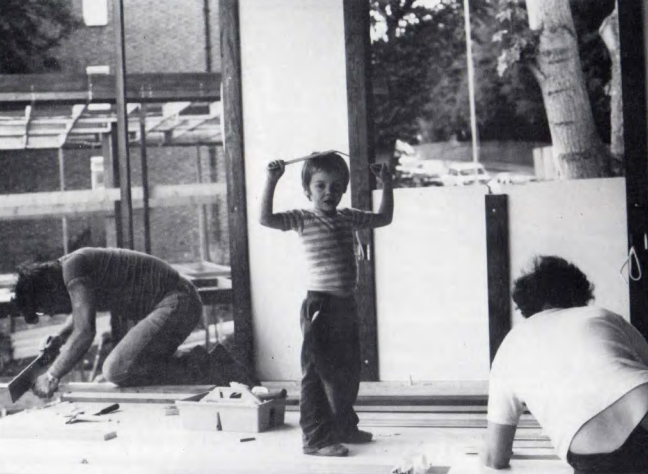
Image: Parents and Child taking part in construction from Broome, J. (1986) ‘Special Issue: The Segal Method’, The Architects’ Journal. The Architects’ Journal, 184(45), 5 November, pp. 31-68. Available at: https://jonbroome.co.uk/wp-content/uploads/2021/02/AJ-Segal-Special-Issue-The-Segal-Method-05-Nov-1986-reduced.pdf (Accessed 10/04/2026)
Affordability and Tenancy
The original schemes in Lewisham were council-funded, with residents either outright buying or social renting (Brooks, 2017), but all eventually owning their homes. Meanwhile, developments post-Right-to-Buy have utilised a mixture of housing co-operatives and housing associations, in the latter case ‘contracting’ self-builders, who then rent their homes, as individuals or a co-operative, at a reduced rate in exchange for their labour (Opsina, n.d.).
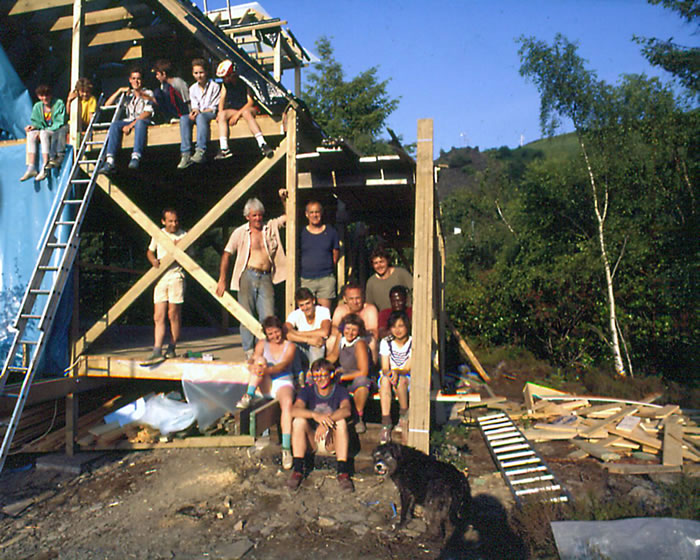
Image: Self Builders on an ongoing construction site from CHISEL (n.d.) The CHISEL archive: The Diggers. Available at: https://www.chisel.org.uk/the-chisel-archive/diggers/ (Accessed 10/04/2026)
Beyond Housing
Despite some of the original residents of Walter’s Way and Segal Close eventually selling up, the sense community formed by its co-construction – and will of new homeowners to take advantage of the many benefits of the method – has meant that new residents integrate easily (Harper, 2015). This sets up a long-term social sustainability, which carries Segal’s ethos, and a wider sense of social cohesion into the future.
References
Brooks, M. (2022) Walters Way and Segal Close. Available at: https://www.designingbuildings.co.uk/w/index.php?title=Walters%20Way%20and%20Segal%20Close&action=history (Accessed 10/04/2026)
Broome, J. (1986) ‘Special Issue: The Segal Method’, The Architects’ Journal. The Architects’ Journal, 184(45), 5 November, pp. 31-68. Available at: https://jonbroome.co.uk/wp-content/uploads/2021/02/AJ-Segal-Special-Issue-The-Segal-Method-05-Nov-1986-reduced.pdf (Accessed 10/04/2026)
Grahame, A. & Wilkhu, T. (2017) Walters Way & Segal Close. Zürich: Park Books.
Harper, P. (2015) Walter’s Way, Lewisham. Youtube [online], Available at: https://www.youtube.com/watch?v=0JbqJNAUOR8 (Accessed 10/04/2026)
Ministry for Housing, Communities and Local Government Committee (2026) Live tables on dwelling stock (including vacants). Available at: https://www.gov.uk/government/statistical-data-sets/live-tables-on-dwelling-stock-including-vacants (Accessed 10/04/2026)
Ospina, J. (n.d.) Self-Build for Rent Model. Available at: https://www.chisel.org.uk/wp-content/uploads/2025/02/Self-Build-For-Rent-Model-brochure.pdf (Accessed 10/04/2026)

This article gives a clear, engaging description of Segal’s housing methodology. The article shows how Segal’s design process can be adjusted for individual needs, the cost to build using Segal’s technique, and Segal’s social impact. The article also emphasizes the significance of user participation, which promotes the idea of empowerment when it comes to housing (Grahame and Wilkhu, 2017). However, a more thorough elaboration of the housing system and the Segal Method would give further depth in supporting the Segal Method. Henri Lefebvre (1991) states that housing is not simply functional but is produced socially by political and economic forces. The article describes self-build as an alternate model of housing; however, it does not address all limitations regarding scaling self-build as a model through the current housing markets (Broome, 1986). Although the article discusses affordability, it does not provide a sufficient discussion of the structural barriers that create long-term barriers to accessing land for self-building. This is especially important in relation to the post-Right-to-Buy situations (MHCLG, 2026). Overall, this article presents a tremendous opportunity for an even stronger critical examination.