

Reflecting on Environmental Justice Through Urban Design and Learning Practice
Personal Reflections on Learning and Positionality
Contributing to the course blog throughout the semester has been an engaging and genuinely formative learning experience, one that reshaped how I understand environmental justice and my position within urban design. As a full-time international student, settling into a new academic environment involved more than adapting to unfamiliar teaching styles; it also required confidence in articulating my own perspectives. The blog created a space where learning felt less rigid and more exploratory, allowing me to engage with complex ideas while locating myself within them.
Over the course of the module, environmental justice became clearer to me not simply as an end result of fair urban systems, but as an ongoing process shaped by governance, participation and everyday spatial practices. This perspective reflects wider scholarship that frames environmental justice as something embedded in daily life, rather than limited to the unequal distribution of environmental benefits and harms (Agyeman et al., 2016). Through lectures and readings, I began to recognise how environmental inequalities are often reinforced through planning decisions that prioritise certain voices while marginalising others. This prompted deeper reflection on how my own background, education and assumptions influence the way I interpret cities and justice. Developing this reflexive awareness has been one of the most valuable outcomes of the module.

Image: (Agyeman et al., 2016). Illuminating radical spatial imaginaries. Available at: https://journals.sagepub.com/doi/10.1177/25148486241270092 (Accessed: 28/12/2025).
Critical Engagement Through Blog-Based Learning
My engagement with the blog focused on themes of environmental justice and urban co-production, particularly the importance of meaningful engagement in shaping fairer urban environments. While I entered the module with some understanding of sustainability and participation, the blogging process encouraged me to question who participation is designed for, and whose knowledge is ultimately valued. I came to understand that environmental justice cannot be achieved through technical solutions alone, such as green infrastructure, but relies on inclusive processes that recognise lived experience as a legitimate and valuable form of expertise. This aligns with ideas of everyday urbanism, which emphasise small-scale, relational and lived practices as central to achieving more just urban outcomes (Urban Design Lab, 2024).
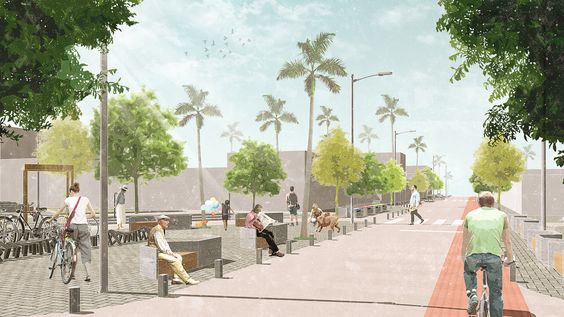
Image: (Urban Design Lab, 2024). Sustainability Through Everyday Practices. Available at: https://urbandesignlab.in/everyday-urbanism/ (Accessed: 28/12/2025).
Using Instagram alongside written posts added an additional and rewarding dimension to this learning. I enjoy photography and visual documentation, and this module allowed me to bring those interests into an academic setting. Translating theory into visual narratives required careful consideration of clarity, accessibility and audience. This process challenged me to communicate complex ideas in a concise and engaging way, strengthening my storytelling and communication skills. While balancing academic depth with creative expression was sometimes difficult, it highlighted the importance of adaptable communication when addressing complex socio-environmental issues in urban practice.
Translating Learning into Future Practice
The insights gained through this module will directly inform both my future academic work and professional practice. Viewing environmental justice through the lens of urban co-production reinforced the importance of early, continuous and inclusive engagement in urban projects. Designers and planners have a responsibility not only to consult communities, but to create conditions where participation meaningfully shapes outcomes. This approach reflects planning theory that advocates for more relational, ethical and inclusive decision-making processes (Houston et al., 2018).
The module’s emphasis on storytelling and visual communication has also expanded my skill set. The ability to communicate ideas clearly and creatively is essential when working with diverse stakeholders, particularly in contexts where trust in institutions may be limited. I intend to continue developing these skills and applying them in future projects to support more transparent and inclusive design processes. Additionally, the habit of regular reflection developed through blogging is something I aim to carry forward, as it supports ethical awareness, critical thinking and self-evaluation in practice.
Conclusion
Overall, this module has deepened my understanding of environmental justice as a socially embedded and participatory process, rather than a purely spatial or technical concern. The combination of theoretical learning and reflective blogging encouraged me to think critically, creatively and reflexively about urban design and my place within it. Although the open-ended nature of the blog was at times challenging, it ultimately fostered independence, confidence and a stronger connection between theory and practice. This experience has not only strengthened my academic skills, but has also shaped how I view my future role as an urban designer committed to equity, engagement and environmental responsibility.
References
Agyeman, J., Schlosberg, D., Craven, L. and Matthews, C. (2016) ‘Trends and directions in environmental justice: from inequity to everyday life’, Annual Review of Environment and Resources, 41, pp. 321–340.
Houston, D., Hillier, J., MacCallum, D., Steele, W. and Byrne, J. (2018) ‘Multispecies urbanism and planning theory’, Planning Theory, 17(2), pp. 190–212.
Urban Design Lab (2024) Everyday urbanism and environmental justice. Available at: https://urbandesignlab.in/everyday-urbanism/ (Accessed: 18 December 2025).
