

Reflections on Spatial Injustice
Personal Reflections:
Contributing to this blog over the past few months has been an insightful and enjoyable experience which has led me to explore topics I wouldn’t have necessarily considered previously. I have found working with other members of the cohort to explore the overarching theme of spatial injustice has provided different perspectives from all around the world and this has helped to shape my view of this issue and how it affects different cultures and communities.
The collaborative aspect of this work has made settling in at university easier. As a part time student not currently partaking in a studio module, it has been harder to get to know my fellow students. This module however has bridged some of those gaps and also provided opportunities for me to share knowledge from my career with the other students, adding another perspective on many of the issues presented in the lectures. Reflecting on other bloggers posts has encouraged me to think critically and also to learn from other perspectives and insights into the various topics discussed.
In my spare time I enjoy pulling together videos from trips I have taken as a way of remembering my experiences. This module has allowed me to utilise those skills in a new way by producing content for the Instagram account. Therefore, my skills in storytelling through multimedia have developed, and I will continue to work on this in the future. I feel this is a skill that I could apply in my work for South Tyneside Council as a way of communicating future plans and work going on for the residents of the area. This would hopefully lead to more effective conversations between our team and the residents as they can be more informed regarding what is being asked of them.
Having studied architecture for my undergraduate degree and then working in planning, I felt I had quite a well-rounded understanding of design and the implementation of it. However, this module has taught me that Urban Design is a combination of even more disciplines than I originally thought. It requires outward thinking and the consideration of the human scale, but at a much larger scale than architecture itself usually considers. Urban design impacts everyday life for everyone, influencing their health, wellbeing, opportunities for employment and access to services (Constructive voices, 2024). The way our communities are designed ultimately has a great influence on all these matters and therefore shapes the lives of the people living there.
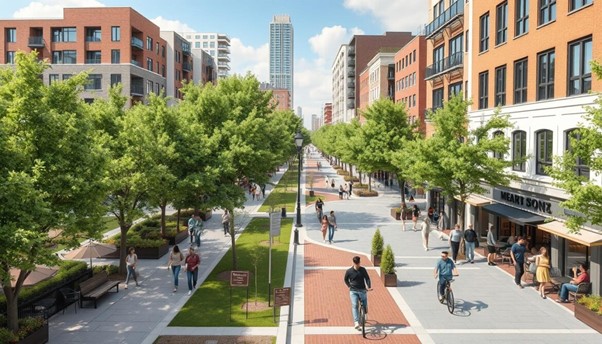
Image: Constructive Voices (2024) From Concept to Community: How Urban Design Impacts Everyday Lives. Available at: https://constructive-voices.com/from-concept-to-community-how-urban-design-impacts-everyday-lives/ (Accessed: 18/12/2025).
My blog posts:
I personally discussed topics of sustainable mobility and housing justice in my blog posts, and have had the opportunity to reflect and comment on posts regarding environmental justice and blue green infrastructure. Whilst I had some baseline knowledge of these topics, the research I undertook for these posts has highlighted more of the underlying theory behind these issues and their solutions. I was particularly interested how small-scale interventions can have major impacts when they are well designed and integrated into the urban fabric of a city (Urban Design Lab, 2024).
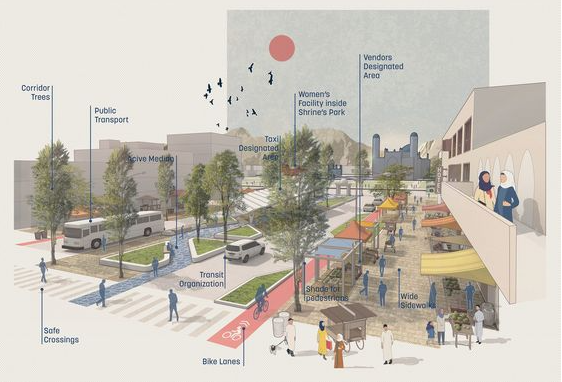
Image: Urban design Lab (2024) Everyday Urbanism: Transforming Daily Life in Cities. Available at: https://urbandesignlab.in/everyday-urbanism/ (Accessed: 18/12/2025).
I will work to implement what I have learned both in my future academic work and also in my career.
How I can use these teachings in future:
Particularly, the insights provided around the importance of effective community involvement and consultation have been invaluable for me. As a statutory requirement we have to undertake many consultations at the local authority, but these have not always been done in a way that allows residents voices to be best heard and their ideas to be effectively implemented. Going forward I will integrate the knowledge provided around storytelling and consultation to achieve better outcomes from future consultation exercises.
Spatial injustice is a topic that I explore in my work role regularly as I work for an area that has high levels of poverty and health inequalities. There are large differences between the more ‘well off’ areas of the borough and the poorest areas (south Tyneside council, 2022), and part of my job includes writing policies to try and reduce this gap. This module has opened my eyes to new ways of trying to address these issues through the implementation of blue green infrastructure, improved methods of consultation and community involvement, innovative housing solutions and sustainable mobility. Whilst I had some awareness of these topics prior to the lecture series, I have gained a much more in depth understanding.
Conclusion:
This module has been invaluable for deepening my understanding of spatial injustice and had provided me with the opportunity to reflect on my role as an urban designer and the influence I can have. It has provided me with inspiration to think creatively and innovatively about solutions to injustice and sustainability. I also feel much more confident in my storytelling and communication which will enable me to work better in the future.
References:
Constructive Voices (2024) From Concept to Community: How Urban Design Impacts Everyday Lives. Available at: https://constructive-voices.com/from-concept-to-community-how-urban-design-impacts-everyday-lives/ (Accessed: 18/12/2025).
Urban design Lab (2024) Everyday Urbanism: Transforming Daily Life in Cities. Available at: https://urbandesignlab.in/everyday-urbanism/ (Accessed: 18/12/2025).
South Tyneside Council (2022) South Tyneside joint Health and Wellbeing Assessment. Available at: https://publications.southtyneside.gov.uk/strategies/joint-health-and-wellbeing-strategy/ (Accessed: 18/12/2025).
