

Reflective Summary: My Learning Journey Through Blogging in TCP8090
Personal Reflection and Learning Process
Fig 1:
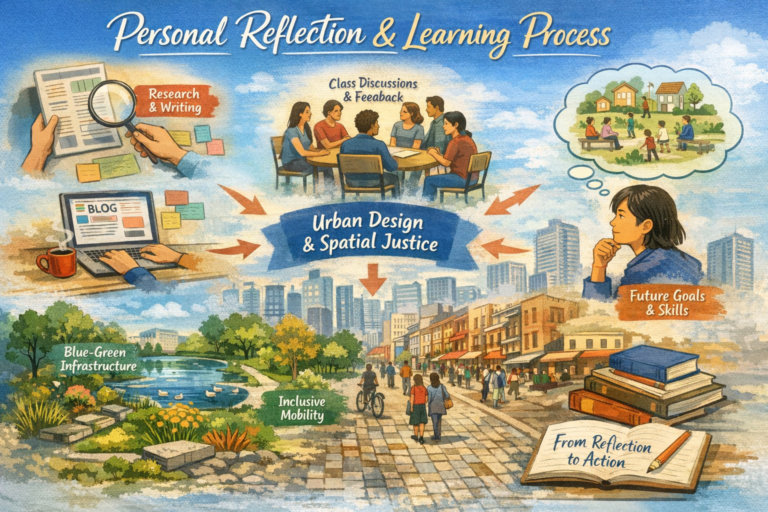
Writing blogs for TCP8090 has been a really enjoyable and valuable experience. Every blog I wrote felt like a little journey where I explored different ideas, thought about what was important, and learned how to organize my thoughts clearly. Using images, diagrams, and examples from real cities also helped me tell a better story and made the ideas easier for readers to understand. Including visuals made the blogs more interactive and helped illustrate my points more effectively.
I also really enjoyed interacting with my classmates. Reading their blogs and commenting on them gave me new ideas and showed me different ways of thinking. Sometimes I had to rethink my own points after reading their perspectives, which was a really useful part of the learning process. Discussing ideas with classmates made me consider aspects I hadn’t thought about before, such as how people from different social backgrounds experience urban spaces differently. This added depth to my reflections and helped me understand the real-life effects of urban design.
Writing blogs made me realize that it’s not just an assignment, it’s a way to record what I’m learning, test my understanding, and share it with others. It also helped me understand my role as a blog contributor: I had to make sure my research was accurate, my examples were clear, and my ideas were connected to real-world situations. This responsibility pushed me to pay attention to details and be more careful in presenting my thoughts, knowing that others would read and learn from them.
Before this module, because I studied architecture at the undergraduate level, I mostly saw design as focused on form, shape, and the preferences of people inside a building. However, this module, through the tasks that required us to research topics, read widely, and through lectures given by highly knowledgeable speakers, taught me that design should be based on the comfort and needs of all people in a neighborhood or even across the whole city. This helped me understand that urban design is not just about aesthetics or individual preferences, it is about making spaces functional, inclusive, and fair for everyone.
Before this module, my understanding of urban design was largely technical, focused on aesthetics, circulation, and functional layouts. However, blogging and participating in this module has transformed my perception. I now see urban design as deeply connected to people, their needs, identities, and rights, and recognize that spatial justice is a core principle that should guide design decisions. Spatial justice, to me, means ensuring fair access to public spaces, safe mobility, housing, and inclusive environments for all members of society. Thinking about spatial justice while writing blogs encouraged me to reflect on real-life examples and how urban design can influence fairness in cities.
Key Takeaways on Urban Design and Spatial Justice
One of the biggest lessons I learned from the readings and lectures is that urban designers have an important role in making cities fair and inclusive. They need to think about how spaces are used by different people and make sure that everyone can access public areas safely and comfortably. This understanding changed the way I look at urban spaces and made me more aware of social responsibilities in design.
My blog about Blue-Green Infrastructure (BGI) showed how natural areas and water management systems can help cities be more sustainable and fair. For example, rain gardens and street trees in Cardiff reduced flooding, helped nature recover, and created spaces where people could feel safe and enjoy the city. BGI also encourages communities to get involved in caring for their environment, showing how urban design can support both people and nature (City of Cardiff Council, 2021). Writing this blog helped me understand the practical benefits of BGI and how they connect to social justice, making me more confident in explaining complex ideas clearly.
My blog about İstiklal Street in Istanbul showed another side of urban design: mobility and accessibility. By turning the street into a pedestrian-friendly area, adding bike lanes, and connecting it to public transport, the city created a lively, safe, and inclusive space. This shows that designers can make a real difference in how people move, interact, and enjoy urban spaces, even in crowded and historic cities (Arslanlı et al., 2017; Turoń, 2025). Including detailed observations and examples in the blog made the impact of these changes easier to communicate to readers.
These examples taught me that urban designers have a big influence, but they don’t control everything. Decisions often depend on clients, authorities, and budgets. Still, designers can suggest ideas, raise awareness, and work with communities to make spaces fairer. Blogging about these topics helped me reflect on the balance between design ideas and real-world limitations, which is an important part of the learning process.
Reflection on Skills and Future Goals
Through blogging, I improved my research, writing, and digital skills. I learned how to find reliable sources, explain ideas clearly, and use images to make my blogs more interesting. Feedback from classmates helped me see my work from different angles and improve it. This process also taught me how to communicate complex ideas in an accessible way, which is valuable for both academic work and professional practice.
Next, I want to make my writing even clearer and more engaging. I also want to learn more about participatory design and how to involve communities in planning, so that the spaces I design can be fair and enjoyable for everyone. Blogging has inspired me to focus not just on technical design, but also on understanding and including people’s needs in every project.
Conclusion
Blogging for TCP8090 has been a very rewarding experience. It helped me connect theory from readings and lectures to real cities, reflect on my learning, and understand the role of urban designers in creating fair, inclusive, and sustainable spaces. I also learned useful skills in writing, research, and digital storytelling. This experience has made me more aware of my responsibility as a designer to think about justice, inclusion, and sustainability in every project, and it will guide me in my future work in urban design.
Reference
Fig 1: OpenAI (2025) AI-generated image created using ChatGPT for Fig 1: “A detailed, square watercolor-style digital illustration visualizing the personal reflection and learning process. Includes research and writing, class discussions, blogging, urban design and spatial justice, blue-green infrastructure, inclusive mobility, future goals and skills, and a cityscape with people interacting. Calm academic atmosphere, warm and soft colors, visually clear for a university reflective summary featured image.”
Featured image: OpenAI (2025) AI-generated image created using ChatGPT for featured image: “A square watercolor-style illustration of hands typing on a laptop with a simple blog layout on the screen, a cup of coffee beside it, soft pastel colors, calm academic mood”.
