

Reflective Summary: The Role of Freehand Sketching as a Tool for Spatial Thinking and Graphic Communication
A personal challenge of moving away from CAD and realistic renders
Reflecting on my experience on the M-AUP Urban Design Masters this year, one of the biggest growths in my professional identity has been a newfound confidence in hand-drawing as a primary medium for design exploration.
During my first three years of university, I often felt anxious about my sketching skills. I wanted to move straight into CAD software because I did not trust my drawings to communicate my design intentions with enough precision for a final review.
I have learnt to trust my ability to represent decisions graphically, and now use my sketchbook from the beginning of a project to build concepts through quick perspectives and sections rather than simply taking notes. Overcoming this anxiety taught me to value iteration over the finality of digital renders, and through my Instagram slides I wish to encourage future students to pick up a pencil and have a go too!
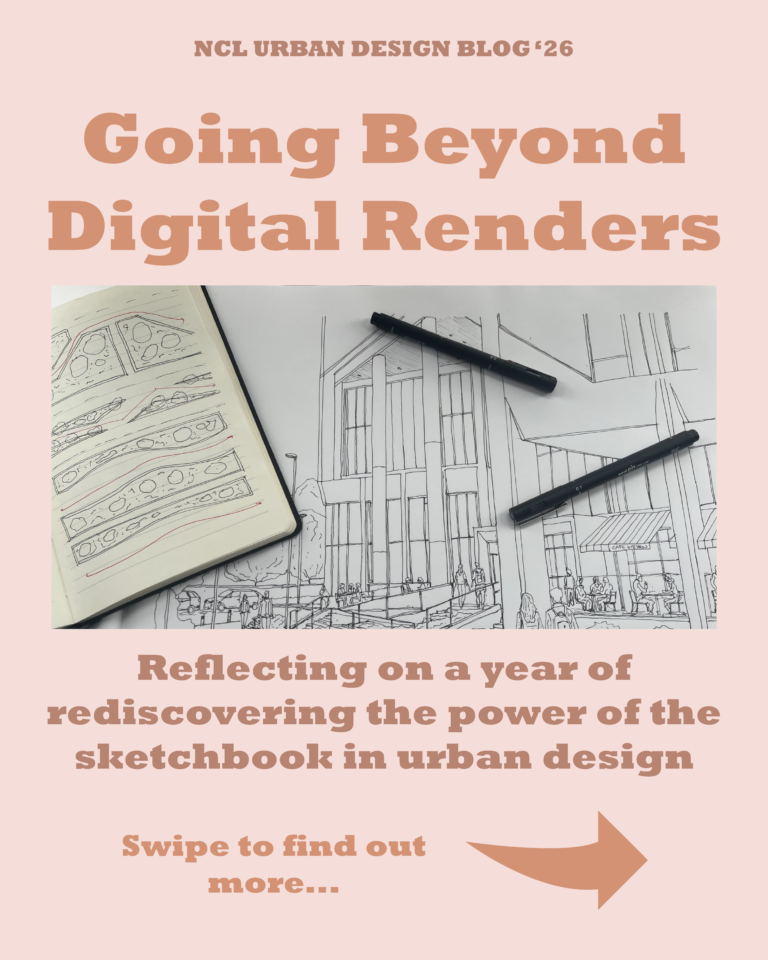
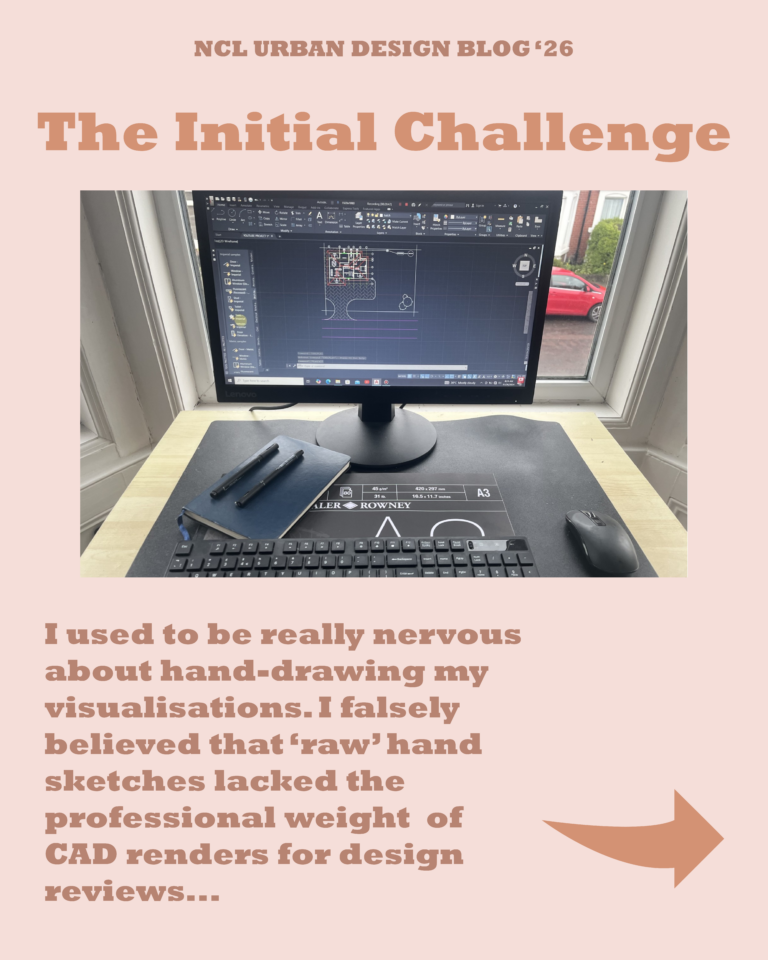
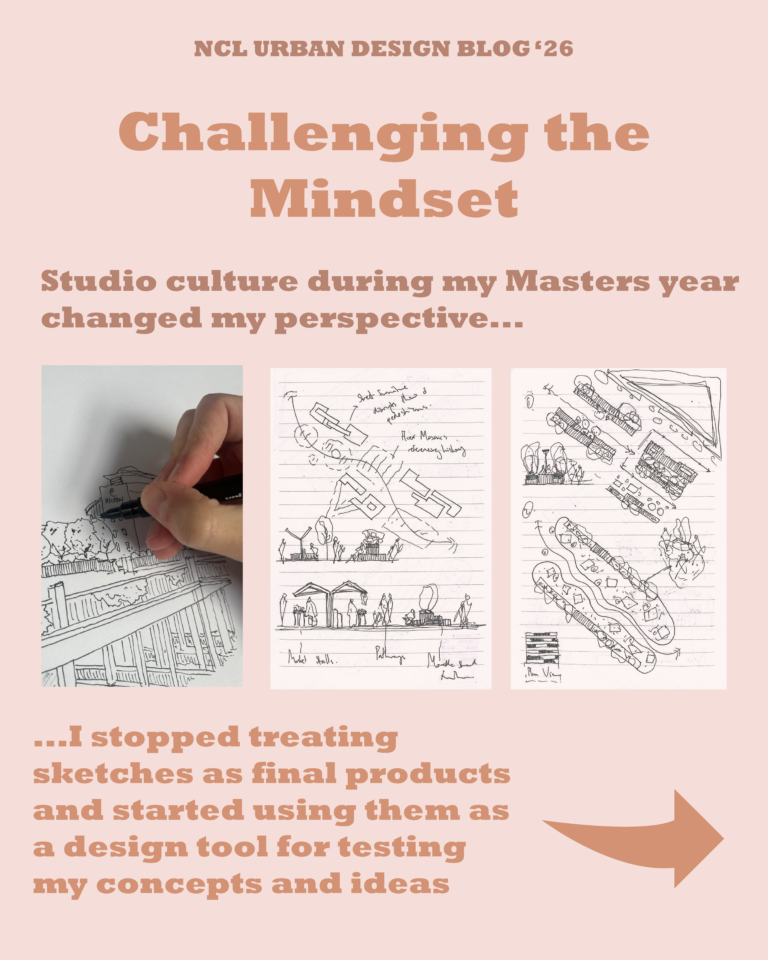
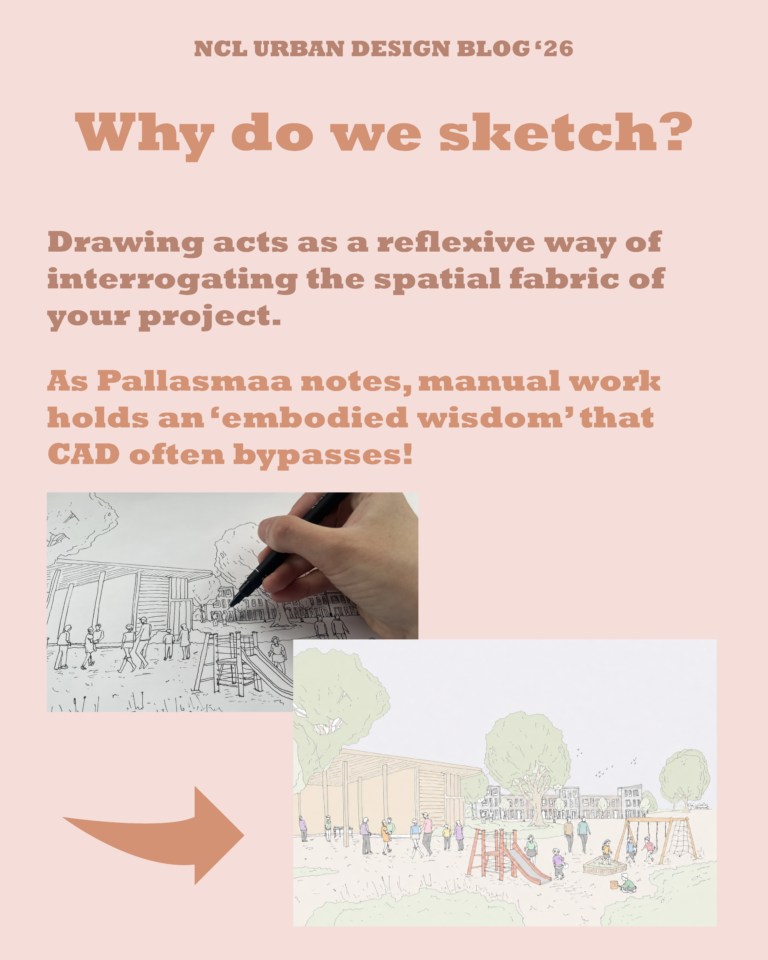
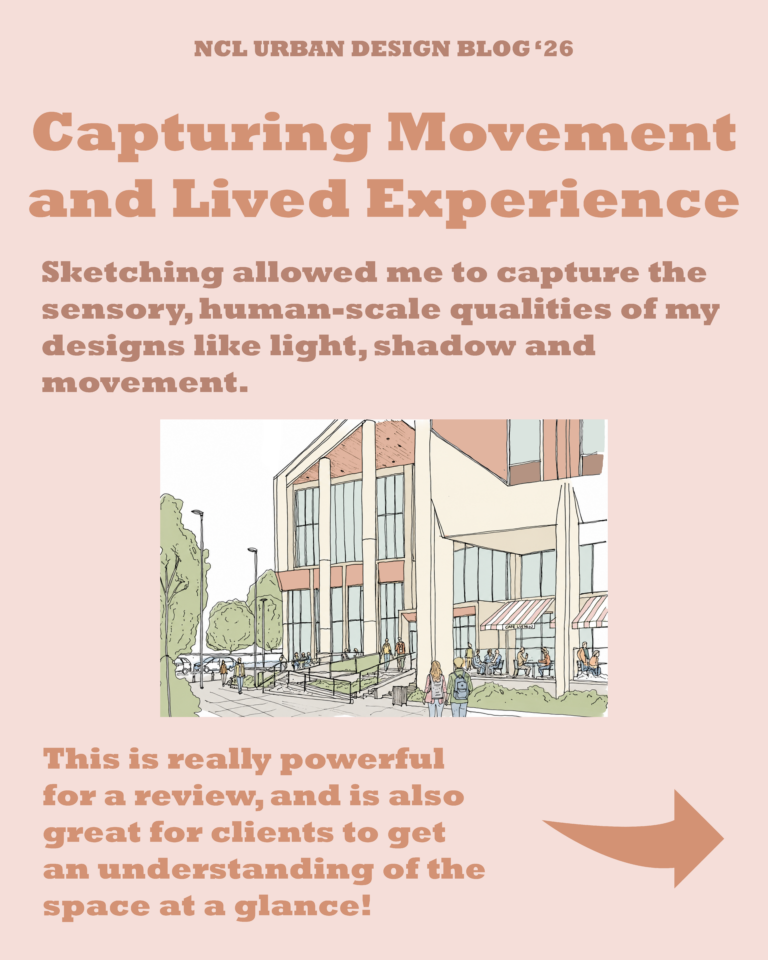
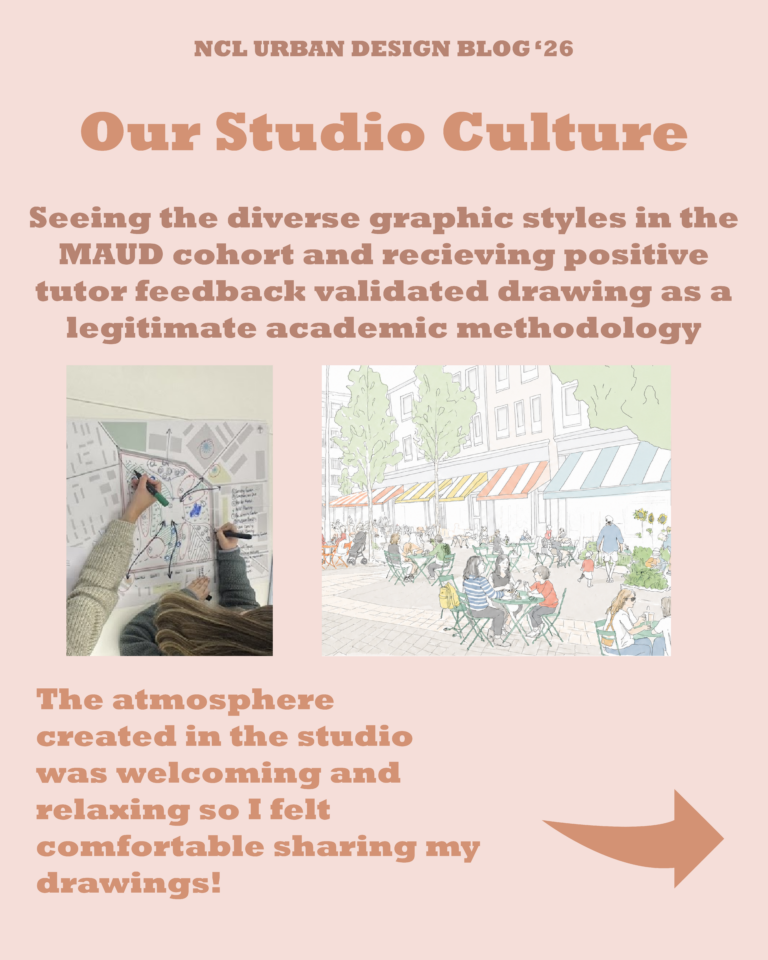
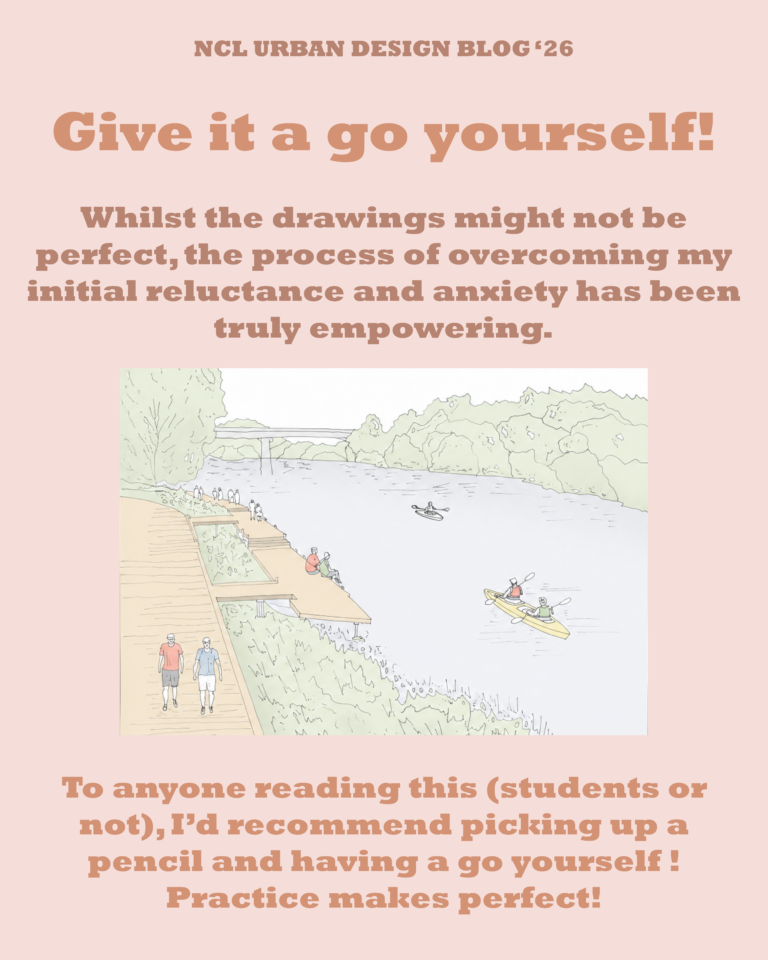
Figure 1: Author’s Own (2026) Carousel Slides for Instagram Post. Available at https://www.instagram.com/maurbandesign/
Reflections and a Key Takeaway: The importance of Freehand Sketching as a Tool for Spatial Thinking and Graphic Communication
A personal challenge I overcame this year became directly connected to a major professional takeaway. The most significant learning curve for me was understanding that an urban design proposal does not need to be digitally perfect to communicate complex spatial qualities. The issues of visually resolved proposals being presented too early in the design process was a topic I enjoyed exploring in my blog about public participation in UK Placemaking Plans. Within contemporary studio culture, there is a tendency to treat architectural visualisations as finished, hyper-realistic products rather than active tools for spatial thinking.
As Pallasmaa (2009) explores in The Thinking Hand, there is an “embodied wisdom” in manual work. Drawing allows us to test volumes, edges, and user experiences in a fluid way that CAD software often bypasses. By avoiding rigid digital rendering, I began using sketching as a reflexive method of critiquing the spatial logic of my design. This aligns with Amoruso (2022), who identifies the phenomenological value of drawing as a bridge between mental concepts and physical reality.
Furthermore, Lucas (2016) highlights that drawing functions as a form of sensory notation. Seeing the diverse graphic styles shared in studio sessions transformed my perspective in this regard. The absence of hyper-realistic renders from my peers, combined with constructive tutor feedback, validated freehand drawing as a legitimate academic methodology.
While my hand-drawn visuals are by no means perfect, they successfully capture the atmospheric, human-scale conditions of my urban interventions. The supportive studio culture within MAUD has given me the confidence to trust my graphic language, something I know I will carry into my professional career with great enthusiasm.
References
Amoruso, G. (2022) ‘The drawing as a tool for urban narrative and design thinking’, Journal of Urban Design and Visual Culture, 5(2), pp. 112–125.
Lucas, R. (2016) Research methods for architecture. London: Laurence King Publishing.
Pallasmaa, J. (2009) The thinking hand: existential and embodied wisdom in architecture. Chichester: John Wiley & Sons.
