

Reflexive Summary
My studio journey this semester: From early ideas to a clearer project
This carousel shows my studio turning point this semester. At the beginning, my studio project had ideas but the links were weak. The mid-review was the first time I presented the full proposal, and the feedback showed what I was missing: my routes were not clear, the green space didn’t connect well, and parts of the design didn’t truly respond to my site analysis—it was too “assumed.” I also noticed drawing-scale issues that made some spaces feel unbelievable. After that, I didn’t simply beautify the drawings. Instead, I completely redesigned the entire plan: rebuilt the circulation routes, adjusted the landscape as a system, and checked the dimensions and proportions more carefully.
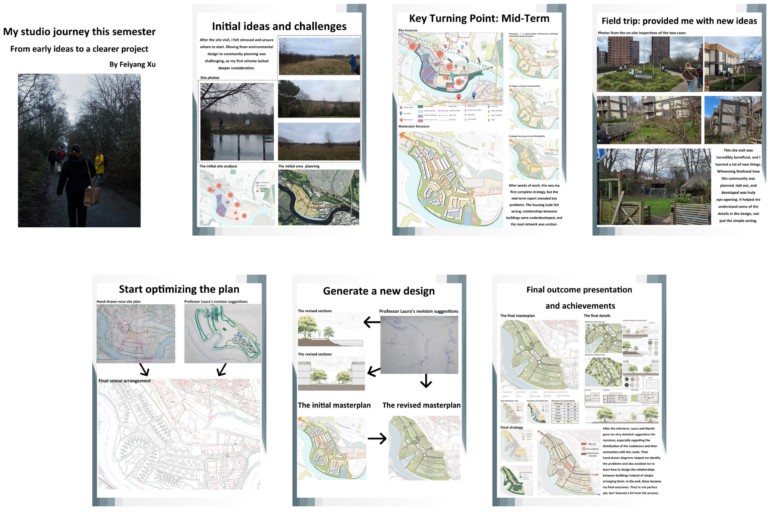
Photos posted on Instagram (All the diagrams and photos were taken and produced by Feiyang Xu)
My Key Takeaways
Writing reflections was challenging for me last semester, time consuming and writing in English was really hard. I can see real improvement this semester. Writing doesn’t seem so scary or impossible anymore. It’s still work, but it doesn’t seem as daunting. I’m also happier, since now I’m able to articulate what I think and feel, not just completing a task.
From Blog 1, my biggest gain was learning to read streets through conflict and trade-offs, not through one “nice” image. I became more sensitive to how pedestrians, buses, bikes, deliveries and cars compete for limited space, especially in peak hours. I also learned to ask myself, “who is safe here, who is pushed away, and what does this street prioritise?” rather than to think, “this street is busy, so it is good.” Moreover, Rui and Othengrafen (2023) noted that streets are not just for moving. They are social space as well. Due to this, tension is a thing to be expected and street design must be fair to the different types of users.
One thing I learned from Blog 2 was being able to explain “liveability” in simple day-to-day terms: distances, access to services and how easy it is to walk and cross. I was able to make that point very clearly by using Grainger Street, and comparing it with Shanghai. I now realise that liveability is more about small things, which can be repeated in everyday life – places to go, routes to get there, and walking will not be obstructed. Baobeid, Koç, and Al-Ghamdi (2021) also noted that walkability is influenced by connectivity, accessibility, distance to other destinations, and services, and that it further leads to health and livability outcomes.
Reference
Baobeid, A., Koç, M. and Al-Ghamdi, S.G. (2021). Walkability and Its Relationships with Health, Sustainability, and Livability: Elements of Physical Environment and Evaluation Frameworks. Frontiers in Built Environment, 7(7).
Rui, J. and Othengrafen, F. (2023). Examining the Role of Innovative Streets in Enhancing Urban Mobility and Livability for Sustainable Urban Transition: A Review. Sustainability, 15(7), p.5709.
