

Reflexive Summary – Developing Diagrams, and The Importance of Alternatives
My Experience – Developing a Clearer Diagrammatic Language
Over the course of our studio project this semester, one of my greatest challenges has been learning to develop a clear diagrammatic language, in order to develop strong, clear and legible diagrams to explain my design proposals.
Whilst initially text-heavy, I learned to focus on the narrative which I wanted to explain. This meant narrowing information to only the components essential in telling the narrative, demonstrated through simple, clear and legible visuals.
Ultimately, I learned that diagrams are not just used to display information, but to tell the story that you want to communicate.
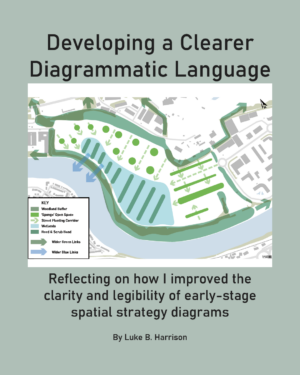
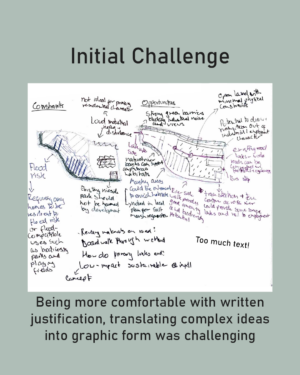
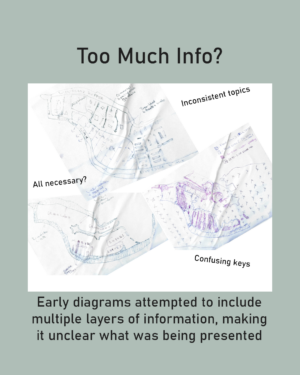
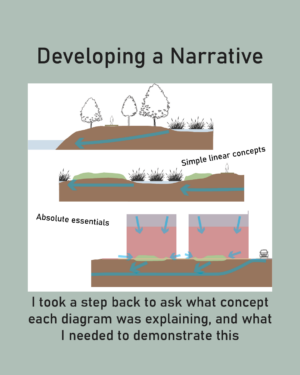
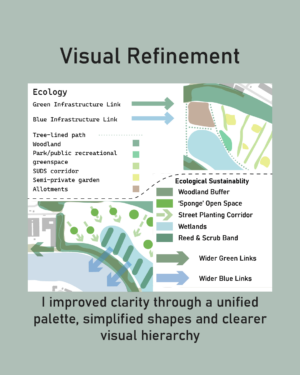
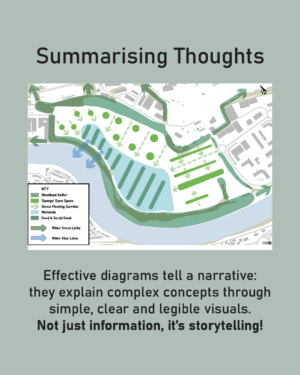
Images: Author’s Own (2026) Carousel slides for Instagram post
Key Takeaways – The Importance of Exploring Alternatives
Across my design studio and blogging experience over the last semester, I have explored various case studies of alternative urban design practice, from co-housing in Leeds, to self-builds in London, and pedestrian-prioritised streets in Germany. In exploring not even a fraction of alternative approaches to urban design, a key takeaway I will take forward into my professional experience is the importance of looking away from the default when working within the status quo.
In practice, more often than not, the types of places we design are shaped by the same sets of standards and regulations; whether building separations, housing typologies or street layouts, these defaults are rarely questioned in favour of the practicality and efficiency of contemporary planning practice. However, the trust given to these standards often means that the potential to do things differently is lost (Madeddu et al., 2015).
In exploring alternative case studies, I have been able to consciously critique standards and norms against alternative design approaches. In the case of co-housing, LILAC in Leeds demonstrates how shared ownership and community self-governance can support social cohesion and sustainable lifestyles (Jarvis, 2015), despite parking and spatial standards which would have favoured more conventional street-based housing forms (LILAC, 2020). This highlights how design norms can constrain resident-led alternatives in favour of established practice.
Similarly, the ‘Verkehrsberuhigter Bereich’ in Germany reframes the priority of street users by emphasising the social function of streets, requiring cars to negotiate space at a human scale. This contrasts with English street design guidance, which reinforces the separation of pedestrians and vehicles (Homes England, 2022), limiting opportunities for “life between buildings” (Gehl, 2010). This difference highlights a broader bias towards efficiency and risk management over human-scale experience.
By exploring alternative approaches to urban design, I have become better equipped to question the priorities of established norms and standards, and consider how emerging priorities can translate into more diverse urban design solutions.
References
FGSV (2006) Guidelines for the Design of Urban Streets (RASt 06) – English Translation. Cologne: FGSV Verlag. Available at: https://www.fgsv-verlag.de/pub/media/pdf/200_E_PDF.i.pdf (Accessed 17/05/2026)
Gehl, J. (2010) Cities for People. Washington, DC: Island Press. Available at: https://www.jstor.org/stable/jj.41003893 (Accessed: 17/05/2026)
Homes England (2022) Streets for a Healthy Life: Design and Planning Guidance. London: Homes England. Available at: https://www.gov.uk/government/publications/streets-for-a-healthy-life (Accessed 17/05/2026)
Jarvis, H. (2015) ‘Towards a deeper understanding of the social architecture of co-housing: evidence from the UK, USA and Australia’. Urban Research & Practice, 8(1), pp. 93–105. Available at: https://www.researchgate.net/publication/276377943_Towards_a_Deeper_Understanding_of_the_Social_Architecture_of_Co-housing_Evidence_From_the_UK_USA_and_Australia (Accessed: 17/05/2026).
LILAC (2020) Living in LILAC: Assessing the first Mutual Home Ownership Society in enabling sustainable living. Leeds: LILAC. Available at: https://lilac.coop/wp-content/uploads/2020/12/Lilac-Impact-Final-Draft-Compressed-200dpi.pdf (Accessed 17/05/2026)
Manuela Madeddu, Nick Gallent and Alan Mace (2015) ‘Space in new homes: delivering functionality and liveability through regulation or design innovation?’ Town Planning Review, 86(1), pp. 73–95. Available at: https://www.liverpooluniversitypress.co.uk/doi/epdf/10.3828/tpr.2015.5 (Accessed 17/05/2026)
