

Reflexive Summary: Spatial Justice and My Learning Journey in TCP8090
Initially, I considered cities as mere physical places, defined by buildings, infrastructure, and zoning regulations, before starting the module TCP8090. However, this fourteen-week course has changed my perception completely, and I see urbanism as people and their identity and needs in the first place. I believe now that spatial justice is the same as everyone having fair access to city space and that every human being has the right to a place in the city, to a home, safe mobility, and public space, too.
Dijkstra (2025) portrayed the lecture as an inclusive landscape architecture, which, according to the viewpoint of sociologists, opened a new chapter of people benefiting from and losing the creation of an environmentally and socially just world (Thomas, 2022). The slide showing “whose story is being told matters” (Haraway, 2019; Dijkstra, 2025) changed my perception of the designer’s role. At first, I thought of designers as unbiased participants, but now I see that our views and backgrounds influence the places we build; hence, inclusive designing needs the designer to be conscious and involved in a critical way, not that of being neutral. At first, I thought of designers as unbiased participants, but now I see that our views and backgrounds influence the places we build; hence, inclusive designing needs the designer to be conscious and involved in a critical way, not that of being neutral.
Arnstein’s (1969) Ladder of Citizen Participation, discussed during the lecture, changed the way we think about the power and the designers during that period. Most of the projects that are called “participatory” move along the lower steps of her ladder, informing or consulting, where the existing power is merely kept. Spatial justice means to go up the ladder to rungs like partnership or citizen control, where the disadvantaged ones are involved in the decision-making process and share the benefits of the results.
The readings and Dutch case studies mentioned in the lecture, The Urban Fringe Lab (BNA/ARCAM, 2022) and Planted Avenues in the Netherlands (Verschuure et al., 2022), have allowed me to see the connection of these lessons to the physical surroundings. The Netherlands has designed the roads, paths for bicycles, and green systems in a manner that they are perceived as a cohesive and just infrastructure, not as a hierarchy with cars on top. This situation made me question the matter: what if the urban environment and transport in my hometown were designed according to the same principles of justice and access, for instance?
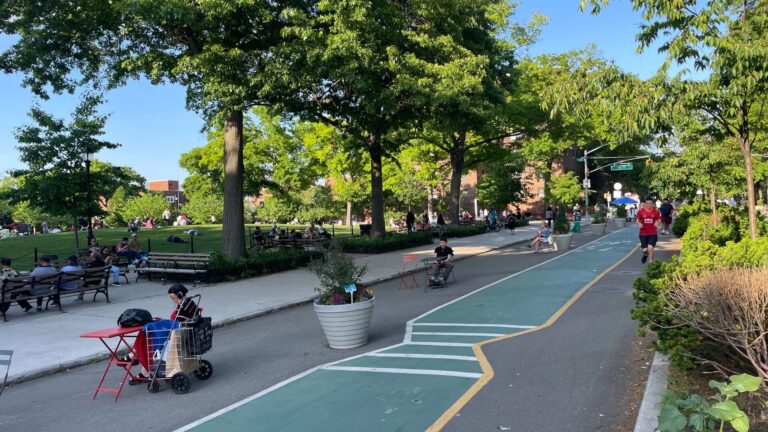
Figure 1. Human-centered street design prioritizes pedestrians, cyclists, and social activity, illustrating mobility equity and inclusive urban infrastructure. Photo credit: Gehl Studio (2024).
The transformation of Qatif Corniche is one remarkable instance, which, following years of limited access, has been made available to the public, thereby providing direct access to the waterfront. The new build of promenades, gardens, seating areas, and family spaces together has made it possible for social groups from different walks of life to use the waterfront equally. One more example can be the construction of sidewalks and bike paths, which is a clear indicator of providing justice to the mobility of children, women, and non-vehicular residents as opposed to the car-centered urban planning. The whole process has been very progressive, as it has shown that the concept of designing for the whole is indeed a key factor in the quality of life; it gives dignity, safety, and freedom of choice. However, by re-evaluating the whole scenario, it turns out that accessibility by itself is not sufficient for the attainment of spatial justice: the designers must be able to identify who the beneficiaries are, who feels welcome, and who is left out. The radical inclusion framework (Thomas, 2022), the lecture presented reminded me that justice can only be done when the lives of the people historically excluded help in defining what public spaces should be.
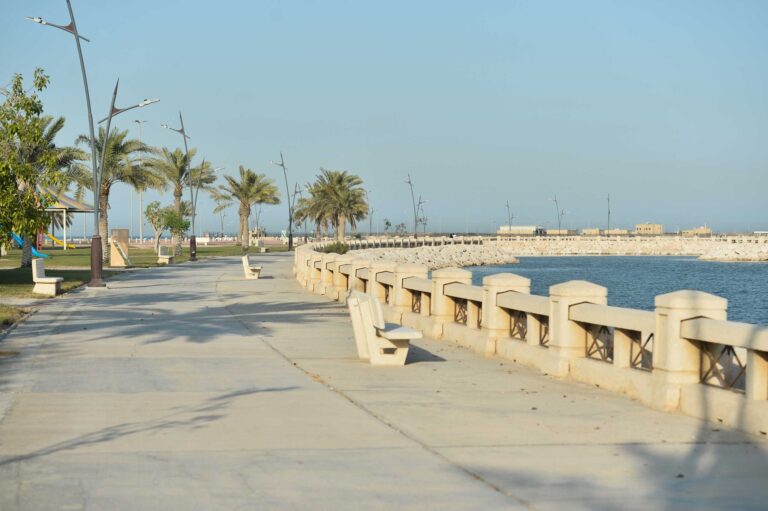
Figure 2. Pedestrian promenade at Qatif Corniche, Eastern Province, Saudi Arabia, a coastal public space with walking paths, seating, and shaded landscape elements. Photo by Saudipedia (2025).
Writing was like keeping a diary of my design philosophy instead of just doing a typical assignment. Through blogging, I concluded that my gut feeling is to do practical designing first and then to do creative designing second. I want to take a leap of faith with imagination next semester to not only solve problems efficiently but also creatively through meaning, emotion, and belonging. Personally, spatial justice is about providing fair access, visibility, and usability for all identities in a manner that does not silence the voices of people but instead involves them through the design process.
References:
Arnstein, S.R. (1969) ‘A Ladder of Citizen Participation’, Journal of the American Planning Association, 35(4), pp. 216–224.
Crenshaw, K. (1989) ‘Demarginalizing the Intersection of Race and Sex’, University of Chicago Legal Forum, Article 8.
Dijkstra, L. (2025) Principles & Practice of Inclusive Landscape Architecture. Lecture presented at Newcastle University, TCP8090, 18 November 2025.
Haraway, D. (2019) ‘It Matters What Stories Tell Stories; It Matters Whose Stories Tell Stories’, a/b: Auto/Biography Studies, 34(3), pp. 565–575.
Thomas, L. (2022) The Intersectional Environmentalist: How to Dismantle Systems of Oppression to Protect People + Planet. London: Souvenir Press.
Verschuure, G., Dijkstra, L., Hirsch, et al. (2022) Planted Avenues in the Netherlands. BNA/ARCAM.
Figure list:
Gehl Studio (2024) Human-centred street design prioritising pedestrians, cyclists and social activity. Photograph. Available at: https://www.gehlpeople.com/knowledge-hub/articles/pedestrian-friendly-streets-how-human-centered-urban-design-boosts-communities-and-local-economies/ (Accessed: 25 November 2025).
Saudipedia (2025) Pedestrian promenade at Qatif Corniche, Eastern Province, Saudi Arabia. Photograph. Available at: https://saudipedia.com/en/article/1772/government-and-politics/al-qatif-corniche (Accessed: 25 November 2025).
