Shaping spaces with yarn: The role of crochet and knitting in community intervention
To many people, knitting and crocheting are hobbies, a way to create and relax. Others might associate knitting with their Gran, or maybe you love that knitted scarf you bought. So, whether you take part in the craft, or it’s just your favourite jumper, yarn plays a role in life, big and small.
There is more to knitting and crocheting than meets the eye. Not just clothing, nor decoration, they can bring both whimsy and reform to public life.
Craftivism is an alternative form of protest or intervention which relies on craft to promote social, political, or other forms of societal change (Sanders-Bustle, 2022). Often, the presence of these cosy crafts in the public realm interrupts the urban environment by seeming out of place and unexpected (Vachhani, Bell, and Bristow, 2025), making you stop to look or take a photo.
Yarn bombing
‘Yarn bombing’ is a more recent form of craftivism. It is often credited to Magda Sayeg (McGovern, 2014) and involves the transformation of everyday objects with knitted or crocheted projects. Sayeg references her interest in “enhancing the ordinary” “by giving it a well-tailored suit out of knitting” (TED, 2015, 01:27).
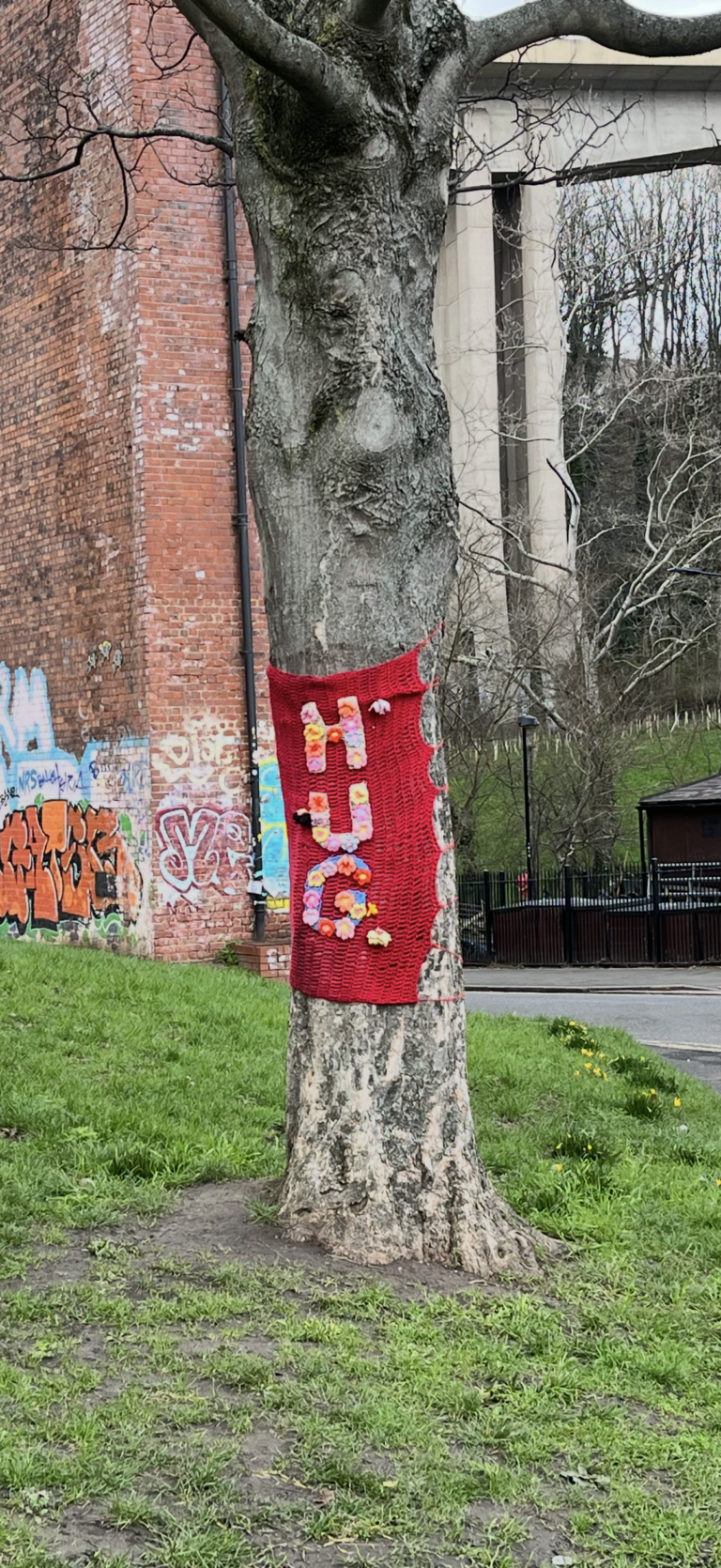
Image: Yarn bomb on a tree in Ouseburn, Newcastle. Authors own.
More frequently than not, these installations are viewed positively by the wider public (McGovern, 2022). This could be in reaction to the softness of the materials used or the obvious time and care put into creating the pieces. It is common for these installations to be group projects. A collection of like-minded people with similar hobbies getting together as a community to bring colour and personality to their streets. It can be a way to bring the neighbourhood together through both active and passive engagement.
The main ways yarn bombing can impact the public realm:
- Adding colour and character to public spaces
- Reclaiming public spaces
- Challenging existing uses and promoting new ones
- Highlighting social inequalities
- It can also provide an outlet for social interaction and collaboration
(McGovern, 2022)
The rise of Postbox Toppers
A popular project which spread through the streets of the UK in 2022 is a form of yarn bombing called postbox toppers (Phipps, 2022). These are crochet and knit scenes or decorations that are attached to the top of postboxes.
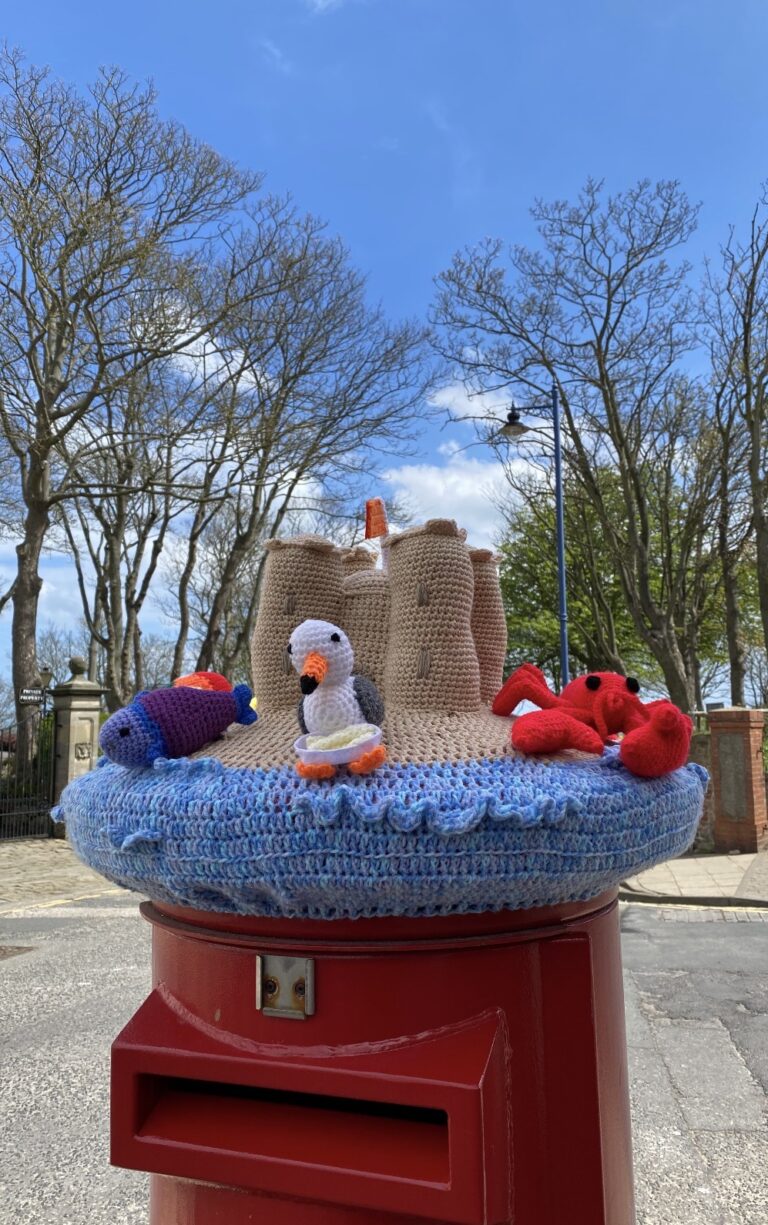
Image: Postbox topper in Filey. Authors own.
Some postbox toppers are used to celebrate occasions, others to bring attention to issues or causes, and many are there to put a smile on your face and soften the outdoor environment.
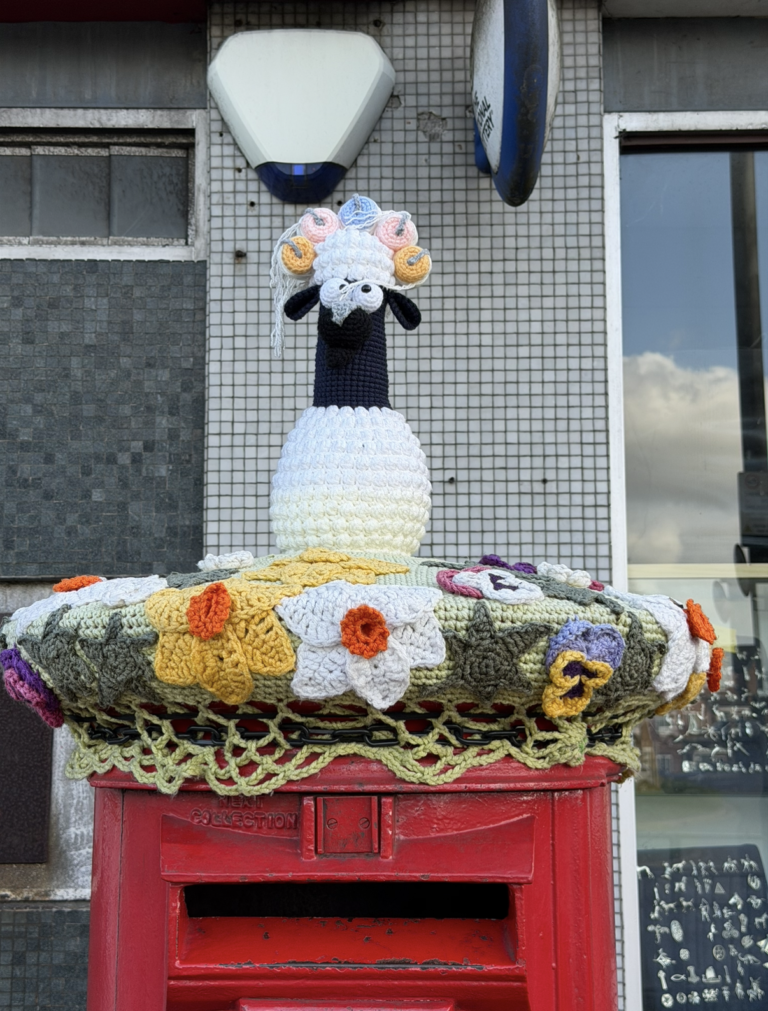

Image: Postbox toppers in Rotherham. Authors own.
Yarn bombing can provide an outlet for people to collaborate in urban spaces, playfully shifting mundane street furniture into a cosy and intriguing piece of art. Armed with yarn, hooks, or needles, the everyday can be a bit more whimsical.
References
McGovern, A. (2022) ‘Yarn Bombing’, in R. Atkinson and T. Ayres (eds.), Shades of Deviance: A primer on Crime, Deviance and Social Harm. Taylor and Francis Group. Available at: https://doi.org/10.4324/9781003138198-4.
McGovern, A. (2014) ‘Knit one, purl one: the mysteries of yarn bombing unravelled’, The Conversation, 5 March, Arts and Culture. Available at: https://doi.org/10.64628/AA.4pqged3pa
Phipps, A. (2022) ‘Postbox toppers: the creative craze that captivated communities in 2022’, BBC News, 31 December. Available at: https://www.bbc.co.uk/news/uk-england-derbyshire-63833983 (Accessed: 21 March 2026)
Sanders-Bustle, L. (2022) ‘Negotiating the Art of Protest through Craftivism’, The International Journal of Art and Design Education, 41(3), pp. 427-445. Available at: https://doi.org/10.1111/jade.12421
TED (2015) Magda Sayeg: How yarn bombing grew into a worldwide movement. November 2015. Available at: https://www.ted.com/talks/magda_sayeg_how_yarn_bombing_grew_into_a_worldwide_movement?subtitle=en (Accessed: 22 March 2026).
Vachhani, S., Bell, E. and Bristow, A. (2025) ‘The affective micropolitics of craftivism: organizing social change’, Organization Studies, 46(4), pp. 525-547. Available at: https://doi.org/10.1177/01708406241305752



I thoroughly enjoyed this entry and learning about knitting, as well as its relationship to craftivism, as I was not very familiar with this topic.
One aspect that I found particularly interesting was yarn bombing. I loved learning how yarn is used to transform everyday objects through knitting and crochet. In some ways, this could also mimic buildings with adaptive reuse, depending on the type of crochet applied to the object.
It was clear to see how this relates to urban design in many ways, but one aspect that stood out to me was the theme of community and how it brings colour to the streets. This could be seen as a way for communities to reclaim the public realm, or simply as a creative outlet for collaboration.
Although you discussed the impacts of yarn bombing, I think to take this a step further you could explore the importance or need for such practices, and link this more clearly to their impact. This would help reinforce the significance of craftivism (McGovern, 2019). This could potentially be supported with personal experiences or secondary sources.
References:
McGovern, A. (2019). Craftivism and Yarn Bombing. Springer Nature.
This was a really lovely read Jess!
I really enjoyed how you highlighted how community engagement can happen through small, informal, everyday acts. This reminded of how accessible urban intervention can be, the idea that people can connect through shared hobbies is really beautiful and human. Urbanism really exists in everything we do. A postbox topper might seem tiny, but it can genuinely change someone’s walking experience by adding surprise, care and personality to an ordinary route. It definitely improve my walks! This links to Jacobs’ (1961) argument that lively streets are shaped by everyday social encounters, not just planned design. I believe these human scale interventions really make public spaces feel lived in and cared for which inherently impacts how people engage with the space, which salso reflects de Certeau’s (1984) view of walking as a practice through which people actively reinterpret the city. I think the post beautifully shows how (yarn) small interventions can soften public space and create quiet, playful and vibrant moments of connection.
References
de Certeau, M. (1984) The Practice of Everyday Life. Berkeley: University of California Press.
Jacobs, J. (1961) The Death and Life of Great American Cities. New York: Random House.