The Magic in Urban Design – How Disneyland uses traditional urban design principles to influence visitor experiences
Disneyland California was a pioneer of what we now know as the modern-day theme park, introducing a city-like environment to the world of fairgrounds. This provides a carefully controlled urban environment which influences the way we, as visitors, experience the world which has been created within the park. The average person is unlikely to notice but the ‘imagineers’ who originally designed the park integrated many traditional urban design principles which have ultimately contributed to the parks great success. Although Disneyland opened before many influential urban design texts were published, its layout reflects principles later formalised by well-renowned scholars in the field.
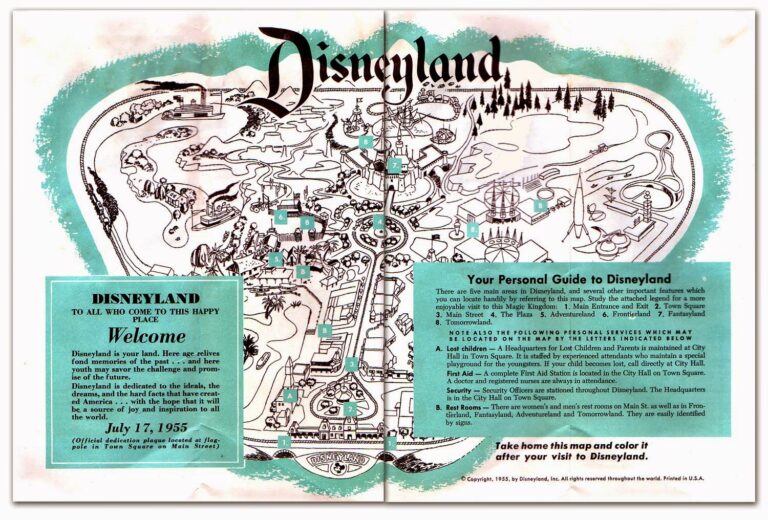
Image: The Walt Disney Company. (1955) Origonal map of Disneyland Park. Available at: https://www.disneyavenue.com/2015/04/disneyland-map-evolution-1955-2015.html (Accessed: 17/03/2026).
Main Street USA is designed to appeal to the human scale and imitates the traditional American small town street, which reflects Jane Jacobs observations regarding the success of streets when they are centred around the pedestrian experience. Closely spaced buildings, engaging window displays and accessible shops cause visitors to slow down, browse the street and meander through a calm entrance into the park. This closely mirrors Jacobs’ statements that urban vitality is sustained through street-level activity (Jacobs, J. 1961).
The hub and spoke design of the park relates closely to the garden-city movement (Howard, E. 1985) as well as embodying Kevin Lynch’s five elements (1960). The diagrams below highlights these comparisons:
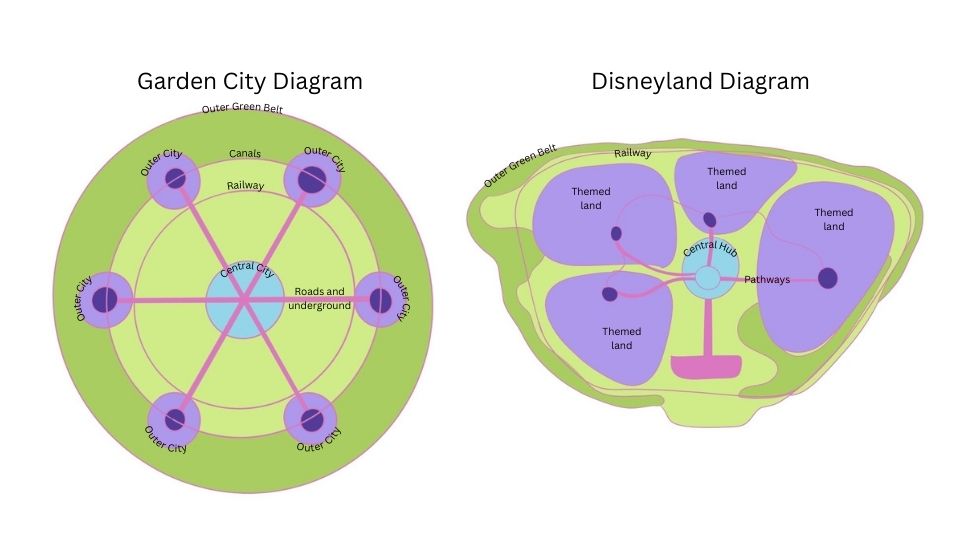
Diagram: Comparison of Howards Garden-City movement diagram to the layout of Disneyland California by Rhiannon Laverick
The central hub acts as a node with paths leading out to different themed lands. Memorable landmarks are located within each land which also have distinct themes to form districts, aiding in wayfinding. Edges are also used throughout with a railroad surrounding the perimeter of the park. Use of the five elements mean visitors always have visual reference points which reduce feelings of confusion despite the complex environment. Crowds are therefore distributed efficiently and a reduction in dead ends subtly guides movement in an intuitive way. Guests also may feel like the different districts have transported them much further than they physically have due to the clever use of theming and narrative environments which come from a sequential spatial experience.
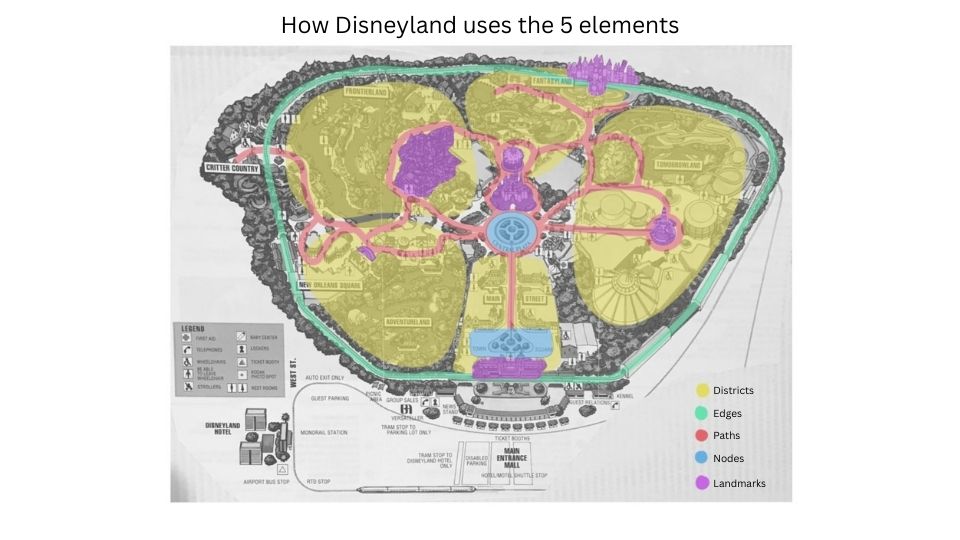
Diagram: How Kevin Lynches 5 elements are utilised at Disneyland California by Rhiannon Laverick
Arguably most of all, the park takes influence from the garden-city movement introduced by Ebeneezer Howard (1985). The hub and spoke design mirrors that of the movement and separates the different zones and types of activities. Landscaping mimics the outer green belt and shields the park from the surrounding city. Integrated transportation allows for ease of movement to and from the park as well as within.
Whilst the use of these principles has aided in the success of the park, particularly of movement within and guest perceptions, there are some elements it lacks. The aspects taken from the garden-city movement are quite artificial and provide less of a community (which was Howards intention) but rather encourage spectacle and consumption. The careful control of the environment also limits spontaneous interactions which were valued by Jacobs.
However, Walt Disney famously stated ‘Disneyland will never be completed. It will continue to grow as long as there is imagination left in the world’ and as such there will always be the ability for improvements within the park (The Imagineering Story, 2019).
References:
Disney Avenue (2015) Disneyland Map Evolution 1955-2015. Available at: https://www.disneyavenue.com/2015/04/disneyland-map-evolution-1955-2015.html (Accessed: 17/03/2025).
Howard, E. (1985) Garden cities of to-morrow. New rev. ed. Eastbourne: Attic Books.
Jacobs, J. (1961) The death and life of great American cities. New York: Vintage Books.
Lynch, K. (1960) The image of the city. Cambridge: Technology Press.
The Imagineering Story (2019) Disney+, 12th November.



It’s interesting to consider how Urbanist ideals intersect with Disneyland’s design and contribute to its sense of vitality.
As your discussion describes, the intimate built form and open architecture of ‘Main Street USA’, supported by it acting as the primary movement corridor between the entrance and central hub, reflect Jacobs’s necessary conditions for Urban Vitality (Jacobs, 1961). Beyond the built environment, the programme of this district supports Jacobs’s described need for diverse uses, with the inhabitants of a district – in this case, visitors – “in the place for different purposes, but… able to use many facilities in common.” To satisfy this condition, ‘Main Street USA’ provides a high density of diverse uses, from a range of restaurants to guest information to toilet facilities, as well as the most accessible attractions – theatrical rather than rides – based on their most recent park map (Disney, 2026).
Disneyland now also offers short stays in off-site hotels (Disney, 2026) – this seems to more closely mimic the suburban form which developed from the Garden City model (Jacobs, 1961). It would be interesting to explore whether on-park provision, increasing the diversity of uses, would also increase vitality, or if market factors would render this unprofitable, similarly to how market desires drove suburban development (Lozano, 1990).
References:
Jacobs, J. (1961) The death and life of great American cities. New York: Vintage Books.
Lozano, E.E. (1990) Community design and the culture of cities : the crossroad and the wall. Cambridge: Cambridge University Press.
Midgely, E. (2026) 2026 Disneyland Park Map California (Printable PDF) – Plus, Each Land Map. Available at: https://mickeyvisit.com/disneyland-park-map/ (Accessed: 31/03/2026)