Urban Design in Practice with ARUP
Introduction: ARUP’s Mission for Better Urban Cities
Today, cities are growing quickly and climate change is a serious issue. Urban design is no longer just about building roads or buildings. It is about how people live, move and feel in cities every day. In this blog, I use Arup, a global firm that works on planning, design and engineering for the built environment, as an example of urban design in practice.
I focus on three points: teamwork and data in urban design, everyday public space, and Climate resilience and green infrastructure.
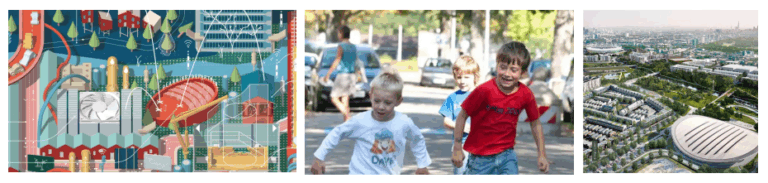
Figure 1. Illustration from Arup’s “AI for Future Cities: Urban Planning and Design”.
Figure 2. Image from Arup’s “Cities Alive: Designing for Urban Childhoods”.
Figure 3. Cover of Arup’s “Cities Alive: Rethinking Green Infrastructure”.
Teamwork and data in urban design
Romice et al. (2022) argue that urban design is a specialised, evidence-led profession that deals with “organised complexity” and should use clear information about urban form and performance.
This view matches Arup’s Masterplanning and urban design service. Arup works on projects from neighbourhoods to new cities, and tries to balance site conditions, social and economic factors and environmental issues, while fitting new plans into the existing urban fabric.
In the city plan for Adelaide, for example, Arup helped develop a framework for future growth and liveability, and used a digital twin model to test different scenarios for physical, social and green infrastructure.
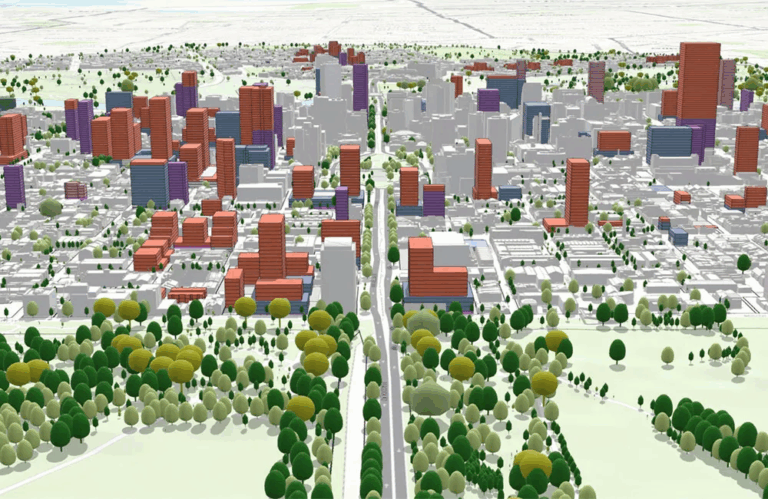
Figure 4. Digital twin style model used for the Adelaide City Plan
For me, this shows that urban design in practice is team-based. Digital tools and models do not replace design, but they help the team see the likely impacts of different options before they choose a masterplan.
Everyday public space
Urban design is also about everyday life at ground level. Jan Gehl’ s book Life Between Buildings explains that the quality of public space depends on how it supports necessary, optional and social activities (Gehl, 2011). If people can stay comfortably and meet others, the city becomes more lively and healthy.
Arup’s report Cities Alive: Designing for Urban Childhoods connects this human-scale thinking to practice. It argues that the time children spend outdoors, their freedom to move and their contact with nature are important indicators of how well a city works, not only for children but also for residents.
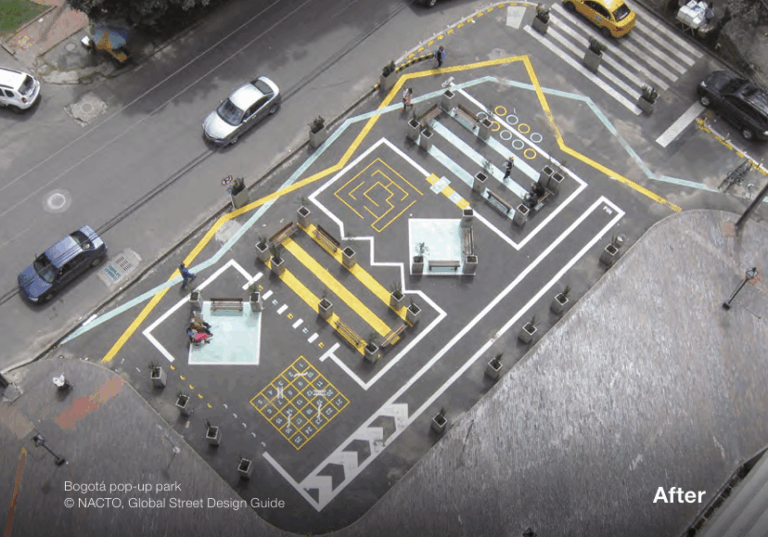
Figure 5. Case study image from Arup’s “Cities Alive: Designing for Urban Childhoods”, showing after change to a street space in Bogotá to prioritise children’s movement and play.
ThIs situation changes how I see familiar places, such as streets in Newcastle or historic areas in my hometown in China. I start to notice where children can move independently, where there is shade and seating, and where there are small pockets for play.
Climate resilience and green infrastructure
The final topic is climate resilience. Arup’s report Cities Alive: Rethinking Green Infrastructure argues that networks of parks, trees, green roofs and river corridors are essential systems, not decoration. They can help cities face flooding, heat, air pollution and biodiversity loss, and at the same time support health and social life.
The L’ Innesto project in Milan gives a clear example. It is planned on a former railway yard and is described as Italy’s first zero-carbon or carbon-neutral social housing district.Arup explains the large share of the area will become public space, car parking is limited, and walking and cycling are supported, with generous bike parking and shared vehicles.The plan also adds facilities linked to a circular economy, such as a community food hub and a zero-waste store. This project shows how energy systems, mobility, landscape and community facilities can be planned together.
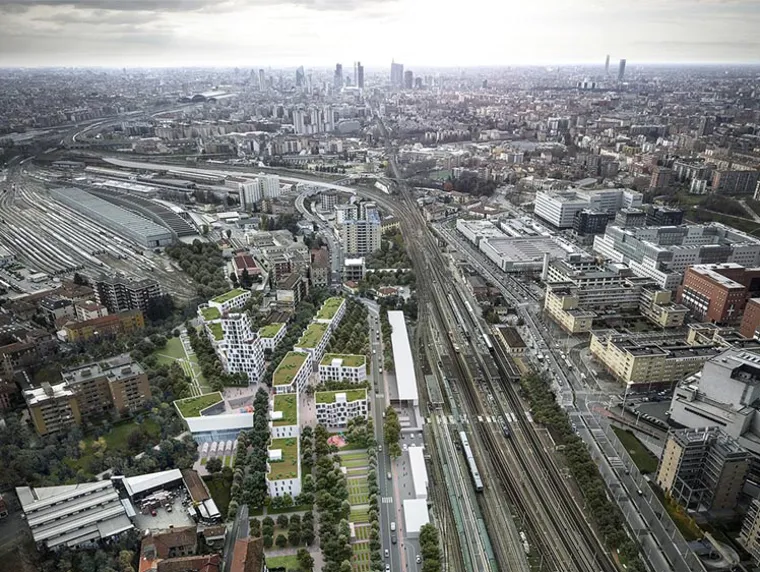
Figure 6. Aerial visualisation of L’ Innesto in Milan, showing the transformation of a former rail yard into a low-carbon social housing district with a high share of green space.
Conclusion
Carmona (2021) describes urban design as a continuous process of shaping places, influenced by shifting global, local and power contexts. Romice et al. (2022) stress the need for clear roles, methods and evidence in this process. Arup’s work helps me see how these cases look in practice.
As a master’s student, I find this mix of practice and theory helpful. Arup’s reports and projects give concrete examples of people-centred and climate-aware design. The academic articles by Gehl, Carmona and Romice et al. help me reflect on these examples. In future work, I hope to use both kinds of knowledge to support cities that are not only smart and green, but also fair and comfortable for everyday life.
References:
Carmona, M. (2021) Public places urban spaces: The dimensions of urban design. 3rd edn. London and New York: Routledge.
Gehl, J. (2011) Life between buildings: Using public space. Washington, DC: Island Press.
Romice, O., Rudlin, D., AlWaer, H., Greaves, M., Thwaites, K. and Porta, S. (2022) ‘Setting urban design as a specialised, evidence-led, coordinated education and profession’, Proceedings of the Institution of Civil Engineers – Urban Design and Planning, 175(4), pp. 179–198. doi:10.1680/jurdp.22.00023.



This article is well written and easy to read, it presents the information very clearly and plainly which is always appreciated. The article touches on a wide range of points and subjects while still ensuring that all information presented is relevant and ties back into the overall theme, the Adelaide masterplan is a clear example of this. Also, by citing the author’s personal experience of cities such as Newcastle or their hometown in China, and their background as a master’s student it adds a personal element to the work which helps communicate the ideas.
A common critique of urban design practices is the consistent “theory-practice gap”, which articulates that although urbanism projects by large scale companies (including ARUP) may emphasize sustainability, equity and user-focused outcomes, they often fall short. This can be due to a number of factors including; institutional constraints, low economic priority, limited engagement and policy-practice misalignment (Crilly & Lemon 2018). Other’s argue that ARUP’s ambitious sustainability narratives might be under-emphasizing how local authorities, economic factors and market forces, can affect what is feasible within an urban project, which again is a common criticism of urban designers today.
ARUP also emphasizes data, simulations, digital modeling and the use of AI, which some have critiqued as prioritizing efficiency metrics and a technological narrative that may not be completely accurate to the real world. Similar to how architects are now critiqued for their drawings being too far removed from physical reality. Jennifer Clark takes this a step further, noting how technological urbanism can actually reinforce socioeconomic inequality and give more power and privilege to tech companies than they already have (Clark 2020). Instead calling for more democratic and participatory city planning over consultancy-driven tech-based solutions.
References:
Crilly, M & Lemon, M (2018). The Misalignment of Policy and Practice in Sustainable Urban Design. ResearchGate.
Available at: https://www.researchgate.net/publication/324397298_The_Misalignment_of_Policy_and_Practice_in_Sustainable_Urban_Design
Clark Jennifer (2020). Uneven innovation: the work of smart cities. New York: Columbia University Press.
This article is quite well written. There is a very fluent writing style and the logic is understandable. It talks about team work, data, public places, and climatic resilience in a succinct manner. Practical cases and pictures are also provided which makes it easy to grasp the main ideas at a glance by the readers. These human-centred themes are in line with the renewal objectives on a larger urban level (Zhu, 2025).
The part of this article that greatly interests me is about everyday public spaces. The article brings up mundane aspects in daily life like people having a place to socialize, which is important in the existence of the community (Zhu, 2025). I also concur with the concern expressed in the article on the issue of whether children can freely play and take rest outdoors. ARUP emphasizes that the time children spend outdoors and the range which they are allowed to roam freely are crucial signs of a well functioning city. This makes me remember a neighborhood I lived in. There are no public recreational facilities available for children and residents within the community and its vicinity. This problem is especially related to me.
On the whole, reading this article not only helped to learn professional information on the topic of urban design but also gave me the impression of human imagery and climate orientation of the design. I have also become aware that climatic factors were not given adequate consideration during the preliminary design. This reflection made me notice that I should pay more attention to human-centered design and climate resilience in my future projects.
Reference list
Li, C., Yang, H., Yao, Q., An, N. and Meng, H. (2024). Governing Urban Climate Resilience (UCR): Systems, Agents, and Institutions in Shanghai, China. Sustainability, 16(7), pp.2648–2648. doi:https://doi.org/10.3390/su16072648.
Zhu, Jingyi (2025). Public space and its publicness in people-oriented urban regeneration: A case study of Shanghai. Journal of Urban Affairs, 47(7), 2319–2338. https://doi.org/10.1080/07352166.2023.2279597